
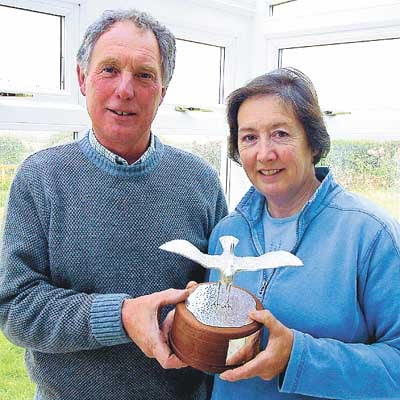
Appreciating what we have around us
Those of us who may lie awake in bed in the morning waiting for the alarm clock to sound cannot fail to be aware of the trilling dawn chorus now well into its third month. Others tell me of the song birds early awakening as they tend to calving cows long before even the first glimmer of dawn arrives. Just why do birds sing? 'Trespassers will be prosecuted' is the message from the singer telling his neighbours to keep out of his patch and any self respecting bird needs to know if his neighbours have made it through the night. Silence may indicate that a neighbour has passed away and a territory is up for grabs! This could present an opportunity to extend one's borders. While the song is a warning to a male rival, to an unattached female it is an invitation -the more elaborate the performance, the more successful a singer is likely to be! Where do they sing loudest and best? Broadleaved woods and hedgerows provide food, shelter and places to build nests. Fresh new leaves in spring are quickly colonised by insects such as greenflies, caterpillars, leaf-hoppers and saw-flies. Blue tits' eggs hatch to coincide with the big flush of caterpillars on oak leaves in early June. Blackbirds poke through the leaf litter on the floor for slugs and earthworms. All-rounders such as goldcrest, wren and robin are spoilt for choice with an abundance of spiders, flies, earwigs, seeds and berries to choose from. Treecreepers with long beaks nosily probe cracks in the bark of tall trees, while flying insects are nabbed by the agile spotted flycatcher.
DAWN CHORUS
Also, the quality of your local dawn chorus may be determined by the habitat available on your farms. Rural dwelling houses can provide suitable habitat in large, wide hedgerows of native species with trees and saplings. Much more appropriate in the countryside than exotic species such as Leylandli or Castlewellan! During a debate in the House of Lords some months ago, it was declared that a countryside without farming is unthinkable; farms need to provide good incomes, which in turn sustain many secondary businesses. Agriculture, it was confirmed, amounts to less than one tenth of the rural economy and an even smaller percentage of rural employment. But its true significance is much greater because farmers are the stewards of four fifths of our landscape. Last week, I met up with someone who lived locally over 25 years ago and is always entranced by the countryside around us - something so many of us take for granted and do not often notice it's true beauty. He drew my attention to the many hedgerows which, he claimed, are flowering now for the first time in many years with spectacular displays of snow-white blackthorn flowers transforming the landscape. He assured me that like the apple, hawthorn and rowan, blackthorn is a member of the rose family. It's white flowers appear early in the year on the bare branches - as long as the plant has not been cut back. They have five petals and have a subtle sweet smell to attract the insects on which they depend for pollination. Not only has the spring landscape become even more beautiful, but the birds can look forward to bountiful berry crops later in the year.


BLOSSOM, IN ABUNDANCE
The return of the blackthorn flowers is, I'm told, due to many farmers opting into schemes such as Environmental Stewardship and managing their hedgerows with the environment in mind - this means not cutting them every year, as mostly uncut hedges bloom. I well remember a talk given by an expert in this field, Jack Donovan, who passionately reminded us that nature constantly works to conserve and enhance biodiversity, landscapes and wildlife in rural, urban, coastal and marine areas. He spoke of its intrinsic value, the wellbeing and enjoyment of people, and the economic prosperity it brings. I was recently taken around the family-run, 265- acre Knapps farm of Terry and Mary Clarke who run the high yielding Knapman herd of 70 Holstein milkers and followers and have 30 acres of well- managed arable, with a low chemical regime and retention of stubble for wildlife benefit over winter. Over recent years the farm has retained and expanded valuable wetland areas, which support a large population of the rare marsh Fritillary butterfly. Other areas of wildlife interest include gorse, willow scrub, wet heathland, stream-side woodland and hedgerows and nine ponds have been created on recently purchased land, which further diversifies wildlife interest. A valuable network of habitats across the farm links with an adjoining neighbours' land. This rich mosaic supports a great diversity of wet grassland plants, insects and birds, including rarities. The skilled retention, management and development of these features within the farming regime is impressive and the couple's efforts were duly recognised when they recently received the silver lapwing award.
ENVIRONMENTAL FORUM
Delegates from across the EU who attended a forum on conservation at Nantyffin, Llandissilio, earlier this month were also duly impressed when they saw at first hand what the Clarke's have already achieved. Alongside the fritillary are a host of uncommon plants such as wharled caraway, royal fern and petty whin and moth trapping have revealed scarcities like the poplar hawk moth. The wet ground is also said to be full of snipe in winter and the scrub holds breeding birds like the grasshopper warbler. Keeping hold of this wildlife richness has involved a close partnership between the Clarke's, the Countryside Council for Wales, and other experts monitoring this site of strategic scientific importance (SSSI). Terry told me that the SSSI management agreement was set up six years ago to focus on establishing a suitable grazing regime. Fencing was renewed, nearly a mile of hedges planted with hazel, blackthorn and beech and a heavy duty flail mower was used to cut stock access paths through some of the tall tussocky areas. Welsh Mountain ponies and Hereford cattle have since been keeping the growth in check and the site is now used as a prime example for restoration management and moor-grass pastures.
STARTING FROM SCRATCH
Creating a wetland out of a low-lying field doesn't sound difficult? Could it be just a matter of blocking the outfalls of the drainage pipes and letting rainfall do the rest. For Terry it was, but that wasn't an approach that appealed to Hugh Griffiths near Lampeter. Some 60 acres of his 750 acres was permanent grassland next to a large area which drains masses of moss and a peat bog. Drawing up a rural stewardship scheme in 2003, he felt this area could be made a much better habitat for wading birds and still provide useful grazing for his cattle. Hugh manages most of his farm on an organic system and produces beef cattle, sheep, poultry and limited arable crops. According to the Farm and Wildlife Advisory Group (FWAG), there were waders on the site, including lapwing, curlew and redshank, but not in large numbers and there was a lot of scope to make it better. FWAG said: "Hugh didn't want to block the drains as it would have been difficult to reverse the procedure as they would soon become useless. Also he wanted to be able to control the water table quite precisely. A good wetland should be squelchy underfoot with some areas under water but only with around six inches to a foot of cover and higher areas should be dry for nesting sites." Some hoof prints are no bad thing, allowing insect life to thrive in them and there is now more botanical diversity than before on the site. Although very demanding and time consuming Hugh philosophically says: "It would be a terrible waste of time and effort to see areas such as this go back to conventional grassland when we are beginning to see such good progress in restoring a true, natural wildlife habitat."