

Nothing stays the same
This coming week, we in picturesque West Wales will again welcome relatives, friends and holidaymakers who regularly come at Easter, or other times of the year, to enjoy a breath of clean, fresh air and get away from the rush and bustle of city life.
Living permanently in the countryside, we long-term residents are the envy of many who sincerely believe that they might sacrifice just about anything to change places with us and be able to appreciate this tranquil lifestyle 24/7.
There are, of course, those who do just that settling in well and making a truly valued contribution to the life of the community but, there are also those pushy so and so’s who want to take over: get elected to the community council, run the cricket club or oust all the locals from the committee of the WI.



The countryside, and farming in particular, is not what it used to be. Most of the accepted facilities in the villages no longer exist. The school - the hub - has probably closed and the shop, post office and bus service are but distant memories as the supermarkets in the urban areas have priced them out if business.
LESS TIME TO SPARE
More than a few people who have sought out a place in the country have discovered the disadvantages of living amongst a busy, hard working group of folk who no longer have time on their hands to chat at the village pump or within sound of the anvil being struck at the local smithy.
I’ve often been told that village life as such no longer exists: people leave for work early - possibly having to drive 20 mile or more - and when they return home all their thoughts turn to putting their feet up and watching the tele for the rest of the evening.
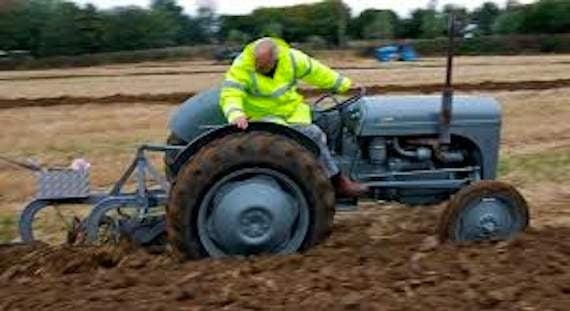
It cannot be denied that over the past seventy years there have been major changes in farming: changes in animal husbandry, in farming practices, in the size of farm machinery and in the increased essential use of chemicals producing a revolution in the way the countryside exists.
FAMILY CAPITAL
Those not directly involved in the farming industry find it hard to accept that these changes are the results of a revolution in a variety of ways: whilst the amount of money received by the farmer for his products barely keep pace with inflation, wages have increased twenty times, a tractor that once cost £600 now costs nearly £60,000 but the return on capital - family capital not company investment - makes one wonder why they ever bother to carry on.
Most of these modern tractors have an expensive built in satellite navigation system which means they can perform seeding or spraying tasks faultlessly even during the hours of darkness!
Miles of specially layed hard core or concrete cow tracks have also had to be installed so that the animals no longer have to be herded along public roads.
Outsiders deprecate the relocation of animals from field to barn so that more and more of our fields are empty of animals; the ever larger agricultural machinery now encountered on the roads; the way fields are cultivated or filled up of polythene tunnels or solar panels; fields used as ‘spreading fields’ on which waste from intensive farms is heavily spread several times a year; the removal of hedgerow and spinney and the blanket use (they say) of antibiotics to keep intensively farmed animals ‘healthy’ in extraordinarily crowded conditions.
HI-TECH FARMING
They also denounce intensive hi-tech dairy farming with automatic manure removal systems which require slurry lagoons with the capacity to store and then release for spreading some 20 millions gallons of slurry each year.
Incomers living close by claim this to be destroying their quality of life. I suppose it is a fact of life that these residents repeatedly suffer the stench from the slurry - which is inherently different to the historic smell of cow dung.
They also claim that they have to indulge the noise of large tractors pulling 4,000 gallon slurry tankers as they roar past their homes - three or four slurry tankers in convoy (they say) spreading at least 12,000 gallons of slurry an hour for twelve hours a day over four day periods have been recorded - in excess of half-a-million gallons of slurry spread within a few days on a few fields, one person claims.
Just as we would if we went to some cities or industrialised towns, the also moan about suffering headaches and coughs from the air pollution that is generated around their homes, their eyes sting and, they say, they have good reasons to fear the long term consequences for their health.
QUALITY OF LIFE
In addition to the farming and animal smells, the impact is significant upon many residents in the area and not just upon those in the immediate proximity - the increased volume of large vehicle traffic and damage to roads and verges that result in change to the ambiance of an area.
The protestors accept that many of those living in the area of a large dairy herd may not be affected by these developments at the moment: they see it as only a matter of time until it adversely affects the quality of life of all those in their rural community.
These same people insist that they want to make it clear that they are not ‘anti-farming.’ They say: “We are against practices that have developed recently without regard to the well-being of the communities in which farms are located.
“We know from conversations with many of our neighbouring farmers that they too share our apprehension about the move to intensive farming - they tell us that the problem is money and cash flow.
“Many of our neighbouring farmers also share our view that the planning rules and processes governing development in the countryside have not kept up with the consequences of this move to larger and larger herds.
‘FACTORY’ FARMING
“We consider that the highways’ authorities, planning departments and environmental agencies have all turned a blind eye to the problems associated with these larger herds and factory farming techniques and they know that this is encouraging the development of other intensive farms.”
What is obviously not fully appreciated by the public at large is the already time consuming and burdensome amount of bureaucracy that farmers have to endure from Wales, Westminster and EU governments.
Constant checks are being made on they way in which farmers farm, the amount of chemicals stored, the health and well being of their cattle with each one having to have it’s birth certificate (recorded via broadband technology) and it’s own lifetime ‘passport.’
Farmers may only apply farmyard manure when permitted to do so, hedges may only be cut back within certain time limits and cross compliance regulations are yet another minefield: standards concerning the environment, food safety, animal and plant health and animal welfare, as well as the requirement of maintaining land in good agricultural and environmental condition.
MOSAIC OF FARMLAND
Ploughed areas must be reconverted to permanent grassland when the Welsh Government requests and, although officials can take months to reply to correspondence, if a farmer fails to do so within nine days he, or she, is subject to a huge financial penalty.
Farmers are also required to be sympathetic towards existing field boundary structures, including hedges, walls, grass banks and ditches which comprise a major part of the semi-natural habitat mosaic of farmland. Due to rapidly increasing labour costs over several decades many of these have been degraded or lost.
A variety of methods of extending and recreating margin habitats are available, many of which buffer adjacent habitat from disturbance from farming operations. Grass margins and beetle banks provide nesting areas for grey partridge in tussocky grass and for skylark in shorter grass.
They also provide habitat for insects and small mammals, feeding areas for owls and other birds of prey and over-wintering habitat for many invertebrates. Common flowers can be important sources of pollen and nectar for bees and other insects.
Operators must also be legally mindful of uncropped wildlife strips at arable field edges which provide conditions for rare arable weeds to germinate and set seed. The seeds produced will in turn provide forage for a range of bird species.
Fields that been under intensive arable cultivation for many years are likely to have impoverished seed banks. However, the seed banks are larger and more diverse at the field edge, thus wildlife strips at the field edge are more likely to promote rare annuals than in the field centre.
Nevertheless, targeting fields known to support rare annual flowers must be protected. Farmers also full recognise that fields that have not been in arable production for long are unlikely to support a seedbank of rare annual plants. Farming topics such as this are widely read and it is often necessary to explain some matters more fully for the benefit of the general public.
Comments
This article has no comments yet. Be the first to leave a comment.