
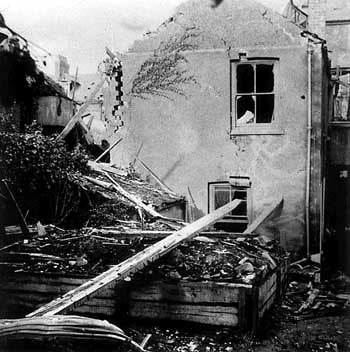
After the long years of fighting, May 8, 1945, and the end of the war in Europe was a cause for overwhelming jubilation, rejoicing and heartfelt relief throughout the British nation. The announcement was the signal for a lightning transformation. Flags and banners, bunting and pennants appeared on every house and shop as everywhere people got ready to welcome home the country's heroic freedom fighters in a joyous celebration in the streets and dance halls. So what was there to sing about in Tenby in May and August 1945? First, perhaps 'We'll Meet Again', as the families of all those men and women who were scattered throughout the war zones could put aside their daily fear and look forward to their return. That was a sudden and welcome relief, but the approaching end of hostilities in Europe was not a surprise and preparations for the party had been mounting for some time. Tenby's war had been eventful rather than dramatic. From being a quiet resort it became the temporary home for troops in training, British, Belgian and American, and for evacuees from bombed cities. Most of the hotels and boarding houses were requisitioned as barracks and temporary housing and most public buildings were put to war use. Adults were conscripted into the Home Guard, Civil Defence and Welfare Services; boys and girls from 16 into the Cadet Corps, WVS and Red Cross. No one was unaffected, if only because of universal rationing and the problems of getting by on food and clothing coupons. People had groped around blacked out streets, cars stood on blocks in their garages and those with any spare rooms had compulsory lodgers. From their work they went on to duty watches. The air raid sirens had sounded through 190 red alerts, even though only four bombs had actually landed in the town and one person killed. As early as June 1944, Tenby set up its Welcome Home Committee to raise funds to celebrate the return of its men and women from the war. In October the Invasion Committee thought it safe to stand down and in November a County Post War Reconstruction and Development Committee began planning for the return of tourism and for new industry. Fifty temporary houses, the to-be-famous 'Pre fabs', were to be erected on the lawn tennis ground in Heywood Lane; it had been put to war service as allotments, 'digging for victory' and Tenby Tennis Week was never to return. In December, the Home Guard went into reserve. By this time it was no comic Dad's Army, but a trained and well equipped force with half-a-million men in Western Command alone. Through the war years they had relieved the army from home defence to train for the offensive. Any attempted invasion to head off the second front would have met formidable resistance. Twelve-hundred men of the 1st Pembrokeshire (Pembrokeshire Yeomanry) Battalion marched behind its own band to St. Mary's Church. Taking the salute was the Mayor, Clr. P. R. Howells, wearing his robes over his uniform as their Commanding Officer - truly symbolic of the 'people's war'. To carry their spirit on they immediately formed an Old Comrades Association. At the beginning of 1945, a start was made on removing defences, pill boxes and wire. At low tide old metal rails, set in the sand to deter aircraft from landing, may still be seen on the South Beach. Requisitioned buildings began to be released back into civilian use, but the Civil Defence and the Air Raid Warning System were kept until only a week or so before VE Day. A very brave new world was over the horizon and in February 1945 Group Captain Ira (Taffy) Jones, an air ace of the Great War, proposed that Tenby should develop an airfield on the marshes or be presented with either RAF Carew or Templeton to receive the influx of new age tourists. Among the more cautious voices, Arthur Leach, Curator of Tenby Museum, warned that the incoming planes might be taking the locals as far as Ilfracombe to do their shopping, to the detriment of the traders in the town. The black-out became a dim out, but hopes for full street and shop lighting were dampened by the shortage of fuel to provide the power. In seeking signs of the end of privation, few thought of the price to be paid for the war and that the end of rationing would not be VE Day, but a whole 10 years on. In April, the council was discussing the celebrations, but no great expense was to be incurred. There was to be a Thanksgiving Service in Tudor Square, still obstructed by an Air Raid Shelter (if wet, in the Parish Church). The children would have teas in their respective schools and the pubs would be allowed an hour extension, until 11 o'clock, although the ministers of the churches hoped that 'it would be possible to celebrate victory in a proper and dignified manner without going to such excess'. When VE Day was at last announced for May 8, the flags were already out in the streets. The Thanksgiving Services were held and the children and mothers paraded through the town behind the Tenby Cadet Band. Crowds gathered at the top of the South Parade to listen together to Mr. Churchill's broadcast at three o'clock and again in the evening to hear the King. The boys built a bonfire on the harbour sands and the children danced round it until it burned out. There was dancing in the streets too, but the clerics need not have worried about excess; the weak war-time beer was all gone by nine o'clock. It was not just a one day wonder, especially for the children. The next few months saw street parties throughout the town, starting with Newell Hill, where there was tea for 100 children and all-comers, sports, a bonfire and jollification into the small hours. It set the pattern and they went on into September. The Mayor and Mayoress not only attended these, but themselves gave a party for 1,300 children at the De Valence. They must have lived on buns that summer. Peace had arrived, but after the celebrations - the hangover. Although liberated prisoners of war came straight home, the bulk of those in the forces returned gradually over the next year, shortages and rationing remained and housing was short. It was an austere world and a slow recovery.