

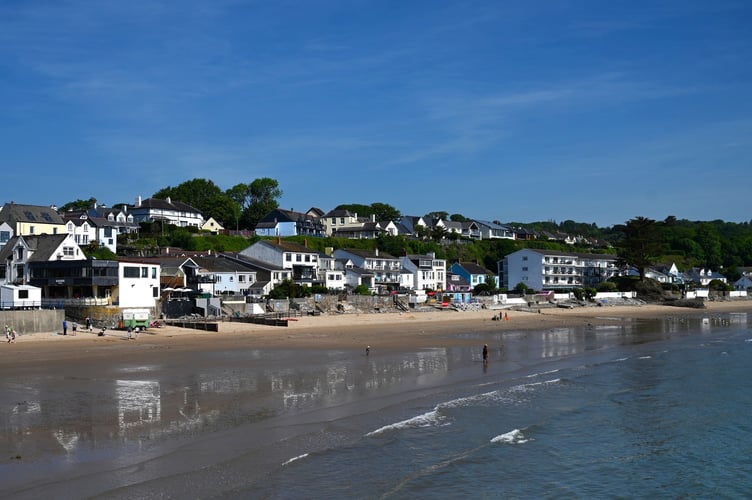
Concerns have been raised about Saundersfoot's housing policy effectiveness in benefiting local residents, with questions being asked as to whether it meets community expectations.
County councillor for Saundersfoot’s south ward, Cllr Chris Williams said that over recent weeks, a number of concerns have been raised with him regarding the current local lettings policy and how it is being applied in the seaside village.
Amendments to the third phase of a previously granted Saundersfoot housing scheme at Whitlow, which will see the overall numbers reduced but the proportion of affordable houses increase, were recently recommended for approval at the March meeting of the Pembrokeshire Coast National Park Authority’s development management committee and given the go ahead.
Morgan Construction (Wales) Limited, through agent Evans Banks Planning Limited sought permission for the reconfiguration of the third phase of the residential development which is located near Saundersfoot School.




The original granted 2023 scheme, already part-built, was for 54 homes, but the proposals would see that reduced to 47.
An officer report for PCNPA members said: “The overall site is partially completed with Phase 1 of the development comprising the 16 market dwellings and Phase 2, 19 affordable dwellings and Phase 3 for a further 19 market dwellings.
“The applicants have submitted evidence to demonstrate that there has been very limited demand for the consented 19 apartments, due in part to the considerable supply of such properties already available in the lower area, and the demand for homes suitable for young families or for the older population to downsize into smaller, low-maintenance bungalows - which may result in Phase 3 being held in abeyance, leaving future residents inhabiting a partially completed site.”
Addressing the concerns, Cllr Williams said that he wanted to be clear, in that he does not believe housing association Ateb have deviated from their stated policy.
“However, I do question whether the policy, both in its design and application, reflects what residents of Saundersfoot, and indeed the Community Council, would reasonably have expected from a development within the village,” he stated.
“The recent social housing development was widely supported on the understanding that it would directly benefit the local community. Developments of this nature, particularly on greenfield sites, are generally supported where there is a clear and meaningful benefit to local people.
“In Saundersfoot, the expectation was that these homes would support local residents, especially those priced out of the area, those living with extended families in the village, as well as those wishing to return. I do not believe this expectation has been fully met.”
Cllr Williams said that Saundersfoot faces ongoing challenges, including a significant decline in school numbers over the past 12 years, placing pressure on the long-term sustainability of the local school.
He believed that such new housing developments were seen as an opportunity to support young families and strengthen the community.

“My support for such developments, alongside others considered at PCNPA, was based on a clear understanding that there would be a strong emphasis on prioritising individuals and families with genuine and well-established local connections,” continued Cllr Williams,
“My concern is not with the principle of the policy, but with whether it is delivering its intended outcomes in practice.
“From what I have observed, the outcomes in Saundersfoot do not reflect the more targeted approaches seen in other parts of the county.
“In those areas, housing associations and the local authority have worked closely with their communities to implement more robust, locally focused lettings policies.
“For example, developments delivered by West Wales Housing Association in Dinas and Eglwyswrw demonstrate what can be achieved through strong engagement and clearly defined criteria.
“These have prioritised applicants with strong local ties, supported by factors such as long-term residency, electoral registration, permanent local employment, children attending local schools, and close family connections. The results are clear, with strengthened communities and increased pupil numbers in local schools.”
By contrast, Cllr Williams states that the Ateb policy applied in Saundersfoot allows for a broader interpretation of “local connection” - criteria relating to residency, employment, and schooling cover a wider geographic area, which in practice widens eligibility.
He explained, for example, employment of just 16 hours per week for 12 months, or two years’ residency within a wider area, may qualify; which taken together, risks diluting the focus on Saundersfoot itself and helps explain why many residents feel the policy is not working in their favour.
“This is not about questioning the needs of those allocated homes, but about whether the policy is achieving its intended purpose. At present, it is difficult to conclude that it is operating as an effective local lettings policy for Saundersfoot,” he stated.
“These developments were supported to help sustain the village, support younger generations, and protect key services such as the local school.
“However, Saundersfoot continues to face pressures around housing affordability, second homes, and limited availability for local people. Without targeted intervention, there is a risk to the long-term sustainability and identity of the community.
“I must be candid in saying that my understanding of how the Ateb policy would operate locally has not been reflected in practice.
“With 19 social housing properties delivered, the first development of this scale in many decades, it is disappointing that this opportunity does not appear to have been maximised for local residents.
“It is concerning that, with 11 of the new properties now occupied and the remaining 8 units designated as one-bedroom accommodation, there has been no corresponding increase in pupil numbers at Saundersfoot School.
“Following discussions with the Chair of Governors regarding recent admissions, it appears unlikely that this development will contribute to future school growth under the current allocation approach. This is extremely disappointing, particularly given the importance of sustaining and strengthening our local school and wider community.”

Looking ahead, Cllr Williams said there is an opportunity to strengthen future approaches. He recently attended a meeting organised by Saundersfoot Community Council and Pembrokeshire County Council’s housing team, where local residents were able to contribute to shaping future policy, particularly in relation to the new Sandyhill Road housing scheme.
He has since organised a meeting with Pembrokeshire Council’s Head of Housing, and the Cabinet Member for Housing to raise these concerns, calling for ‘clearer and more robust’ criteria, including stronger weighting for local school attendance at Saundersfoot; longer residency requirements of up to 7 years; clearer expectations around permanent local employment; and greater emphasis on close family connections.
Following these discussions, the housing team has engaged with housing partners across the county, who have expressed support for a more consistent and collaborative approach. There is also ongoing discussion around the role of planning authorities in setting local lettings criteria as part of planning conditions, as has been done successfully in other areas.
Cllr Williams added: “With further developments planned, including 21 additional properties in Saundersfoot, it is essential that we take this opportunity to ensure a more robust and effective approach.
“If strong local connections are not meaningfully prioritised, the purpose of a “local lettings policy” risks being undermined. It is vital that future developments genuinely support village life and provide fair opportunities for local people.
“At present, I do not believe this has been fully achieved, and it is important that this is addressed.”
Comments
We've recently changed our login process. If you have an account for commenting, you will need to re-register on the login window.
This article has no comments yet. Be the first to leave a comment.