

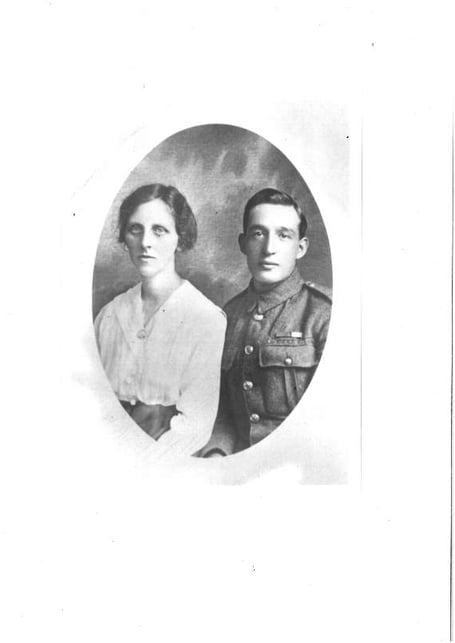
Grace excelled at Greenhill School and on the strength of her Central Welsh Board examination results was chosen to become a teacher at the Parochial Church School in Upper Park Road later moving to New Hedges School.
Alfred was also born in 1894 his father Edward being the Property Master – responsible for the construction of stage sets – at the Prince of Wales Theatre in Cardiff. The family later moved to Portsmouth when Edward was employed at the Theatre Royal there.
On leaving school, and finding permanent employment difficult to obtain, Alfred decided to join the Army and, putting his age on in order to qualify, was recruited as a Private into 1st Battalion, The South Wales Borderers (SWB) at Brecon in July 1912 for a period of seven years with the colours and five on the reserve.




At the outbreak of WW1 on 4 August 1914 the 1st SWB became part of The British Expeditionary Force – known later as the Old Contemptibles – landing in France on 12 August 1914. After being driven back from Mons by the overwhelming might of the German Army the SWBs strength was greatly depleted through casualties and the few survivors, including Alfred, were withdrawn from the frontline and sent to Penally Camp to rebuild their numbers with new recruits.
So it was that Alfred, off duty one evening, was wandering around Tenby when he saw a sign outside the Church House in Upper Frog Street inviting servicemen in uniform to come in for refreshments. He was welcomed by Grace, a volunteer helper there, and so began a relationship through courtship, - or walking out as it was then called – an engagement and marriage that was to last almost seventy years.
The time came for the SWB, and Alfred, to return to the Western Front but the blossoming romance continued by correspondence, Grace with letters but Alfred, back in the trenches, usually by Field Postcard. These cards had a number of pre-printed lines on them such as ‘I am well’, ‘I have received your parcel’ and so on which the sender crossed out if they were not appropriate. A short personal message and a signature then sufficed to complete this quick form of communication which were then passed from hand to hand down the trench and placed in the mail pouch – albeit usually somewhat muddy!
At home Grace knitted gloves, mittens, socks, scarves and balaclavas which she sent via the efficient Forces Postal Service to the soldiers in the trenches. When she could obtain them Grace would hard boil eggs and cushion them in the toes of rolled up socks along with a ‘good luck’ message and her name and address. She often received notes of thanks from the recipients who were glad of a small variation in the monotony of their trench diet.
Grace and Alfred’s courtship continued and became an engagement on one of Alfred’s infrequent leaves. Grace’s engagement gift to her fiancé was a gold medallion on a chain inscribed with the words ‘God keep you safe’ which Alfred wore around his neck along with his identity disc until the end of his Army service.
A later unexpected weeks leave allowed them to quickly arrange a low key Wedding at St Mary’s Parish Church, Tenby on 12 July 1918, the Rector, Bickerton Cross Edwards officiating. There was no formal reception afterwards and because of wartime food restrictions no cake! (This was rectified sixty years later when at their Diamond Wedding Anniversary in a celebratory gathering of their five children Denis, Donald, Esmé, June and David, sons/daughters-in-law, eleven grandchildren and many Tenby friends they were able to stand together and at last cut their ‘wedding cake’. A congratulatory telegram from the Queen was an added delight.)
A three day honeymoon and it was back to the front line for Alfred and a return to the classroom at New Hedges School for Grace but for a short time only as because of employment rules at the time women teachers on marriage had to give up their posts. Grace loved teaching and was sad to have to leave New Hedges and her pupils but not the daily walk to and fro via the Slippery Back Lane in all weathers!
The war ground on, casualty lists were still long and for Grace waiting at home it was an anxious time dreading the knock on the door and a telegram stating “The War Office regrets to inform you ----------”. Thankfully Alfred survived, the medallion had done its job, and on 11 November 1918 suddenly it was all over. With his seven year service period still in being Alfred had to wait until July 1919 before demobilisation, and a return to civilian life, and being reunited with Grace in Tenby which was now his home.
Footnote:
Alfred had been awarded the Distinguished Conduct Medal for gallantry at Langemarck, Belgium on 21 October 1914 but was never one to speak about his wartime experiences. As his service record, along with many other WW1 service records, were lost when the building they were stored in was destroyed in the WW2 blitz, then his family have had to rely for information from brief details of the Langemarck action given in The History of The South Wales Borderers – The Great War 1914-1918 together with a contemporary newspaper cutting that has survived all these years but is now barely legible.
It reads:
A Portsmouth Hero.
Among the Portsmouth heroes, whose services had been recognised by the award of the Distinguished Conduct Medal, is Private Alfred Hullah, of the South Wales Borderers. He is the son of Mr Hullah, property master at the Theatre Royal and has lived in Portsmouth for some fourteen or fifteen years. He enlisted in the Borderers in July 1912. The circumstances under which Private Hullah distinguished himself were such as to involve a considerable personal danger. A detachment of his regiment that was holding an advanced position, 250 yards from the trenches, became enfiladed by the fire of German machine guns, and there was heavy loss in the British ranks in killed and wounded. Volunteers were called for to get back and ask for reinforcements. Private Hullah at once offered to do so. Taking his loaded rifle, he crawled with it on his stomach for about 700 yards across an open space that was covered by the enemy’s machine gun and rifle fire. Fortunately he reached the reserves, and the necessary assistance was despatched. Private Hullah has been twice wounded during the present war.
Alfred was also twice Mentioned in Dispatches but again because of his destroyed Service Record his family have no details as to what they were awarded for.
David Hullah
Comments
This article has no comments yet. Be the first to leave a comment.