

— By Albie Smosarski —
Let me take this opportunity of wishing all readers a Happy New Year, yes, Blwyddyn Newydd Dda!
Over the festive period we have been experiencing the tail-end of various storms but this is nothing new as we shall see from a report in the Tenby Observer Weekly List of Visitors and Directory, December 9, 1886.
GREAT GALE




Rescue by the Tenby Life-boat
DESTRUCTION OF PROPERTY IN TENBY
On Wednesday morning a gale of great fury from the west-south-west commenced to blow at Tenby, accompanied at times with heavy hail and rain squalls, during which the force of the wind reached nearly a hurricane. All along the Pembrokeshire coast its effects have been felt, both on sea and land. In Tenby it was especially destructive to property, and nearly every house in the town exposed to the full blast of the storm, suffered more or less damage.
A circumstance, which nearly proved fatal, occurred early in the morning. About 8.30 a boat containing three lads - William Kingdom, Charles and William Lilycrop - put off from the Pier to draw herring nets in the roadstead. The storm so increased in violence after they left the Pier that they were unable to return, but succeeded in getting on board the ketch Honor, from which they were taken by a shore boat later on in the day, previous to the crew of that vessel being rescued by the life-boat. The boat and herring nets were lost; they were the property of Mrs. Lilycrop and will be a great loss to her.
At low water there was a terrific sea in the Bay which increased as the tide began to flow. Two vessels, a ketch and a schooner, were anchored in the roadstead, and for their safety some uneasiness was expressed by the coastguard and boatmen, as one of them especially was making bad weather. About 2.30 the master of the ketch hoisted a signal, and three shore boats put off from the harbour. The master declined their services, and afterwards hoisted his flag for the life-boat. The Captain, William Way lost no time in getting the crew together. There was a very heavy sea on the beach, but after some delay the boat was got afloat and proceeded to the distressed ship. the Bay at this time was a mass of foam and broken water, but the boat behaved well and reached the vessel in safety. The crew, consisting of two men and a boy, were transferred to the life-boat and taken on shore. She proved to be the Honor of Cardiff, bound from Newport to St. David’s with coals. The names of the rescued men are— Elias Evans, master; Evan Jones, mate; Thomas Evans, boy.
About four o’clock a schooner anchored in Caldy Roadstead parted her anchors, and was driven before the gale across the Bay in the direction of Carmarthen Bay. What became of her is not known, but it is expected she went on shore, and if so probably all hands are lost. She is believed to be the Henrietta, an Irish vessel.
About 9.30 pm the schooner anchored in Tenby Roadstead parted her anchors and went off in the direction of Pendine Point. The life-boat crew were on duty on the Castle Hill in case their assistance was required, but the master of the vessel made no sign. She was called the Rover of Wexford, laden with coals from Saundersfoot. At daylight this morning a vessel was observed on the beach near Pendine, but whether it is the Rover or Henrietta is unknown. It has been ascertained that the crew are safe.
During the afternoon the chimney stack of No. 3 Esplanade fell with a terrific crash through the roof of No. 2, breaking through two ceilings and causing other damage. The house was being prepared for occupation by Mr. Pemfrey. No. 4, the residence of Mrs. Lawten Jenkins, suffered from a similar mishap, the stack of the adjoining house having fallen and demolished a great portion of the roof. No. 3 Marine Terrace, the residence of Mrs. Shears, is partly roofless from a like cause.
Tudor Square chimney pots and tiles were flying about in all directions, and many narrow escapes are reported. Several panes of glass in Brecknock House, the residence of Mrs. Thomas, were broken from slates being hurled against them, and the roof of the Post Office has suffered severe damage. The coastguard house on the Castle Hill came in for a full share of the storm. The stack went through the roof and into one of the living rooms, a window was blown out, and Chief-Boat-man Merchant himself had a narrow escape. Standing near the gun in front of the watch-house with his glass watching the vessels in the roadstead, a falling tile struck him a severe blow on the head, luckily not with the edge.
The roof of a cottage at the top of Lower Frog Street is nearly all off, and higher up the Corporation stores, the dairy of the Cobourg Hotel, and several other houses show unmistakable signs of the severity of the gale. The roof of the nave of St. Mary’s Church has also suffered damage, as well as that of one of the side chapels.
Victoria Street and Culver Park also felt the full force of the gale. The roof of No. 2 Somerset is very much damaged and the windows blown in. The Rectory has also received some damage. The glass houses in the garden of Mr. W. Williams in South Parade, and at Rosemount, are broken, and a good deal of property injured. The trees in and about the South Parade suffered severely. A fine elm in the South Parade was uprooted, and fell against the town wall demolishing the telegraph wires; another near it was only saved by a large branch being broken off. Near the Gas Works the Surveyor secured one of the elms to prevent it falling on one of the cottages; and near the Railway Viaduct on the Green another was roped back to prevent it falling across the road.
The launching of the life-boat and the grand sight presented by the sea in the Bay, brought hundreds of persons to the Castle Hill during the afternoon, and those who had the hardihood to brave the perils of the streets were rewarded for their trouble by one of the grandest sights witnessed for many years. The sea at times made a clear breach over St. Catherine’s Rock, the foam being carried high into the air with the force of the wind. The sea rolled in with great violence on the shore, and in the distance Giltar Point and the rocks in Small Sound were at times quite lost to view. There were several vessels in Caldy Roadstead, and owing to the quarter from which the wind blew, experienced great difficulty in riding out the storm. This morning it was ascertained that three vessels in the roadstead yesterday afternoon had disappeared.
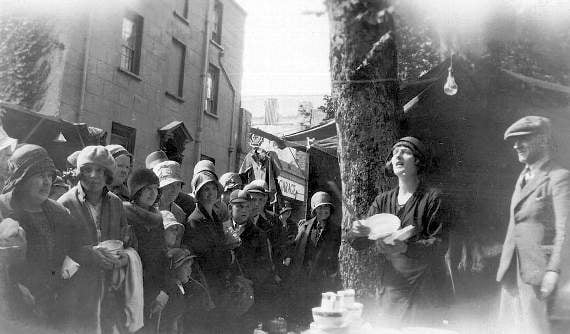
Phew, time for something calmer! The snapshots take us back to the 1920s. Enjoy 2017 and please get in touch if you have anything interesting to share. It is always appreciated.
Comments
This article has no comments yet. Be the first to leave a comment.