

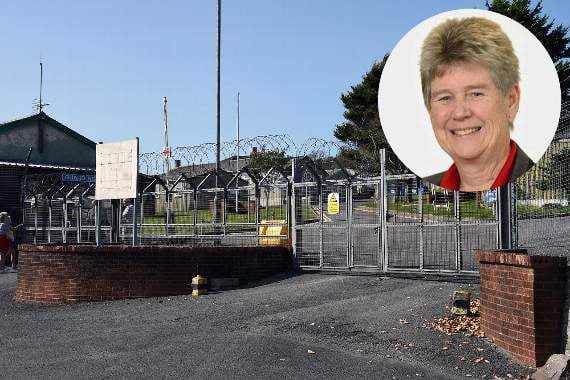
Welsh Government Deputy Minister and Chief Whip Jane Hutt, has reaffirmed once again that the asylum seeker accommodation centre in Penally is ‘unsafe’ and must close ‘urgently’.
Despite rumours circulating in the community that the camp at Penally would close later this month, the Home Office when contacted have denied this, with a spokesperson stating: “Penally will not be closing on February 12”.
The Home Office stated last month that they intend to move all of the asylum seekers at Penally Camp into “suitable dispersed accommodation as soon as reasonably practical” - with suggestions that some ‘vulnerable’ males from the camp had already been moved into other accommodation following action from solicitors.
As of January 21, 118 men were still being housed at the camp, but when asked this week to clarify how many service users still remain at the facility, a Home Office spokesperson responded on Thursday (February 4): “We do not provide a running commentary on the number of residents on site.”




Back in November, the Senedd debated and agreed a motion that the Home Office’s decision to accommodate asylum seekers at the Penally army camp should be reconsidered because it is an unsuitable place without access to appropriate support networks.
Jane Hutt wrote to the Minister for Immigration Compliance and the Courts, Chris Philp MP, on November 25 to alert him to the debate and repeat the Welsh Government’s call for the UK Government to close the Penally camp and move asylum seekers to alternative accommodation which can properly cater for their needs, respect their dignity, and help them to progress their asylum applications.
“I had the opportunity to discuss this matter with the UK Government Minister on December 1 but he did not accept my view that the use of the camp for this purpose is inhumane,” said the Deputy Minister in a statement this week.
“Nevertheless, I continue to raise significant concerns about the safety and appropriateness of the camp as asylum accommodation. We have seen footage, photographs and safety reports from within the camp which support our concerns. We believe the Penally site has inherent risks due to the operational model being implemented.”
Jane Hutt said that she welcomed the camp inspection by the Independent Chief Inspector of Borders and Immigration (ICIBI), after the First Minister wrote to the ICIBI on January 19 to call for an ‘urgent inspection’.
“I am pleased to say that the inspection has now started,” she continued.
“We warmly welcome the decision to undertake this inspection to provide much-needed confidence in the standards in place in the camp.
“The priority is clearly to ensure those in the camp and the surrounding community are kept safe, treated with dignity and community cohesion can be repaired following this disruptive decision.
“The decision to use the Penally camp has undermined our ability to implement an effective migrant integration policy, as set out in our Nation of Sanctuary plan.
“Responsibility for the asylum system is reserved to the UK Government but the Welsh Government is responsible for integration, community cohesion, local government and the health system – all areas which have been impacted negatively by the Penally site implementation.
“We need a full exploration of how the asylum system should operate in a devolved context and, for that reason, Welsh Ministers intend to act as an Interested Party in any Judicial Review cases which arise from occupants of the Penally camp.”
The Home Office is utilising emergency planning powers to operate the Penally camp as asylum accommodation until March 20, 2021, and beyond this point, local planning consent will need to be granted to enable continued authorised use of the site.
“We are continuing to urge the Home Office to provide a plan for how those accommodated in the camp will be moved to alternative accommodation if planning consent is not granted,” said the Deputy Minister.
“Although the provision of asylum accommodation is the responsibility of the UK Government we are working closely with Welsh local authorities to widen the asylum dispersal system to new areas. Conversations with local government will continue throughout February in the hope that new opportunities for asylum dispersal can be found.
“Successfully enrolling additional local authorities in the asylum system will take time. Decisions like the use of Penally as asylum accommodation will only make local authorities more reluctant to participate in the asylum system.
“We will need the Home Office to be far more flexible in their approach to ensure local authority concerns around safeguarding, data sharing, partnership working and funding can be adequately addressed.
“Nevertheless, we are committed to providing support to this endeavour. We recognise that 10,000 asylum seekers in temporary accommodation is not sustainable and urgently needs to be addressed by the UK and we want to play our part in addressing this.
“However, we do not accept that Penally is a necessary provision until additional dispersal accommodation is identified – it is unsafe and must close urgently,” she added.
The inspection into the the use of hotels and barracks as contingency asylum accommodation will remain open until February 19, and anyone with relevant knowledge or experience can submit their evidence to: [email protected]
Comments
This article has no comments yet. Be the first to leave a comment.