
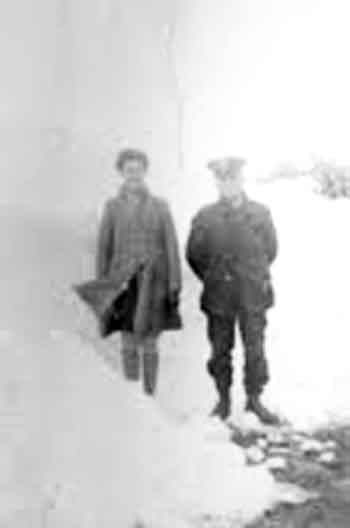
'The weather in Pembrokeshire has been the severest for many years...'
...This was the headline found newspaper clipping from this week in 1945. The article goes on to describe how heavy snow had caused a 'dislocation of traffic,' with 'bus services suspended for hours' Sound familiar? Yet similar reports of the 'intensely cold' winters throughout the 1930s and '40s can be found in Miss May George's scrapbooks at Narberth Museum.
As we bemoan school closures, a disruption of services and transport delays, the wartime generation simply 'kept calm and carried on.'
In an era when shortages left 'no slates in the county' to mend storm-damaged homes, the county sessions house was 'like an iceberg' and Pembrokeshire was 'indisposed by influenza and severe colds', there is a real sense of a community drawing together and 'making do'.


The humour and fortitude of our ancestors sings from between Miss George's pages, where no battle (or meteorological challenge) is too great.
In 1941, when the river Taf froze 'for the first time since 1917,' children went skating and 'chains were fixed to the wheels of cars and lorries.'
In February 1945, Mrs. D. James of Jesse Road, Narberth, proved beyond doubt that 'the show must go on' when she walked over four miles in snow to attend rehearsals for Cinderella at Palace Theatre, Haverfordwest.
A non-essential journey we might argue today, but faced with war, austerity and bitterly cold winters, mere survival gave way to living and making the best of every situation.
In 1940, rationing meant that a 'Haverfordwest butcher had to procure a saw to deal with the joints...so severe was the frost' yet somehow, a grim situation is salvaged by humour and the Pembrokeshire love of a good yarn.
With this in mind, the following reports appeared in local newspapers between 1940 and '50.
The first began with the headline 'A queer adventure and a true story' telling of a retiree 'in search of winter flora' at Freshwater West in January 1941.
The subject is said to have 'overlooked the approach of darkness and advent of a thick mist rolling in from the sea...
Unable to locate a landmark, the atmosphere was cold and he was already feeling the numbing effects of exposure.'
The article reads more like a thriller, building suspense and portraying its' lead character as 'lost, perplexed and rather badly frightened.'
It later describes him dramatically 'falling to his knees' in prayer, which is immediately answered by the 'star of deliverance' that appears in the sky to guide him safely back to his car.
Perhaps less sensational are the anecdotes of January 1940 and '49 that highlight 'back yards and gardens swarmed with starlings, robins and seagulls searching for food.'
The first feature goes on to tell the tale of a Haverfordwest man who adopted two starlings and kept them in a box.
When one went missing, 'he was just about to give up the search when his attention was attracted to the corner of the room where the household dog and cat slept together on a cushion. There, to his amazement, he found the starling asleep on the cat's back!'
Similarly, in February 1949, the ingenuity of garden birds was the subject of another article, reporting on 'more small birds about the houses at Narberth than usual at this time of year.'
It continues: 'some more tame than others, even tap at windows and wait until a few scraps are put out for them. Others remove the cardboard discs on the milk bottles and fly away with them.'
Almost 70 years on, with milk bottles a thing of the past and sat navs replacing the 'star of deliverance,' it seems the world has changed beyond recognition.
And yet for every cynical news report there are many more images of snowmen and groups on sledges.
Facebook statuses celebrate unexpected days off and time spent with families; we're even feeding the birds!
As always, in times of austerity, it seems we find comfort through shared experience: connecting with others and with our past.
Emma Baines,
Learning Officer,
Narberth Museum.
Comments
This article has no comments yet. Be the first to leave a comment.