
Vibrant festival
It has been interesting and impressive to notice the increase in numbers attending events during festival week this year, indeed many have had capacity audiences (writes P. P.).
Congratulations are due to the organisers who have developed a wide ranging choice of top-flight events, new programming, new venues and marketing.
It has been a sparkling week, enjoyed by very many people.

History alive and well
Alison Neil came to Tenby. In readiness for her visit, she had carefully researched the life of Katherine Parr, the 'sixth wife' of Henry VIII. Then she wrote a narrative from that research. Finally, she presented that narrative to an audience at St. Mary's Church House, for the Tenby Arts Festival.
And there you have it. That is what happened last Friday evening; those are the bare facts. That final presentation was pure brilliance!
As one entered Church House, the transformation was amazing. Period music was playing, and the stage was dressed beautifully as an ante-room in a castle. In those minutes before curtain-up, the aura created by these effects pervaded the hall.
Gently the pace and volume of the music eased, the lights dimmed and we overheard a hushed conversation from the adjacent bed chamber where Henry was breathing his last. Katherine Parr entered down the centre aisle, and began to intone her crucial part of that hidden conversation.
As she reached centre stage, the lights came up on an elegantly gowned Queen Katherine. Thence, she alone took us through the intriguing life of the lady who was to become 'The Sixth Wife'. She told us first of the child Katherine - and there she was, as the precocious child who was smug too, and had an intense dislike of custard. Her private tutors had to work hard to keep ahead of her remarkable intellect. Tuition for her first marriage at 13 years of age was delightfully presented.
Alison Neil was all of the characters. She portrayed children, maidservants, courtiers, male or female, with equal subtlety by use of gesture and voice alone. When we again met characters whom she had introduced earlier in the presentation, we recognised them instantly.
This was an outstanding performance. During this marathon presentation, occasionally she needed a sip of water. She picked up an elegant goblet from a side-table, continued her monologue, paused for effect for a moment, took a sip and found herself back at the side-table to replace goblet. Nothing interfered with the studied solo performance.
She even danced the pavane, and we met all her partners. When she spoke to the King, how very gracious she was. We were there with her.
When the lights dimmed for her to exit for the interval, a gentleman behind me leaned forward and whispered: "This is a tour de force." Other conversation during that interval was muted - she had us in her thrall.
Students of history could do no better than listen to this narrative, and so be inspired. For such an audience, she might do this presentation in sweater and jeans and still entrance them.
However, for us, in her theatre, all those wonderful effects were very special. A major tribute is also due to her director Barrie Wilmore, who will have moulded the whole. I left the hall quickly, not wishing to see Alison Neil. I did not want to break the spell of Queen Katherine, the sixth wife.
I am a frequent, enthusiastic and I hope a discerning theatre-goer; it is a long, long time since I was so captivated. Brilliant!
N.V.
Symposia at St. Mary's
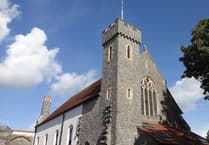
On Wednesday, September 24, St. Mary's Church was once again the venue for a concert as part of the programme for Tenby Arts Festival.
This time it was the turn of the String Quartet Symposia. They were formed in 2002 and in that short time have established a reputation for quality musicianship and a broad repertoire.
Their venues have been as diverse as Covent Garden Opera House and Greenwich Market.
Unfortunately, there was an unavoidable change to the normal line-up as advertised earlier, and for this evening, the quartet comprised Charlotte Newman (violin one), Joao Carneiro (violin two), Amy Greenhalgh (viola) and Gina van Hoorn Alkem ('cello).
The programme opened with Haydn's String Quartet opus 64, No. 5 (The Lark) in four movements: allegro moderato, allegro cantabile, minuet and trio and vivace.
The opening lines have the first violin soaring lark-like above the other players - hence the nickname of the piece. From the start it was clear that we were going to hear quality music-making.
In the second movement, with its theme and variations, a particularly fine ensemble sound was achieved, the lower strings providing a rock-solid basis.
The final movement was taken at almost break-neck speed, but they all stayed together beautifully to produce a really exciting finale.
There followed Adiemus Variations for String Quartet by Karl Jenkins. This provided a considerable challenge with its innumerable repeats and cross rhythms, but it was very well received by the sizeable audience.
After a short interval came Dvorak's String Quartet No 12 in F, Opus 96 American. The wistful longing for a distant homeland (Dvorak was living in America at the time) was admirably captured in the first movement where the opening theme was finely played by the viola.
In the second movement, the influence of native American melodies could be heard performed so expressively by the 'cello. The piece ended with an exciting flourish.
After prolonged applause from an appreciative audience, the performers were presented with bouquets, and they responded by playing two encores by Elgar, Salut d'Amour and Mot d'Amour, a fitting ending to a most enjoyable evening.
J. W.
A journey through Wales in just an hour!
George Borrow's 'Wild Wales' is a big book in every sense of the word, so to present it to an audience in a dramatised version in one hour would seem an impossible undertaking. However, Peter Richards, artistic director of Fluellen Theatre Company, managed to do just that on Thursday afternoon.
A capacity audience at the St. Brides Spa Hotel were enthralled as Borrow's journey from Llangollen through the middle of Wales and across to Chepstow was played out with humour and passion.
Peter Richards managed to bring to life, not only Borrows, but many of the characters he met on his journey, and in doing so, gave us a fascinating insight into life in Wales in the 19th century.
George Borrows was a man interested in everything, and everyone, and spoke 15 languages, including Irish and Welsh.
He was much travelled throughout Europe, and it was in 1854 that the wanderlust struck again, and he began his journey across Wales, accompanied, in part, by his wife Mary - described as an expert pudding maker - and daughter, Henrietta.
He loved nothing better than to converse in Welsh with the 'locals' and became a great fan of Welsh mutton! He gathered many stories along his way, and when he reached his final destination at Chepstow, he tells us that he drank a bottle of port, and sang Welsh songs into the night, but he never returned.
Francis Hardy, who adapted the book for Fluellen Theatre Company, has managed to capture its 'essence' and says himself that George Borrows would be on his short list of people he would like to invite to a dinner party.
I think the audience at the St. Brides Hotel would share those sentiments, judging by the lively discussions that followed, over tea and shortbread in the bar.
The performance was enhanced by sensitive and evocative harp music performed by Delyth Jenkins, who has worked with Fluellen Theatre Company on many occasions.
She and Peter Richards worked so well together, it was easy to imagine we were out there on the roads of rural Wales in the 19th century. Truly, a memorable afternoon.
N. E.
Choir gets better and better
"They just get better and better", "I think it's been the best ever concert," "What a wonderful evening!"
These were some of the comments overheard at the Tenby Male Choir concert, with guest artists Jamie Hutchinson and Seimon Morris, when they performed for the Arts Festival at St. Johns Church, Tenby on Thursday, September 25.
With Graham Powell opening the concert on behalf of the committee, the choir was introduced to and welcomed by the capacity audience. Some late-comers had, unfortunately, been turned away as the church was full, and indeed by 7.50 pm, there was hardly a seat in the sanctuary or in the gallery.
Compére for the evening was the MD, Ian Williams, who made an excellent job of it, in his own inimitable style.
Singing from their current seasonal repertoire, with new pieces dotted here and there, the tone was set from the very first piece. Enthusiastic responses from the lively audience, seemed to 'lift' the choir to meet the expectations of the Arts Festival goers and faithful local followers.
Paul Varallo gave a Welsh lullaby as his first solo item, before Jamie was introduced.
Well known and with a 10-year relationship with Tenby choristers, Jamie looked gorgeous in a full-length red satin dress. Since her degree at the Royal Northern and a Masters taken with Distinction last year, Jamie has been spreading her wings rather widely.
Based in London, Jamie is playing and has played with many of the famous London orchestras, including the BBC Philharmonic and the Hallé. She also commutes one day a week to teach at Manchester High School for Girls, and plays in various quartets in London, Manchester, Leeds etc. She is continuing studying by doing Master classes and has also now entered the 'pop' world, by touring with 'Westlife' and appearing on TV.
She remains very loyal to Tenby Male Choir, who gave her many opportunities to play solo violin as a schoolgirl and student.
Accompanying Jamie was the excellent, well-known Pembrokeshire musician, Seimon Morris. A conductor, composer, musical director and pianist, Seimon's talent and skills are much admired.
In the first set, Jamie played traditional Russian music to begin: 'Deep Sorrow' and 'Two Guitars'. These were both taken from 'The Gypsy Violin'. Next came 'Alt Wien' by Drdla, - lovely, easy-listening and the beautifully controlled though dramatically delivered 'Mayurka' by Nolck. This composer is a favourite of Jamie's, as we've noted over the years.
When the men returned to sing, Ian ironically commented how they returned in 'military precision'. This was because a number of the choir had scattered to squeeze into spaces somewhere at the front of the church, instead of going out back, because they wanted to listen to Jamie! However, despite the scramble back to stage, the choir settled into their disciplined singing at the first note played by Jill and the audience were treated to five more pieces. The final piece, 'Amen', was at such a tempo, that there were cheers from the audience at the end.
Paul returned to sing in Italian the lovely aria 'Ideale', and very nice it was too!
When Jamie and Seimon came on for their second set, one could sense the pleasurable anticipation of the audience. She began with a charming medley of traditional Welsh tunes which included 'Dafydd y Garreg Wen' and 'Bugeilio'r Gwenith Gwyn'. The arrangement was delightful and the whole delicately and beautifully played. This was followed by an 'Allegro Brilliant', at the end of which Jamie and Seimon achieved a standing ovation. And it was well deserved.
In beginning their final set, Tenby Male Choir began with the emotive 'O Gymru' and ended with 'American Trilogy', two very patriotic songs. About five or six men in the audience joined the choir at Ian's invitation to sing the Trilogy and there was truly tremendous applause. It had been a superb concert, once again, and Heather Williams, for the Arts Festival committee, thanked everyone for their wonderful singing and playing, and presented flowers to all principals.
The concert ended with the audience and choir singing The Queen and 'Mae Hen Wlad Fy Nhadau' with much feeling.
Although this concert was to have been Tenby's final concert in Tenby this year - there is one at the Regency Hall in Saundersfoot on Thursday, October 16 - news is leaking out of a very special extra concert in St. Mary's on November 1, when the Cambrian Choir are coming to Tenby to do a joint concert. It seems there was a request from the chairman of the valley's Cambrian Choir to chairman Terry Evans in Tenby, to do a joint concert here, following their competition in Torquay in February. Watch the Observer for further details.
M.N.
THE Final Concert
St. Mary's Church was full to capacity on Saturday evening for the recital given by cellist Julian Lloyd Webber and pianist Pam Chowhan. Amongst the audience were many of Pembrokeshire's young cello students.
Julian Lloyd Webber is widely regarded as one of the most creative musicians of his generation and one of the world's most renowned solo cellists.
He opened the recital with Adagio in G by Bach. A stillness and calmness descended over the church as the beautiful sound of his Barjansky Stradavarius cello hovered above the audience long after his bow had stopped. A complete change of style, pace and centuries came with the next two works by Frank Bridge and his one-time pupil Benjamin Britten. The Bridge Scherzetto was discovered by Julian Lloyd Webber in the library of the Royal College of Music. It was written in 1902, but had to wait 77 years for its first performance! It is a brilliant, virtuoso work, full of skittish zest, which he controlled beautifully. It inspired one young cellist to say "I really want to play that piece."
The Scherzo, Pizzicato e Marcia from Sonata in C by Britten was written for Mstislav Rostropovich. Although Britten did not play the cello he had an amazing knowledge of cello technique which he used to great effect in this music. It included sound effects ranging from an ominous buzz, acid like sounds being played on the bridge and eerie high pitched glissandi. The two performers rose impressively to the challenges.
Julian Lloyd Webber can sing a tune on his instrument beautifully and the next tune he chose to sing was Faure's Elegie. His playing was ravishing, with a rich, warm and lyrical style full of heart-wrenching emotion. This was perfectly matched by the delicate piano accompaniment.
The first half ended with the Debussy Sonata for cello and piano. Julian Lloyd Webber informed the audience that Debussy had composed new things for the cello to do and to listen during the second movement for the cello imitating a guitar or lute being strummed and plucked. The cellist and pianist brought out the drama, starkness and contrast in a massive interpretation.
During the interval, Julian Lloyd Webber came into the church to sign CDs and to chat to the audience, which thrilled the young cellists present. So great was the demand that more CDs had to be brought in from his car.
The second half began with a family connection. In the Half Light was written by Julian's father, William Lloyd Webber. He had explained to Julian that the piece is supposed to depict someone sitting in front of the fire one evening looking back over their life. It was a beautiful, romantic piece with its long, smooth, lines being so suited to the cello. Julian Lloyd Webber's control over his bow is truly amazing.
Keeping it in the family, he then played one of his own compositions. This was a cradle song written in 1992 for his six-week-old son, David, whilst he was sleeping. It certainly depicted the innocence of childhood.
We then arrived at the last item far too quickly. This was the most substantial work of the evening. Brahms gave both his cello sonatas the title of 'Sonatas for piano and Violoncello', a clear indication that he regarded the piano as an equal not as an accompanist. This was very much demonstrated by Julian Lloyd Webber and Pam Chowhan.
The E minor sonata (Opus 38), his first, starts off in a brooding mood. The central movement 'Allegretto' comes as a welcome relief and was given a charming, light-hearted interpretation. The partnership performed with vigour and determination in the final movement which brought the recital to a close.
The church erupted with rapturous applause which continued until the soloists returned to play an encore. Manuel de Falla's Ritual Fire dance was played with such energy, but it still did not satisfy the audience who called for a second encore.
Julian Lloyd Webber stated that he had played pieces by two members of his family, but there was a third member who did a little composing. The piece he would play was written for him by his brother Andrew as the result of a lost bet over a Leyton Orient football match.
He then played the brilliant last of the Variations on a theme by Paganini (his 24th Caprice, a theme used by Brahms, Rachmaninov, Lutoslawski, et al). This ends with a long glissando down the C string followed by turning down the string to give a final resonant bottom A.
The final applause was long and enthusiastic. When asked after the concert for her opinion, a nine-year-old cellist said "He was amazing. The best in the world."
I think this was the feeling that left the church with us all.
S.E.L./A.M.
Festival's new direction
The staging of an opera with music by Handel and Gluck was a first for Tenby Arts Festival last week, and a first for the De Valence Pavilion as well. But this was real entertainment, even if your ear is not tuned to opera. Castradiva is no conventional opera. Instead there was dialogue for several characters, all cleverly played by mezzo-soprano Buddug Verona James. More appropriately, Castradiva should be called a play with fine music.
The fictional play was devised and written by Mark Ryan and Buddug herself, about the Castrato 'Pedrolina il Magnifico', and featured some of the greatest arias written by Handel and Gluck for the castrati of the 18th century.
The time was 1700, the place Rome. The Pope had banned women from performing in public. Young boys were sold to the church and castrated to keep their voices high. Castrati performing the female as well as the male roles, were adored like pop stars and discovered the perfect disguise for visiting a ladies boudoir. Cross dressing became the order of the day. Castradiva tells the tale of the extraordinary lives of the castrati.
Buddug treated the audience to a unique and brilliant piece of theatre. Dressed in exquisite costumes and bewigged in the style of the times, she swaggered across the stage perfect in every look, move and and gesture.
With style and wit, Pedrolino the Magnificent unfolded the risqué details of his love life and adventures. Throughout the show, Buddug maintained the illusion of a woman playing a man, who in turn plays the part of a woman and then back to a woman playing a man as though falling through the looking glass!
But Buddug is an experienced and skilled actor. The parts were played with impeccable timing, her superb gestures and changes of facial expression aided at times by half-facial masks, brought each character to life.
Buddug's voice has been described as 'bronze-toned', the rich mezzo dealt effectively with the intricacies of the arias and evoked the great emotions of sadness in 'Pena Turana' from Amadigi by Handel, and joy in Ho non so che nel cor' from La Resurnezione.
Musical director Andrew Wilson-Dickson led the stylish accompaniment on harpsichord, with Lucy Robinson on bass viol and Mark Elton on baroque violin. All were dressed in period costume and performed on the stage which helped to set the scene.
The director of this entertaining show was Chris Hogan.
P.P.
An Exceptional Concert
Tenby is ideally situated for a celebration of the Arts. This was the seventeenth Festival and included some of the great performers as well as a talented new generation representing the arts and bringing us together. The best festivals grow from their roots and Will Dawes from Manorbier, the Senior Lay Clerk at Christchurch Cathedral Oxford, is both creator and director of the Edinburgh Camerata. A group of eight singers who created an exceptional concert. Will spoke of his music making as being being fun reminding us that we cannot separate music from our daily lives and the power of music has the ability to speak to all aspects of life emotionally, intellectually and spiritually. We learnt in this music that everything becomes connected.
In the first part Palestrina's Stabat Mater was followed by Byrd's Mass for four voices, a liturgical setting or the Roman Mass and a setting by Praetorius of the Magnificat. there were moments for us to remember, subtle changes of mood as we changed from light to shade with beautiful tome and the spirits soared.
The second part represented a living tradition in which Vaughan Williams who died fifty years ago who composed nine symphonies, an opera and well known and loved hymn tunes drew on the folk songs rooted in the soil of England. The two Welsh folk songs Gwenllian and Swansea Town were composed by Sir Michael Tippett and Gustav Holst also rooted in the Welsh culture. The last four songs included the inventive and highly amusing Frank Bridge's 'The Gosling'. This was an evening of outstanding choral music making.
Julian Lloyd Webber, the distinguished cellist, who gave the final recital at St Mary's Church on Saturday 27th, September wrote, "I have believed that music is for everyone ... I can see what music can do. It can change lives."
C.L.
Pub-goers get a taste for
plays with their beer
During the Tenby Festival last week, five pubs in Tenby were hosts to a new drama form. 'Pint-sized Plays' are five to 10-minute plays written to be performed in the bar areas right amongst customers enjoying their pints.
And they certainly fulfilled their potential, playing to packed houses on the Monday and Tuesday nights - not normally busy nights. So the Lifeboat, Five Arches, Stage Door, Crown and Buccaneer were very pleased with the extra custom that the plays brought in; and the customers, judging by the enthusiastic applause, were more than happy with the plays themselves.
They varied from the sad, to the poignant, to the funny to the downright hilarious.
In one, 'Menage a Trois (thousand feet)', the three actors were lying stomach down on bar stools dressed in overalls, helmets and goggles playing skydivers in free-fall.
In another, Santa Claus at the bar was accosted by a grown man enraptured at meeting his childhood hero and then complaining about the fire engine he had been given as a Christmas present decades before.
While another, 'Who's Joe?', was a thought-provoking piece about a mysterious man who may, or may not be, a terrorist.
Pint-sized Plays organiser, Derek Webb, said of the event: "I hoped it would be successful - but the opening evenings exceeded our wildest expectations, and what is particularly gratifying is the number of people, who never normally go to the theatre, saying on the feedback forms that seeing the plays had encouraged them to go in the future."
One of the Pint-sized Play authors, Dorothy Lambert, came all the way from Dorset to see her play and is coming back again for a Script Slam at the Theatr Gwaun on October 11 when 10 of the plays will compete for the coveted 'Pint-Pot' awarded to the best script which is voted for by the audience that night. Pint-sized plays are also playing in Fishguard and Goodwick this week.