

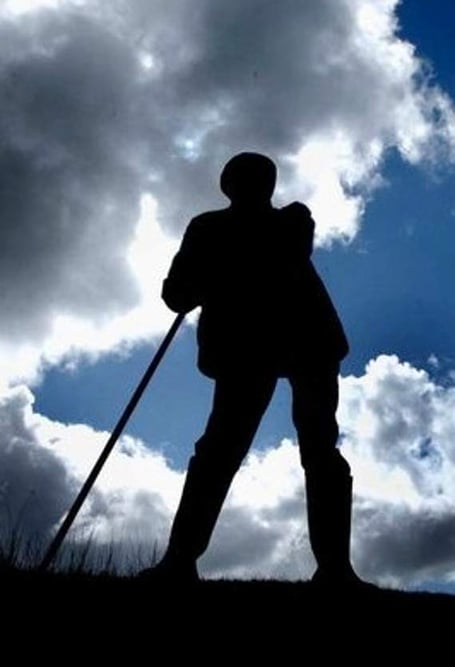
A vulnerable period
Taking best good care of their own health is, perhaps, an area where farmers and farm workers do not apply sufficient attention.
Now well into the winter period, many who are out at work in the early hours, or even late in the evening, will really need to come to terms with chest problems.
Respiratory disease, particularly asthma and COPD remains a substantial burden on health services especially with ageing populations and the co-existence of other non-communicable diseases.


Lung disease - not least the so called Farmers Lung - is a significant cause of mortality in the UK, ranking as the third biggest killer with 115,000 people a year dying from it.
Current forms of treatment for most lung diseases include bronchodilators and steroids and recent innovations in lung disease prevention, diagnosis and treatment, such as pilots to screen and diagnose lung cancer have, to a certain extent, led to some improvements.
A glimmer of light on the horizon comes in the form of a new taskforce, chaired by Dr. Penny Woods, of BLF, which aims to produce a national programme for the prevention, diagnosis and treatment plan for lung health.
Penny tells me: “Our ambition is to work with patients, professionals, the NHS and the pharmaceutical industry to design and publish a new, five-year plan for lung health. Like the cancer and mental health taskforces before, this will lead to a step change in how we prevent, diagnose and treat respiratory disease.
“Lung patients should be able to expect world class care. Our plan will make sure everyone affected by lung disease gets the outcomes they deserve.”
Festive spirit
A fantastic festive few days have once again been enjoyed by thousands of happy visitors at the Royal Welsh Winter Fair in Llanelwedd, Builth Wells, last week.
Primarily a trade event, the Winter Fair provides a perfect opportunity to network with fellow farmers, producers, suppliers and buyers, and has become the ideal hub to discuss, plan and do business.
In his address (spoken by his grandson, Shaun), at the official opening ceremony Oriel Jones, 88, referred of the Winter Fair as a celebration of our industry where farmers and local butchers meet and collaborate.
“It is a credit to the society and all involved that the show has continued from strength to strength and is so highly regarded within the agricultural industry and further afield,” said Mr. Jones.
“I have enjoyed attending this show for many reasons over the years. To meet with friends, to negotiate deals and to entertain customers. It is at events such as these that farmers and all stakeholders within the industry gather to discuss their state of affairs and how we are progressing.
“The one overriding factor that we have against all adversity is resilience. I don’t think there is a more resilient individual than a farmer. We as an industry are forever evolving, and that’s what makes us so special. There is no doubt that there are challenging times ahead, but in all adversity there is one certainty... thus being, that we, as an industry, will be here for generations to come.”
The support for the event from the industry, especially the livestock exhibitors was again quite phenomenal: With strong entries from across the UK in all sections, and record entries in the sheep, and carcass competitions, the livestock, as always, played centre stage to the busy two-day event.
Non Native
Recently researching some of the local history of the NFU over the past 100 years, I discovered, surprisingly, when there was a period when many landowners were calling for the protection of foxes.
Why? Because these were seen then as a valuable means of coping with the increasing problem of keeping the rabbit population under control.
Times have moved on and one of the biggest pests today, in some areas, is the growing number of grey squirrels.
Red squirrels used to be common in the UK, but since the introduction of greys, which not only drive out reds through sheer competition, but by spreading a pox -that they are immune to -but which wipes out the red population.
The invasive grey squirrel, a rodent native to the eastern half of North America, is damaging Britain’s native trees by stripping the bark from native broadleaved trees like beech, oak and sweet chestnut and can even kill the trees as well as eating bulbs and seeds in large quantities.
The latest figures show the Forestry Commission killed more than 50,000 greys in the last five years.
Thinking ahead
“With the Christmas and New Year festivities coming up, imagine you could counsel your younger self: what words of advice would you offer?
I’m reading a book at the moment in which numerous celebrities write letters to their teenage selves. From the hilarious to the heartfelt, there are some little nuggets of wisdom: don’t do drugs, listen to your mother, buy shares in Google - and my personal favourite - stop hating your thighs!
It got me thinking about hindsight and our fantastic ability to understand a situation after it’s happened. Hindsight can make things look so completely, utterly different. I’ve often thought that if I could go back in time to when I was struggling to stop drinking, there would be about a hundred things I’d want to tell myself.
For example, it would’ve been handy to know that alcohol-free living was not going to be hell on earth (despite first impressions). I was convinced that drinking was the only way to have fun and relax.
If I’d known that eventually I’d feel a million times happier without alcohol, then perhaps I wouldn’t have wasted so much time trying to get booze to fit into my life. They say the definition of madness is doing the same thing over and over again and expecting a different outcome; looking back, this sums up my behaviour exactly.
It goes without saying that we can learn a lot from other people’s experiences. So, I asked a few graduates to reflect on what they’d love to have known, back when they were still drinking. What would they have told themselves, if only they’d listen? The results are funny, touching - and straight from the heart.
Jamie related: “If I could go back and give myself some advice, I would tell myself that once you aren’t drinking anymore and you observe how people behave at parties, you will feel so grateful that you are not behaving that way. Asking the same questions over and over, crying about something that’s not even a big deal, making the ‘sexy face’ (even though it’s really the drunk, train wreck face) and having really fake conversations. I wish I could have shown myself how I was acting and coming across. I always thought a core value of mine was being authentic. It’s only now, as a non-drinker, that I feel like I’m really living in line with that. It’s so great. It’s the best way I have ever connected with myself and felt real and genuine.” (Contributed)
Self belief
Polish physicist and chemist, Marie Curie, who conducted pioneering research on radioactivity, and became the first scientist to be awarded a Nobel Prize in two different categories fully recognised that life is not easy for any of us. But what of that?
“We must have perseverance and above all confidence in ourselves. We must believe that we are gifted for something and that this thing must be attained,” she insisted.
Comments
This article has no comments yet. Be the first to leave a comment.