

A labour of love?
Thinking back, it was probably a generation or so ago that people in the large towns and cities longed - no, they were desperate - for their idyll cottage in the country.
Little did they realise that this is a completely different way of life and many of those who took the plunge lived to regret it.
There are very few homes that can immediately transport you back to a simpler way of life from the moment you step inside, but the Collings’ were definitely well amongst them.


.jpeg?width=209&height=140&crop=209:145,smart&quality=75)
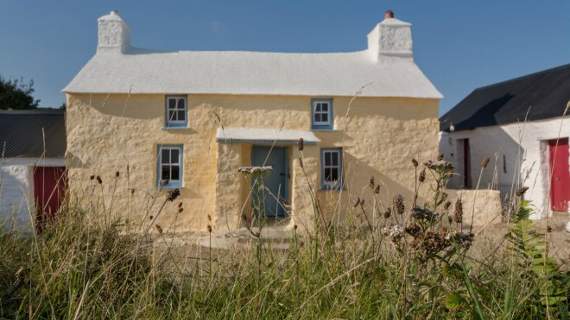
They soon came to realise that buying a traditional Welsh cottage, built in the 1840s - without so many of the trappings of contemporary living - would be a home that had just an open fire in place of a television as a focal point in the sitting room, vintage utensils rather than gizmos in the kitchen, and traditional Welsh blankets, quilts and antique lace in everyday use in the bedrooms.
Oh my, it felt instantly welcoming and calm - a retreat away from the hustle and bustle of modern times. This is not a way of life that suits everyone, and neither would such a traditional renovation, but restoring the little cottage to the most original state that money and practicality would allow, was something that owners Mike and Tanya were passionate about.
The couple bought the property 20 years ago and now live there with an accumulation of pets, but no TV!
How did they find the cottage of their choice?
“It had always been my dream to live in an old cottage,” says Tanya, who feels very sad that so many Welsh cottages have lost their identity through modernisation.
When she and Mike got married in 1992, they were living with her mother in the neighbouring town, in which she was born, “but we really wanted a house of our own,” she says.
“I saw the cottage in an estate agent’s window and liked the look of it.”
While Mike was reluctant to view the cottage because he feared that it would be too small, she persuaded him to see it, yet ironically it was Tanya who was disappointed with the interior when they visited.
“I had my dream of what I pictured a Welsh cottage to be - beams, an inglenook fireplace, stone walls and lots of character, and there wasn’t any here because it had been given a terrible 1960s makeover,” she shudders.
“There were polystyrene tiles on the ceiling, plastic tiles on the floors, all of the doors were covered in hardboard panels and the fireplaces had been boarded up. There was no kitchen, no heating, and ivy was growing up the chocolate brown walls.”
To her amazement, Mike turned to her with enthusiasm and said: “I think we could do something with this!”
Mike convinced Tanya that he could create the authentic Welsh cottage she had dreamed of by doing much of the work himself, and so they put in an offer of £29,000, which was accepted.
““For the first 10 years, we did things a bit at a time,” Tanya recalls, as money was tight. “Mike was a catering officer and he travelled a lot, but he always started work on the house after supper at 8 pm every night.”
Every inch of space in the cottage is utilised, including a coat and boot area positioned next to the front door, opposite the kitchen.
Mike remembers the graft only too well.
“One of the first jobs was to remove all of the plaster on the downstairs walls, which were damp. We took them back to the stone work and repointed them with traditional lime render. Then, we opened up the fireplace in the sitting room, put in a damp-proof course and installed fascia board and guttering on the back and front of the house before repointing it with lime,” he says.
“The next priority was to repair the roof. Damp had come through the slates and you could see daylight through them.”
A local builder re-felted the roof, then salvaged and relaid as many of the original slate tiles as possible.
With the house more structurally sound, Mike removed the uPVC windows and replaced them with timber sashes handmade to the original pattern used on other local homes. Then, once he had removed the polystyrene tiles and taken the ceilings back to the beams, the couple turned their attention to the design of their home.
With the help of a friend, Mike designed the small kitchen area to make maximum use of the space, with everything in reach on two simple shelves. The couple replaced the quarry floor tiles that were damaged by layers of thick black adhesive, with originals salvaged from a neighbour.
“The kitchen was in a hell of a state when we found it,” says Mike. “There was a cupboard hanging on the wall and a single kitchen unit, but no cooker or fridge.” He retained the original unit, replacing the doors and painting them to match the newly laid tiles, then a friend added beech worktops.
When it came to decorating, Tanya went to the National Museum Wales, in Cardiff, for inspiration.
“I wanted our home to look like an old Welsh cottage and a lot of them had wallpaper,” she says.
She worked on a general theme of three autumnal colours, which she weaved through the house so that it blends together, with pattern from wall coverings and her Welsh blankets and quilts.
“When we first moved in, we had to make do and mend. We had an old battered settee off someone for £25. After eight or nine years, we started collecting older pieces,” which became a passion. When the couple’s television broke four years ago, they preferred instead reading by the side of the fire in the evenings, and so didn’t replace it.
This way of life, in their carefully restored home, seems to be perfect for Mike and Tanya.
“When you put so much heart, soul and work into a house, it becomes part of you, so I don’t know if I could ever leave here,” Tanya says.
“We are now attached to the place, and we’ve got so much pleasure and joy from it. Even now, when we’ve lived here for 20 years, we really love our dream cottage.”
The wallpaper in the sitting room is now Brer Rabbit by William Morris. Tanya lives by his famous mantura - ‘Have nothing in your house that you do not know to be useful or believe to be beautiful.’
Lessons from life...
“I grew up with practical parents. A mother, God love her, who washed kitchen foil after she cooked in it, then reused it. She was the original recycle queen before they had a name for it.
“A father who was never happier than getting his old shoes fixed rather than buying new ones.
“Their marriage was good, their dreams focused. Their best friends lived barely a wave away. I can see them now, dad in corduroy trousers, check shirt and a cloth cap and mam in her pinny (pinafore dress). a bucket in one hand, and a dishcloth in the other.
“It was the time for fixing things. A curtain rod, the wireless (radio) set, the latch on the oven door, the hem in a dress or socks to darn.
“Things we keep. It was a way of life, and sometimes it made me crazy. All that re-fixing, eating, renewing, I wanted just once to be wasteful. Waste meant affluence. Throwing things away meant you knew there’d always be more.
“But then my mother died, and on that clear summer’s night, in the warmth of the hospital room, I was struck with the pain of learning that sometimes there isn’t any more.
“Sometimes, what we care about most gets all used up and goes away...never to return.. So... while we have it..... it’s best we love it.... and care for it... and fix it, when it’s broken......... and heal it when it’s sick.
“This is true. For marriage....... and old cars..... and children with bad school reports..... and dogs with bad hips.... and aging parents...... and grandparents. We keep them because they are worth it - because we are worth it.
“Some things we keep. Like a best friend that moved away or a classmate we grew up with. There are just some things that make life important, like people we know who are special........ and so, we keep them close!” (contributed)
...and death
When you die, nine things God won’t ask you:
1. God won’t ask what kind of car you drove. He’ll ask how many people you drove who didn’t have transportation.
2. God won’t ask the square footage of your house, He’ll ask how many people you welcomed into your home.
3. God won’t ask about the clothes you had in your wardrobe, He’ll ask how many you helped to clothe.
4. God won’t ask what your highest salary was. He’ll ask if you compromised your character to obtain it.
5. God won’t ask what your job title was. He’ll ask if you performed your job to the best of your ability.
6. God won’t ask how many friends you had. He’ll ask how many people to whom you were a friend.
7. God won’t ask in what neighbourhood you lived, He’ll ask how you treated your neighbours.
8. God won’t ask about the colour of your skin, He’ll ask about the content of your character.
9. God won’t ask why it took you so long to find Him and ask Him into your house, He’ll lovingly take you to heaven and not to the gates of Hell .
...even after!
The story is told of a man and woman who were married for many years. Whenever there was a confrontation, yelling could be heard well into the night.
The old man would shout: “When I die, I will dig my way up out of the grave and come back and haunt you for the rest of your life!”
The neighbours feared him and the old man liked the fact that he was feared. Then one evening, he died when he was 98.
After the burial, her neighbours, concerned for her safety, asked: “Aren’t you afraid that he may indeed be able to dig his way out of the grave and haunt you for the rest of your life?”
The wife said: “Let him dig. I had him buried upside down...and I know he won’t ask for directions.”
Comments
This article has no comments yet. Be the first to leave a comment.