
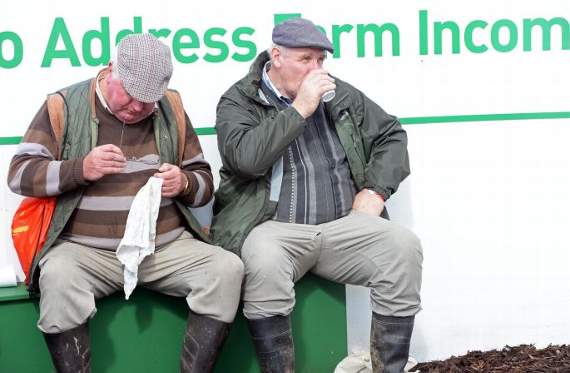
A Farmers lot: Not always a happy one
It may not be apparently so, but the lives of many farmers, men and women, can be extremely lonely apart from the daily visit of the postman, although with the onset of electronic mail this is becoming much less so.
On the smaller holdings, the wives, all to often, feel obliged to take up employment away from the farm in order to ensure that there is food on the table for her family. This may be treated with a measure scepticism, but in reality this is so very often the way things are.
Bureaucracy and red tape are also a minefield which the farm business has to deal with, intricate records having to be kept and an army of inspectors, often repetitively turning up unannounced.


Ridiculously low returns on the produce being sold also drive strong men and women to despair and the right sort of help and the required depth of understanding may not be acceptable to the strong minded and may, indeed, not be available.
Over recent years, the industry as a whole has become indebted to the Farm Community Network who, quite obviously, cannot wave a magic wand to solve every problem, but they are there to share the burden, listen and understand and will make a true effort to provide and bring in appropriate help and support.
A Yorkshire farmer confirmed: “It is so good to have someone to talk to who understands and who I don’t owe money to and who doesn’t make me feel like it’s all my fault.”
A South Wales vet added: “Before FCN visited one of my clients, he was showing signs of extreme stress, but their sympathetic and practical attitude was just what he needed and now matters on the farm are much improved.”
A Devon widow said: “After my husband’s suicide, FCN supported me and brought in further help from RABI and the Addington housing scheme - they are all brilliant and without them I would not be here,” and a couple from the north of England fully approved of the FCN work by saying: “They have been a great help and become our friends, giving knowledgeable and sympathetic support, and always taking the time to talk.”
Taking matters further, farming has, traditionally, experienced amongst the highest rates of suicide across the globe and the world’s first online mental health programme specifically targeted at farmers aims to provide them with effective coping techniques and prevention methods.
The 2014 Regional Wellbeing Survey found that almost 50 per cent of Australian farmers had a mild or worse mental disorder, compared with 26 per cent of the general rural population.
Lead researcher Kate Fennell said it was the first online resource of its kind in the world to specifically target farmers.
She said it would not only help farmers who lived with a mental illness, but could also be used as a prevention tool to address potential issues before they materialised.
“The main thing that it is going to focus on is helping farmers deal with things that are beyond their control because we know that farmers are already good problems solvers and are quite independent,” Dr. Fennell said.
“Things like the weather, commodity prices and disease outbreak - are all things that aren’t easily fixed, can’t be controlled and our previous research has shown us they are what causes the most stress.
“We are hoping to provide them with the skills to cope better with the difficulties of their everyday lives and essentially prevent the development of mental health issues.
“Some farmers have told us that they are worried about their mental health but don’t speak to their GP about it because they don’t know how to have that conversation. One of the things we are working on is a script for the website that they can read through as an example or a video of someone else having that conversation so that they realise that it’s actually not that hard and is something that has been done before.”
The Australian farmer’s mental health site will be used primarily as an information hub, but will also include a discussion board where users can interact with other people and share their frustrations in a professionally moderated environment.
“We want to work within Australia at the moment to make sure it’s culturally appropriate and targets their needs specifically. Farmers in other countries might have different needs,” Fennell said. “Once we make sure the programme is effective here, we have had initial discussions about rolling it out in other parts of the world as well.”
Dr. Fennell, who grew up on a farm in South Australia, is looking for 80 farmers from around Australia to assist them in developing and evaluating the website.
Truth: stranger than fiction?
I recently came across an intriguing tale of how a concrete mixer and a caravan led Byron Rogers to the tale of an Australian sheep shearer and his ancient Welsh castle.
It states: “For me, this story started one Sunday afternoon in the small Welsh town of Narberth, which, like all small Welsh towns on a Sunday afternoon, feels like the end of the world. I walked the streets and then climbed its mound to the castle. And that was when I saw it.
“Someone had put a chain across the entrance, from which dangled the notice ‘private.’ Fair enough, most castles in Britain, even the ruins, are privately owned, even though they are in Government care. But this chain was made of plastic!
“I stepped over it, and it was then that the surprises came, one after the other. There was an abandoned car, its tyres flat, beyond which there were piles of stone and a concrete mixer. A concrete mixer!
“All repairs to ancient monuments have to be done under official supervision, and then old techniques like lime mortar have to be used. This castle was a building site!
“Someone had re-roofed one chamber, a real cowboy job. But not only that, he had moved in. There was a caravan, which seemed to have been broken into, and a tap and an overhead electric cable. Whoever that someone was, he had had water and electricity laid on to a medieval castle. Yet everything looked abandoned.
“Upon further investigation I discovered what had happened. In the early 1980s, an elderly man had turned up in Narberth, who, by some accounts, had been an Australian sheep farmer, and by others a P&O steward. But the accounts were agreed on one thing: his name was Perrot.
“Since the 16th century, the Perrots had lorded it over Pembrokeshire, the grandest of them the giant Sir John, the viceroy of Ireland, said to have been the illegitimate son of Henry VIII. But he had died in the Tower of London in 1592, convicted of treason, and his estates were confiscated, with his family slipping into history. But now after 400 years they were back.
“The castle then belonged to the local doctor, who was so impressed by the old man’s story that he sold the ruin to him, so it is said, for £5. But it was what happened next that startled everyone. The last of the Perrots, which was how he had introduced himself, moved in. The first thing he did was to remove all the topsoil of what had been an overgrown garden 40 yards long: this, you must remember, was done by a man in his seventies, who started work at dawn and continued until the light went. A man living at the foot of the mound told me that his wife became so concerned for his welfare that she took cakes up to him.
“Stone was delivered, tonnes of it, and gravel. Perrot dug down, up to four feet, to reveal the curve of towers hidden for centuries, and some work was meticulously done, but for the chamber he roofed over he used new sandstone, an offence against every heritage law. Yet no inspector called, for no one in authority knew what the lost heir was up to. And then, as suddenly as it had started, it was over. The lady who took him cakes went up one morning and found Robert Perrot, aged 77, dead in his caravan.
“When I called, time had again stopped in Narberth Castle, the car and tools and concrete mixer being just as the last of the Perrots had left them.
“In his will, he named his sister’s grandson as his heir, so a young dentist in Essex has to face the problem of what to do with a partly rebuilt castle in Wales. It will probably occupy him for the rest of his life.”
200 years ago
A dry year - with a dry summer: the Thames so low by September that people walked under the arches of London Bridge. This was apparently caused by a combination of drought, strong winds and low tides.
Now you know
Have you ever wondered how much you spend on lottery tickets and scratch cards per year? The average Brit is said to blow a huge £416 a year, yet 82 per cent of people have never won a penny, let alone the jackpot!
Comments
This article has no comments yet. Be the first to leave a comment.