
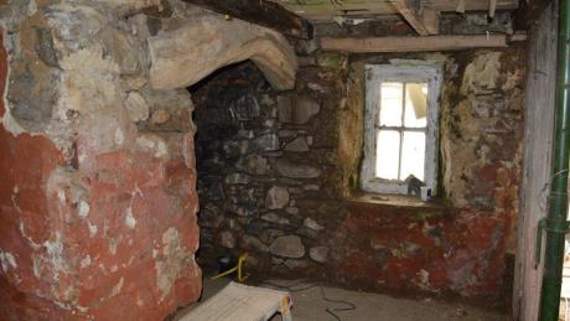
Well restored
The National Trust are to be commended for restoring a traditional single bedroom detached Pembrokeshire cottage situated in a small hamlet near St. Davids.
The charm of this property, was bequeathed to NT by its former owner Glyn Griffiths with the request for it to be preserved, both inside and out. He had lived there since his childhood and the traditional tydyyn, two up - two down crofters type cottage had remained largely unaltered.
Over the past 30 months, a carefully planned and executed restoration of this truly fascinating building - steeped in history - has taken shape. The associated farm was first referenced in the mid-16th century, however, most of the structure and fabric dates from the late 18th century.

When an initial inspection of the cottage and its structure were undertaken, little gems were unearthed including a timber beam which had been wrapped in a newspaper - the Daily Mail from 1928! Also discovered were many designs of wallpaper from through the ages and over 40 different types were painstakingly uncovered.
Following vegetation clearance and a first chance to see the real extent of the project, the restoration gathered momentum, local history groups and interested parties had been able to visit this captivating site and experience at first hand the work that needed to be done, and learning from the conservation challenges which needed to be faced.
The end result is immediately evident as you enter and a cosy retreat has been created for guests… at a price! Weeklong breaks cost from £250 - £900 depending on the season.
May is just around the corner!
The story goes that the best cure for spring fever is to loaf in the sun or go fishing - it is nature’s divine intimation to halt for a few moments and watch how she Does Things.
In one sense, spring fever is a penalty of civilisation. To our savage, as well as our animal ancestors, spring was a time of awakening from the winter’s torpor, a time of throbbing pulse, of eager running hither and thither, of combat and mating and rioting.
It was the real New Year, and should be ours instead of that pale, frost-bitten shadow of a shade which the almanacs have deluded us into anæmically celebrating in midwinter.
But now, with Puritan perversity, civilised man celebrates the real glad birth of the New Year at this time with spring medicines and spring cleanings and the bankruptcies and heartburnings of Easter bonnets.
And when, instead of caroling with the birds and gamboling with the young lambs and reveling in the young green of the grass and the scent of the woodland flowers, we feel depressed and headachy and fur-lined and bilious, we say we have spring fever, and proceed to dose ourselves with a ‘herb’ tea or a blood medicine. It is a slander upon Nature - Dr. Woods Hutchinson (1862–1930).
Farm girl who became a celebrity
Just over 50 years ago, a remarkably attractive Pembrokeshire young farmer gained celebrity status as she was crowned the National Dairy Queen of England and Wales.
She was Mary Llewellin, a farmer’s daughter from Clarbeston Road who was later to become feted almost worldwide.
Her family had collected hundreds of press cuttings, virtually from across the globe, and last year - with the generous support of her daughter, Margaret, who did all the typing - she chose to publish a booklet of her wonderful memoirs.
With a lifetimes experience of dairy farming behind her, she dedicates: ‘Cows and Crowns’ to her ‘rock’ - her mother, Nanny (the 10th child of a family of 11) - who remains well living in an excellent care home. Dad, Norman, and Nanny in turn had had seven children and her family has since extended to 22 grandchildren and 34 great grandchildren.
Mary, the eldest, married Graham Roberts who sadly passed away in 2014.
During her ‘reign,’ the National Dairy Council promoted not only the Tour of Britain Milk Race, but also sponsored the World Cup and Mary recalls being introduced to some of the top footballers of that area, including Bobby Moore.
As the ambassador for the dairy industry, she was also taken on a tour of Canada and the United States and met up with Bob Hope at a national exhibition.
Mary, who has suffered from Parkinsons for the past 10 years, recalls many of the high spots and disappointments over her lifetime but pays high tribute to family and friends who have been her inspiration and support.
She considers life to be what you make it and, in the words of her mother: “Do as you would be done by, help one another and love one another - make the most of what you have and be satisfied with that.”
This well-illustrated and comprehensive life story can be obtained by ringing Mary on 01437 731286.
What you see
Country folk are well-known for their powers of observation: We’ve seen the first swallows arrive and we always spot the first starlings in autumn… but how often do we note their departure in autumn and spring!
Women’s Rights
Mindful of next Thursday’s Welsh Government and police authority voting, my attention has been drawn to ‘The Women’s Suffrage Movement in Wales, 1866-1928’ in the Studies in Welsh History series which runs to 384 pages and costs £48.
So many aspects of local history are contained within the covers which claimed to be the first comprehensive study of this movement in Wales, records the names of committed but lesser-known individuals, covering not only the sensational actions carried out by suffragettes in Wales, but also the more mundane day-to-day campaigns for equal democratic rights for women and men.
An organised women’s suffrage movement operated continuously in Britain for more than 60 years, from the mid-1860s until the achievement of equal voting rights with men in 1928. In the decade prior to the outbreak of the First World War in 1914, both militant suffragettes and law-abiding suffragists ensured that the issue came to the forefront of British politics.
When originally published, this book was the first large-scale, comprehensive investigation into the movement in Wales, which participated in the agitation throughout the whole of the period.
Grounded in primary research of extensive archival material, this study examined the impact that all the various campaigning organisations had in Wales, it highlights the role of the many hugely committed, but unsung individuals on whom local impact was dependent and looks at the stances adopted by various politicians and at parliamentary developments.
The book covers the dramatic and sensational actions carried out by the ‘suffragettes’ in Wales, some of which led to several of the most widely-publicised clashes between demonstrators and authority outside London, and the more mundane work undertaken by the vast majority of campaigners across the decades. Due attention is paid to the opponents of women’s suffrage, to their arguments and to their organised resistance.
Finally, the study recognises the survival of the campaign in the face of the wartime difficulties and then details the much-neglected last decade of the campaign, between the granting of partial enfranchisement in 1918 and the triumph of equal franchise almost 90 years ago.
June Purvis, professor of women’s and gender history, University of Portsmouth, considered: “This lucidly written book offered the first comprehensive coverage of the women’s suffrage agitation in Victorian Wales until the granting of equal voting rights in 1928. Drawing on extensive primary sources, it has chapters on the Women’s Social and Political Union, the National Union of Women’s Suffrage Societies, the Women’s Freedom League, the impact of the Great War and the campaign for equal suffrage - an invaluable read for all suffrage scholars.”
Seasonal quotes
The first day of spring is one thing, and the first spring day is another. The difference between them is sometimes as great as a month! - Henry Van Dyke
Spring is not the best of seasons, colds and flu are two good reasons; wind and rain and other sorrow, warm today and cold tomorrow. - Unknown
April hath put a spirit of youth in everything. - William Shakespeare