
This life
We should all know that this life is the real thing and not a rehearsal - we have only one shot at it.
But, even though we know this, how many of us would live the exact same life again if we had our time over?
For farmers, it is a profession that many people end up in by accident of birth. We all know farmers who are no more suited to or interested in farming and yet they are farmers because they were born the eldest or youngest son.
Life must be pretty miserable, especially when you don’t have the courage to change it - I’ve always admired people who follow their dreams. Those people who are in good jobs or who have a path marked out for them and yet change course to follow a quite different path.
More often than not, the sky does not fall in and they get on very well just like the London barristers recently featured in the excellent, 12 part BBC 2 series showing a whole year in the lives of five distinct Scottish farming families.
It is not often we can say that the TV had got it right, but I am sure that for very many who live a comfortable life and enjoy a well-paid job ‘This Farming Life’ was a true eye-opener.
A documentary series of this sort fully engages the struggles and triumphs of eking out a living albeit in what appears to be (at least in the summertime) some of Scotland’s most beautiful and remote landscapes.
Allowing the cameras onto their farms and into their lives, the families featured were attempting to turn a profit in testing economic times. Life, often times, is tough - but never dull. As one farmer puts it: ‘This is not a job, it’s a way of life.’
On the Isle of Lewis in the Outer Hebrides, sea shepherd and ex-barrister Sandy Granville and wife Ali gathered in a flock of semi- wild sheep from a remote island by boat, and then attempt to lead - train two wayward Highland calves before taking them to a local show.
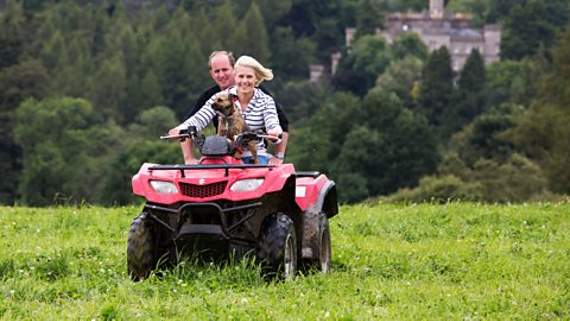
Back on the mainland in Banffshire, soon-to-be-wed Mel Kelly and Martin Irvine (pictured) headed to market to seek out the perfect rams for mating. Hill farmers Bobby and Anne Lennox were making winter preparations too at their farm near Loch Lomond and wondered who will farm the 2,000 acres after their days.
In the far north in Fearn, Ross-shire, large-scale sheep farmer John Scott has his work cut out with 4,000 ewes to check, but had other things on his mind too with thousands of visitors from all over the world about to land on his doorstep as he hosted the World Sheepdog Trials.
I also read about an Irishman just across the water, John Hempenstall with his Wicklow farmhouse cheese: John wouldn’t have been a large-scale farmer but he saw the opportunity offered by diversifying into farmhouse cheese - he grasped this chance with both hands and I’m delighted it has worked out for him and the 16 people now employed by the business.
Another was John Neilly, a master cooper with 50 years’ experience. He retired a couple of years ago but got bored and started his own business making ornamental casks. He’s now working with the local craft distilleries that are popping up all over the place!
So, again, it just shows that if you are open to them, opportunities arise.
A warm welcome awaits
We all recognise that the former Wales Tourist Board had it’s faults, but that surely fades into insignificance when compared with the present set up as taken on board by the Welsh Government.
Rather than taking steps to ensure that what we have to offer get’s maximum publicity, their ‘strategic marketing’ division comes up with the idea of commissioning yet another very expensive and non productive survey to see how well we have done - and they then again pat themselves on the back!
Never learning from past mistakes, they then, irritatingly, propose to carry out another extensive telephone survey that again put’s people’s backs up and, alarmingly, intend to expand this approach further in later waves this year before ‘making some improvements’ - their terminology.
Why, oh why don’t they take a lesson from the Irish promoting the many variations on the Irish personality -around six million variations, in fact.
That’s the number of people calling their beautiful and uncomplicated island home, and every one of them brings something different to the table.
There are certain standards that all maintain, of course. The passion, the poetry, the infectious chat and humour (claimed to be their ‘oxygen’) which is pretty much true all round.
But Irishness goes deeper than all of this, too. You’ll find arts festivals and craftspeople in the smallest of towns, breathing new life into old mills and milk parlours in every corner of the countryside.
It’s often said that the national pastime (well, the male one anyway) is taking the Mick - you’ll find all manner of ways to describe these crafty torrents of affectionate abuse. And visitors are by no means immune to this cultural talent.
As a rule, you see, they don’t take themselves too seriously. They all say ‘After the tumultuous centuries we’ve had in our time, laughter has always come out as the healthy option. It’s the best medicine, after all. Come join us in a drop.’
Oh, and another thing across West Wales - nothing is less welcoming than the green and dirty road signs that never seem to get cleaned.
Husbands’ one liners!
Two times a week we go to a nice restaurant, have a little beverage, good food and companionship - she goes on Tuesday, I go on Friday!
We also sleep in separate beds. Hers is in Llanelli and mine is in Aberaeron.
I take my wife everywhere -but she keeps finding her way back.
I asked my wife where she would like to go on our anniversary: “Somewhere that I haven’t been in a long time,” she said, so I took her to the kitchen.
We always hold hands - if I let go - she shops.
Comments
We've recently changed our login process. If you have an account for commenting, you will need to re-register on the login window.
This article has no comments yet. Be the first to leave a comment.