
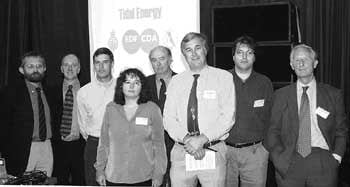
Speakers at the Pembrokeshire Darwin Science Festival's public conference and debate on Energy and the Environment held at the Queen's Hall, Narberth on Friday. From left: Gordon James, Pembrokeshire Energy Agency; Chris Reynolds, environmental manager, Barclays plc; Narberth based consultant engineer Rob Ellis; Valerie Morse, Pembrokeshire Darwin Science Festival; Professor Graham King, chairman of National Coasts and Estuaries Advisory Group, who chaired the afternoon session; Professor Anthony Campbell, Pembrokeshire Darwin Science Festival; Dr. Richard Dinsdale, University of Glamorgan; and David Lort-Phillips, Pembrokeshire Darwin Science Festival.
Pic. Gareth Davies Photography
The Pembrokeshire Darwin Science Festival concluded their 2001 programme on Friday with a well-attended public conference and debate on Energy and the Environment.
A large contingent of students from Pembrokeshire College was among the audience who were treated to a stimulating series of lectures at the Queen's Hall venue in Narberth.



The full day programme began with the 'Alfred Russell Wallace' lecture from keynote speaker Gordon James, of the Pembrokeshire Energy Agency, who gave an overview of environmental issues both on a global and a local scale.
Following his talk, Dave Randall, of Barclays, gave him a thank you gift from the festival, which was presented to him.
Barclays have been one of the main supporters of this year's festival. Their environmental manager, Mr. Chris Reynolds, travelled from London to take part in the conference and gave a short lecture relating to his company's policies on energy conservation in an office-based environment. He spoke about the aims of Barclays to save energy and be more sustainable and the problems faced by the company in achieving these aims.
Talking about harnessing tidal energy from his work on the design and development of free-flow tidal turbines was Narberth-based Rob Ellis, a freelance consultant engineer. There has already been a lot of publicity about his latest project, which he is working on with Richard Ayre, as this project is currently sited in the Haven where there is a test rig.
The fourth guest speaker was Dr. Richard Dinsdale, a senior lecturer in the School of Applied Sciences at the University of Glamorgan, who spoke on 'Renewable Biohydrogen Production,' the biological production of hydrogen.
Other speakers at the conference were festival members Valerie Morse, who is a science lecturer at Pembrokeshire College, Professor Anthony Campbell, who is professor in medical biochemistry at the University of Wales College of Medicine, and Lawrenny farmer and local magistrate, David Lort-Phillips.
Valerie Morse spoke about the importance of educating future generations about environmental issues, Professor Campbell spoke about 'Energy from Life' and David Lort-Phillips spoke about a rural industry, namely the use of wood fuel in energy and heat production.
Chairing the question time forum at the end of the day was Professor Graham King, chairman of the National Coasts and Estuaries Advisory Group. Although audience numbers were somewhat depleted, the debate was nonetheless a stimulating and lively session.
In addition to finalising next year's programme of events, the festival team are now busy with preparations for a trip to Florence in November as part of European Science and Technology Week. They are taking a group of Pembrokeshire students and teachers to Italy when they will have the opportunity to meet up with their Italian contemporaries and peer groups from Uppsala, Sweden, who are also travelling to Florence to take part in the project.
The Pembrokeshire Darwin Science Festival has been awarded a share of EUR 132,000 by the European Commission to take part in this event.