Sardis village welcomed the 'Wildlife on Your Patch' team on Saturday, May 26, to give people a chance to explore the local wildlife and learn survey skills from experts (writes Rosemarie Irvine). Sardis woodland and the churchyard of the Congregational Church were examined in the morning and a survey of the Miners Walk was made in the afternoon. The weather was perfect for this day, which was organised by Jetski Germing, of PLANED, and Bethan Cox for Pembrokeshire Biodiversity Partnership, the Countryside Council for Wales, and the village scheme Sardis Parks and Gardens. Many people came along from Sardis and from other communities to enjoy the day, which had many magic moments and laughter. At the end of a day looking at wildlife, the tired group walked back to the village up the very long steep road known locally as Painful Hill, which was aptly renamed by Sharon as 'Excruciatingly Painful Hill.' Over the last seven years, Sardis Parks and Gardens have endeavoured to create a haven for wildlife in the small woodland by managing it in the traditional way, cutting the summer's growth at the right time to allow the plants to seed and attempting only to plant native plants, so that there is a succession of flowering plants such as snowdrops, bluebells and foxgloves. The churchyard is also a haven for wildlife, as could be seen from the small patch of land nearest the oldest graves, which had not been mowed and allowed to flower. All the people who participated in this day were delighted to see these wild flowers and all the butterflies and moths associated with them, and commented that these sights had disappeared from many parts of the country, and only remain in special places. Bethan Cox said she was surprised by the variety of wildlife in the community woodland and churchyard and commented that Sardis was very lucky to have entensive areas of wildlife in their community and to have history in the Grove Colliery and Stepaside Ironworks on the doorstep. Altogether, five wildlife experts came along with lots of equipment so that everyone had a chance to examine wildlife close up. Sam Bosenquet, the terrestrial science officer for Countryside Council for Wales, said: "The churchyard is fantastically rich with flower species and grasses not found in the surrounding countryside and because of that it holds a wonderful range of insects, including butterflies, moths and shield bugs." Also along for the day was Mike Karpaty, who is the local tree warden and ancient tree hunt verifier for the Woodland Trust. He was excited to find some old and rare trees in and around the village and pointed out some fine specimen trees. Jon Hudson, a conservation officer for CCW, taught people how to use a lens to examine tiny insects and moths, and talked about the importance of all the little lanes near the village and patches of countryside, which form links for wildlife to move between. He said it was no good having isolated patches of conservation areas without these connections between and this became obvious as they all walked around appreciating the beauty of the hedgerows and learning more about wildlife on their doorstep. The knowledge of the experts was impressive and their enthusiasm infectious and it wasn't long before everyone was involved in examining the flora and fauna close up and learning more about Pembrokeshire's wonderful, and often mysterious, wildlife. The team hope to return to Sardis at another season of the year when different plants, particularly lichen mosses and fungi, are at their best.
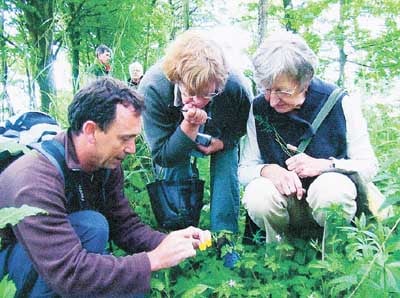
Wildlife expert Sam Bosenquet examining wild flowers in Sardis woodland with Jennie Johnson and Val King.