
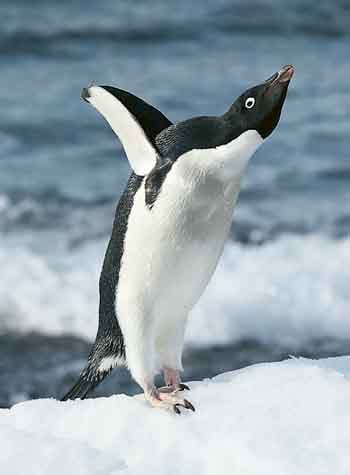
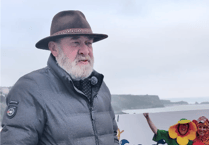
Tenby and District Arts Club would like to extend its best wishes to Miranda Rees as she was unable to come to give an evening of music last Friday due to illness - hope you are feeling better (writes A.D.). We would also like to extend our thanks to Roz Oak for rushing around finding a replacement and to Mick Brown for stepping in at the last minute to give us an illustrated talk on penguins. Our president, Philip Marsden, was pleased to find out that Mick, when shooting penguins, was photographing them, rather than assassinating them!
The talk was intriguingly called Penguins: air-breathing feathered fish, which we found they had been dubbed by a Pope so that it was okay to eat penguins on Fridays! Mick Brown has spent the last 15 years as a guide on small ships travelling around the polar regions, and showed us his own photos of penguins seen from the Galapagos Islands to the Antarctic - a 100 degree range. There are 17 species of penguin, with only two actually in the Antarctic.
In the Northern Hemisphere, there was once a penguin-like bird (large, flightless, black and white), the Great Auk, but it was actually from another family of birds. One of the main reasons for there not being any penguins over this side is the existence of polar bears and arctic foxes - flightless birds were never going to survive long with them around!
Penguins are birds that evolved to spend 78 per cent of their lives in the sea, partly as in many of the regions they inhabit, there is a better food supply in the sea, and no ground predators. Traces of 40 extinct species of penguin have been found. Penguins are all black and white, though they have many variations, both between and within species. Although we think of them as having short necks and legs, this is actually as they keep them drawn in on land for protection from the cold. They actually use their legs for swimming, and necks for catching fish in the sea. They are highly evolved for swimming with solid propeller-like wings, getting up to 25 mph.


Penguins have a sort of antifreeze in their blood to help cope with the cold, but get 75 per cent of their insulation from their feathers - they have 60,000 of them, all closely packed like roof tiles. They preen for two hours a day, spreading oil on their feathers. The feathers moult all at once each year over a week or so, during which time the penguins can't swim.
Most penguins stay at sea all winter and stay ashore three months to breed, mainly laying two eggs and raising two chicks per season, taking turns to forage miles out to sea and returning each day with food to regurgitate for the chick. Penguins can live 30 to 40 years, and try to stay with their partners for life. They generally recognise their chicks by their call.
Penguins need cold water to be comfortable, and the species living in warmer areas such as South America, have a piece of bare skin to cool off through. They can dive up to 1,200ft deep, and the record for the longest dive is 28 minutes without a breath.
A new colony of penguins has recently been found in the Antarctic, so there's much more to learn. A local man, Mike Crockford, was involved in restoring a research base in the Antarctic, which Mick had been to. Researchers now have transmitters with ECG devices which transmit to satellites. The talk finished with some comparisons of penguins and researchers with strangely similar hairdos!
A fascinating talk - and Mick said he will come back some time with part two!
At the next meeting, this (Friday) evening, the speaker is Prof. Tony Curtis, of the University of Glamorgan, poet and author, with a talk intriguingly titled, 'The right words in the right order - stories and poems from the Fortunate Isles'. This will be at St. Johns Church Hall at 7.30 pm, members £2 (annual membership is only £10) and non-members £4 - including tea or coffee and biscuits at the end. Everyone is welcome!
Comments
This article has no comments yet. Be the first to leave a comment.