
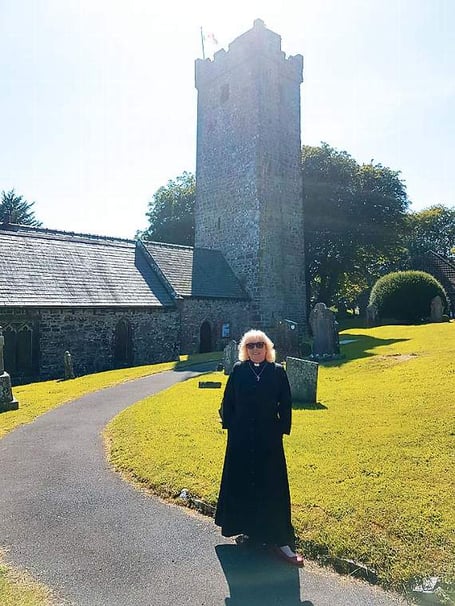
Getting married in church? Rev’d. Caroline Mansell tells you all you need to know: Rev’d. Caroline Mansell is the parish priest of the Benefice of Begelly, incorporating the churches of St. Mary’s, Begelly, St. Elidyr’s, Ludchurch, and St. Elidyr’s, East Williamston.
“Ours is a busy country benefice, made up of a good number of people whose families have lived hereabouts all their lives,” she says. “Conducting the wedding of local couples who were maybe baptised in one of our churches or whose parents were married in the same church that they are now to be married in, is very special. This continuing connectedness and rootedness in our heritage and Christian past gives our community solid foundations for the future.
“Presiding at weddings then is a real joy for me as a priest: it gives our churches chance to shine; it lifts our spirits, as witnessing two people in love only can; it gives our community hope in its future; and let’s be honest, who doesn’t love a good wedding!”
So, getting married in church, what do bride and grooms need to know? Here Rev’d. Mansell answers some of the most frequently asked questions and shares her advice and knowledge.
How long before couples plan to get married do they book their ceremony?
Couples tend to book their weddings further and further in advance these days, often as far as two years out. However, this is generally not driven by church availability, rather than wedding reception venue availability. That said, some churches are far busier with weddings than others, depending on the size and demographic of the parish (i.e. where there are more young people living, there will generally be a demand for more weddings).
What sort of marriage preparation do you offer?
Wedding preparation for me involves regular contact with the bride and groom; generating open discussion and building a comfortable relationship between the couple and myself. As they approach their big day, we go through the ceremony together, and come to appreciate the importance of the words that will be said on the day, their vows and the meaning behind them.
What does the signing of the register signify and who is involved?
In the church ceremony, the priest not only guides the spiritual and logistical side of proceedings, but sees to the legal side of things too; and this is what the signing of the registers is about. The details of the bride and groom are recorded for posterity (in indelible ink!) in the marriage registers and the couple receive their wedding certificate at this point in proceedings. Each document is signed by the bride and groom and two witnesses over the age of 18 - usually the best man and maid of honour or other nominated guests.
Are there any restrictions as to days and times of the year when couples can get married?
Holy Week, Easter Sunday and Sundays generally are kept free of wedding ceremonies. Some priests extend this to the 40 days of Lent too, depending on their church tradition.
In 2012, the rather archaic law of 1837 which restricted the times of day during which weddings could take place, was repealed, meaning that one can now request a ceremony at any time of day or night… whether the priest and wedding guests would want to come along to a midnight wedding however is another thing!
Is it possible to have a church blessing after being married abroad or by civil ceremony?
Yes, of course it is possible and it does happen.
How soon before the big day do couples attend for a rehearsal?
The rehearsal takes place usually a day or two before the wedding itself, any sooner than that and things get forgotten amongst the many other final arrangements that the couple have to tend to. I tend to keep this a small affair with the bride, groom, best man and maid of honour (parents and future-in-laws are welcome too) and maybe any that wish to rehearse their reading.
How much does it cost to get married in church?
Each church is entitled to charge its own local fees over and above the basic £420 laid down by the Church in Wales (which covers the fee to the Parish Church Council and the officiating priest). These local fees may cover for example, the organist, the choir, the bell ringers, the extra grass cutting or maintenance that may be required, the one or maybe two church wardens that need to be on duty to prepare the church and often to man the car park too. The priest will outline all of these costs at the first meeting and of course, like everything, they are subject to annual review. I encourage the
couple to pay these fees gradually, month by month, with everything paid for a month before the wedding.
What are popular hymns?
There is a wonderful array of hymns available to choose from, Love Divine All Love’s Excelling, Guide Me O Thou Great Jehovah and Praise My Soul the King of Heaven are examples of timeless wedding hymns. However, younger unchurched couples often default to the few that they can recall from their school days - Give Me Joy in my Heart and All Things Bright and Beautiful seem to be the two which are remembered… I think I speak for many priests when I say that I neither feel bright nor beautiful after singing these two for the umpteenth time!
How many hymns are sung?
Generally, two hymns are chosen. However, if the couple and their guests have some church background, then three hymns is more likely and then the hymns can add a wonderful richness to proceedings. As with all things in wedding planning, one works with the couple to tailor these things to suit them.
Are couples allowed to bring their own musicians, and if so who have you had taking part in ceremonies?
Yes indeed they are allowed to bring their own musicians and certainly where hymn singing is going to be hard work, individual musicians help proceedings considerably. Individual soloists singing secular love songs has worked very well instead of hymn singing for example; so too has male voice choirs (who also then boost the hymn singing). Instrumentalists of all kinds can help create the right mood - harpists are of course quite popular.
What are popular readings?
In my experience, the scripture readings are left to the priest to decide and we usually call on those passages that talk about love - 1 Corinthians 13… “And now faith, hope, and love abide, these three; and the greatest of these is love.” John 15, 9-12… “Love one another as I have loved you.” Colossians 3, 12-17…‘Above all, clothe yourselves with love, which binds everything together in perfect harmony,” the last one being one of my favourites.
Do couples often ask a family member or friend to give a reading?
If they don’t, then I encourage them to think about this. It makes a big difference to the ceremony if one has family and friends involved, after all, the congregation are there to be witnesses and to declare their support of the couple, not simply to watch. There are many books available now which offer secular and religious readings for weddings, there’s never been more choice.
What is the traditional music played when a bride arrives at the church and when the couple depart?
The church traditional music I think is still The Bridal Chorus (Wagner) on arrival of the bride; and The Wedding March (Mendelssohn) on departure of husband and wife. However, younger couples are moving away from these, more towards current tunes that have some meaning for them as a couple. The priest’s role in this is to guide and steer - some couples put little emphasis on the music; yet for others it’s an important statement in the ceremony.
Are couples allowed to decorate the church with flowers?
Yes of course. The degree to which flowers are arranged and displayed varies in each church and so the couple would do well to have a look around the church to take stock of this. They may not need to add too many flowers of their own, maybe just some pew ends and floral decorations around the door arch or lych-gate. The 40 days of Lent and the season of Advent however are times when most Anglican churches are kept rather bare and free of flowers. So if marrying during these times, the provision for flowers will need more thought and discussion with the priest and or church wardens.
Do you allow photographs to be taken during the ceremony and for it to be recorded?
Each church council and priest will vary regarding their views on this. Often it’s down to previous experiences of too much clicking and flashing at critical parts of the service, a service which many forget is a serious act of worship. However, I am generally guided by the wishes of the couple and seek to reach a compromise somewhere. I certainly ask for mobile ’phones to be switched off during the ceremony and this does then inhibit photo taking by the congregation.
How long do ceremonies take?
Around 45 minutes to an hour.
What’s the most memorable wedding you have officiated at?
The most memorable to date, was where the guests thought they were attending a baptism, when in fact the parents of the child surprised them all by getting married too. So I married the couple and then baptised their daughter. It was such a happy and emotional day for their family and friends; but it was all rather cloak and dagger leading up to the day though! With that said, I get to marry my daughter and her fiancé next summer - I fancy that will be quite memorable for me.
Have you ever officiated at a wedding where the best man has forgotten the wedding ring?
Not yet, but I’m sure the day will come…
Have you ever had any unusual requests?
Our approach to weddings these days is more flexible than it has ever been and every wedding is so tailored to the individual couple that words like ‘usual’ or ‘normal’ seem to have gone out of the window. Having said that, I do know of clerics who have been asked for the couple’s pets to be involved in the service, but I’ve thankfully had no experience of this to date.
Have you ever officiated at a double wedding?
No, I haven’t. I don’t think the church aisles in any of my churches would be wide enough to accommodate two couples processing down together! And this highlights another point - consideration of the size and shape of the church must be factored in to ensure that the day goes off smoothly. Having 10 bridesmaids may seem wonderful, but they could dominate proceedings somewhat, in a small country church which only seats 60 people comfortably….
What’s the most popular time of the year to get married?
The spring and summer months are more popular. However, couples are often driven by the availability of wedding reception venues, meaning that autumn and winter weddings are becoming more common and why not? A candlelit church is very special.
Have you ever conducted more than one wedding in a day?
I’ve not had the joy and stress of this, but it is not uncommon in larger parishes.
I hope the above is in some way helpful. At the end of the day it comes down to flexibility, good communication, a healthy dose of respect for the wishes of the couple on the one hand and the traditions of the church on the other. Not forgetting, of course, the desire of two people to declare their love for each other before God and their loved ones, and to receive God’s blessing on their lives together from that point on.
My hope is that with relationships now formed, that after the wedding we see more from our newly-weds well into the future and as their family expands we may be able to help them with baptisms too.
Rev’d. Caroline Mansell, The Benefice of Begelly, Ludchurch and East Williamston, The Rectory, New Rd, Begelly, SA68 0YG, Tel: (01834) 218918 Mob: 07771 800444. Find us on Facebook : Begelly, Ludchurch, East Williamston Churches.
Comments
This article has no comments yet. Be the first to leave a comment.