

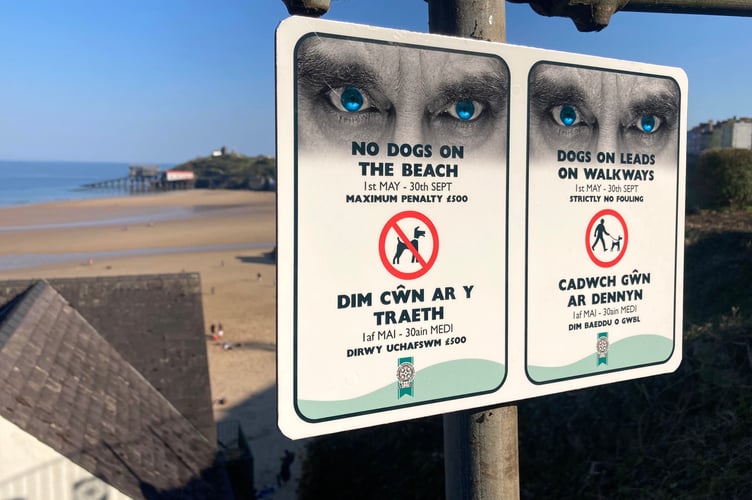
Pembrokeshire County Council have stated that its preference is to work with dog owners and educate them about the seasonal beach ban rather than taking enforcement action.
The local authority’s bye-laws prohibiting dogs from areas of certain beaches across the county during the summer season, is in force between May 1 until September 30, although councillors in Tenby recently proposed to approach PCC to look into the possibility of altering the restrictions, with Cllr Duncan Whitehurst suggesting an idea to amend the times dogs are allowed on areas such as North Beach, rather than a total prohibition for five months of the year.
Bans in other seaside resorts across the UK, such as Cornwall, only have restrictions on beaches between ‘peak times’ such as between 10 am and 6 pm.
Guide dogs of course are exempt from the restrictions.




When posed the question as to what Pembrokeshire County Council had been doing to enforce restrictions on the beaches that the ban applies to this summer by the Observer, a spokesperson for the local authority said: “Pembrokeshire is a dog friendly county but during the height of the summer some of our more popular bathing beaches have dog restrictions which are aimed at ensuring the safety and pleasure of those visiting the beaches.
“Throughout the summer the Council has an officer on the ground dealing with the summer dogs on beaches restrictions.
“The officer engages with dog owners and highlights the restrictions in place. The Authority’s preference is always to work with dog owners and explain and educate about the restrictions rather than having to take enforcement action.
“We also try to raise awareness of the restrictions through signage and communications.
“This autumn the Council will be undertaking a detailed review, following feedback from this year, which will include how we deal with environmental enforcement issues corporately in the future,” they added.
In contrast, Swansea Council told the local democracy reporter for the region, that it had issued 14 fixed penalty notices since May to owners who have ignored the restrictions, including three at Port Eynon beach on August 10.
The restrictions in Swansea apply from May 1 to September 30 at Swansea beach from the River Tawe to the former slip bridge opposite Victoria Park and from Sketty Lane to the of the slip at the West Cross Inn.
They also apply to Bracelet Bay, Limeslade Bay, Rotherslade Bay, Langland Bay, Caswell Bay, and Port Eynon beach from the eastern edge of the steps to the eastern edge of the access to Horton beach.
A Swansea Council spokesperson said: “In terms of enforcement, our aim has always been to work with pet owners to encourage them to clean up after their pets and also be mindful of the restrictions.
“The benefits of the by-law have always been to ensure families and children that are nervous around animals can feel safe when they are at the beach. It also helps us to minimise the impact of dog fouling on beaches, which sadly, occurs each year.”
In Carmarthenshire there are May 1 to September 30 restrictions at Cefn Sidan and Llansteffan beaches; with the County Council stating that breaches of its dog restriction by-laws are dealt with by a summary report to courts and not fines. But the seasonal by-law does not form part of the council’s public spaces protection orders, which allows officers to issue offenders with a fixed penalty notice.
Cllr Aled Vaughan Owen, Carmarthenshire cabinet member for climate change, decarbonisation and sustainability said: “Whilst the vast majority of dog owners are responsible, these restrictions are in place for public safety, with regards to coming into contact with toxocara in the faeces, and to provide visitors with a choice.
“Our enforcement officers patrol theses areas on a regular basis, in particular on weekends.
“We often find that those dog owners that breach the by-law are visitors to our county and are unaware of the restrictions in place. In these instances, our enforcement officers will offer words of advice and ask them to go to the non-restricted areas of the beach.”
Comments
This article has no comments yet. Be the first to leave a comment.