

Monkton Flower Festival
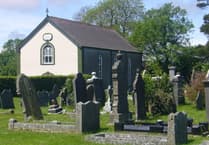
There is so much going on here during the summer and the History Society has been invited to help support several events with our exhibitions. This week is the Flower Festival at Monkton Priory Church which opened on August 10 and runs until Sunday, August 17. I admire people who can produce the beautiful flower arrangements which so enhance our churches - I could never do it! If you have not already seen it, a treat is in store with the stunning displays you will find at Monkton Priory Church. The poetry of the First World War is the theme of the festival and the work in producing the displays has been undertaken by members of the community who have each been allocated a poem for interpretation.
The Opening Service
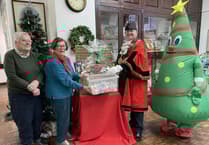
Last Sunday, August 10, the flower festival began with a service. The congregation was welcomed by Vicar Paul Nash who thanked Pembroke's Mayor and Mayoress and town councillors for their attendance. The service was then taken by guest preacher, the Venerable Graham Davies, who was formerly Archdeacon at St. David's and is an eloquent preacher. After the moving service, those assembled were welcomed to stay for refreshments whilst looking at the displays. Declaring that it almost took his breath away to see this long nave full of flowers, the Rev. Davies said he was so impressed at the shear amount of work and talent that had gone in to fill it. Likewise, Pembroke's Mayor Clr. Aaron Carey told me how impressed he was with the festival and added that he felt honoured to be asked to attend such an event in this year of commemoration, so fitting a tribute to those who made the ultimate sacrifice for their country. I spent a good hour looking at the displays, and found them really touching. Poetry has such power to evoke feelings of pathos: how well the War Poets conveyed that suffering and loss of life, the futility of it all.

The Lament by Wilfred Wilson Gibson
The P&M Local History Society committee chose this poem, a poem which questioned how those who survived the conflict could ever hope to return to a normal life, haunted by the sacrifice of so many. It begins: We who are left, how shall we look again Happily on the sun, or feel the rain, Without remembering how they who went Ungrudgingly, and spent Their all for us, loved, too, the sun and rain? That our display looks really striking is due entirely to the artistic efforts of George Lewis (who is president of our society) and his wife Jeanne, and a lot of thought went into their interpretation of the poem. The simple flower arrangement set in a tranquil rural setting is set against a backdrop of soldiers silhouetted against a red sky and ruined landscape.
For the Fallen By Laurence Binyon
This poem was interpreted by Barbara Ambrose in a stunning flower arrangement on top of the old funeral bier. It is a poem which contains probably the most famous lines in English poetry, words which are engraved on countless memorials and spoken each year on Remembrance Sunday throughout the land They shall not grow old, as we that are left grow old: Age shall not weary them, nor do the years condemn At the going down of the sun and in the morning We will remember them. The Times on July 5 carried an article on the poet Laurence Binyon, about whom I have to admit I knew nothing. He is described as a Quaker and a pacifist and he composed this poem at the very beginning of the war, a time when soldiers enthusiastically and cheerfully volunteered to fight: it was not a reaction to the massive and horrific loss of life which subsequently occurred. The poem was published in The Times just seven weeks after the war began. Binyon was 45 when war broke out: he did not serve in the trenches, but volunteered as a nursing orderly in France.
The Cenotaph By Charlotte Mew
Margaret Sercombe's flower arrangement, in which she was assisted by Ann Archibald, was particularly poignant as it was personal - her own tribute to an uncle who fell in the Great War. Philip Picton with his two brothers George and Joseph all served on the Front Line, but on February 17, 1917, he was killed. Amongst the flower arrangements, Margaret had arranged some artefacts preserved by her family. These included the book of service given to Philip's mother because she couldn't attend the memorial service herself on February 27, 1918, at the Holy Trinity Church, Sloane Street, London, and bears the inscription 'In memory of the following Officers, Non-Commissioned Officers and men of the Welsh Guards who have died in the service of their country since the formation of the Regiment on February 27, 1915." There too was the widow penny bearing Philip Picton's name; his name is also engraved on our cenotaph in front of Pembroke Castle. We shall build the Cenotaph: Victory, winged, with Peace, winged too, at the column's head. And over the stairway, at the foot - oh! here, leave desolate, passionate hands to spread Violets, roses and laurel ...
A Soldier's Kiss By Henry Chappell
Now this poem really brought tears to my eyes, a dying horse, a compassionate farewell from a soldier who comes to its aid, ignoring the shelling. Only a dying horse! he swiftly kneels, Lifts the limp head and hears the shivering sigh Kisses his friend, while down his cheek there steals Sweet pity's tear, 'Goodbye old man, Goodbye.' This was interpreted simply and effectively by Hannah Karpaty, assisted by her father Rev. Martin Cox, whom we all know as the former Vicar of this parish. In a brutal war where so many died, one cannot help, but feel pity for those horses and those which survived were horribly left behind to be butchered. It is estimated that around half a million British horses were killed and many more wounded - on all sides the death toll is put at eight million or more. We have a purple poppy to remember the animals.
A community event
I've run out of space. There are so many poems, so many lovely arrangements - best visit yourself! The festival is a credit to its organisers Mike Davies, Roger Davies, Pauline and Kenny Davies, and Joan Bessant who, as event coordinator, researched the poetry to be used. I asked Mike Davies, chairman of the flower festival committee, for his comments. He told me: "In order to restore the church building, we have to raise funds and our members felt it would be an appropriate gesture to commemorate the centenary of WW1 by the floral interpretation of poems written at that time. In this instance, Joan floated the idea and everyone took it up. The whole group has been absolutely marvellous. "We shall be closing with Songs of Praise at 6 pm on Sunday, the community choosing the hymns and delivering the readings. This really is a community effort." The festival is open from 10.30 am to 7 pm with refreshments and lunches available. All proceeds will go towards continued restoration of the church.
Contact
If you have any stories, photographs or feedback for this column, please contact me, Linda Asman, on 01646 622428, email [email protected]">[email protected] and visit our website http://www.pembrokeandmonkonhistory.org.uk">www.pembrokeandmonkonhistory.org.uk
Comments
This article has no comments yet. Be the first to leave a comment.