
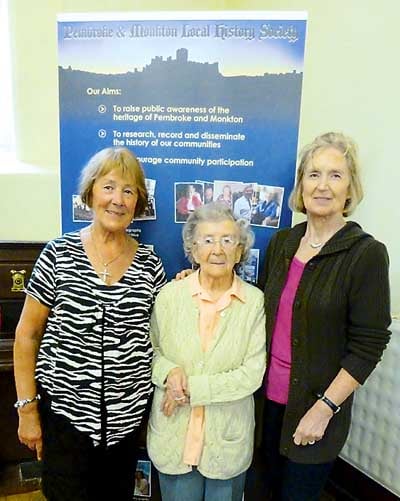
WW1 commemoration event in Pembroke
Town Hall
On August 4, 1914, Britain declared war on Germany. In a wave of popular support, huge numbers responded to the request for volunteers 'for King and Country' not only from Britain but from Australia, New Zealand and Canada. It was popularly believed that it would be all over by Christmas, but the dreadful stalemate of trench warfare locked Britain into a conflict that was to last over four years.
The impact of the Great War, which cost so many lives on a scale never before heard of, is evidenced by the war memorials in every city, town and village throughout the country. So how did Pembroke and district fare, what are the stories of those who served in the war or who supported the war effort at home?

This is what we want to discover with the launch of our World War One project tomorrow (Saturday, February 8) in Pembroke Town Hall at 10.30 am.
A Community Project
Pembroke Town Council are sponsoring this event and we are working in conjunction with Planed, who are coordinating a series of commemorative talks on the Great War and Dyfed Archaeological Trust, which has carried out a scoping study to assess the archaeological impact of WW1 in Pembrokeshire. There will be an update on this from Alice Pyper, of the Dyfed Archaeological Trust, and popular speaker Simon Hancock will be giving a talk on 'The Home Front in Pembrokeshire in World War One'.
Also supporting the event are the West Wales Maritime Heritage Society and Pembroke Civic Trust, and it is hoped other local heritage organisations will join in. We are also putting together an exhibition of local photographs taken during the First World War years and we would like to invite members of the community to bring along to the event memorabilia and photographs to scan - plus any stories and information which will enable us to increase our understanding of the impact of the war on this area.
The event will run from 10.30 am to 12.30 pm and there will be a coffee morning from 10 am, proceeds to go to Pembroke Museum. We will be opening the museum following the talks so that you can see how it is progressing - work in progress at the moment, as it is very different from the display we put on last summer.
Your Stories
Johnny Casey: Hundreds of thousands of men flocked to join the army in response to the call to arms, many among them mere children who lied about their age. One of these was Jeannette Casey's father, Johnnie Casey pictured here.
"At the outbreak of the 1914-1918 war, my father, Johnny Casey was 15 years old. However, like many other young boys, he joined the army straight away convinced it was his duty for his country. Also, there was probably some excitement at what seemed like a great adventure. Many very young boys lied about their age and were accepted into the army. My father seldom spoke about his experience in the trenches, but sometimes, when he had had a bit to drink, he would talk about 'going over the top' very frightened, but pretending he (they) were not. He did say, one of the miseries they had was that they were infested with lice. He said they would run a cigarette down the seams of their jackets to try to kill them.
"Dad told me that the soldiers believed that the senior officers of the high command would have very good dinners and then plan campaigns along with their cigars and brandy. I do not believe this, but the fact that the young soldiers did, speaks volumes of their respect for the senior officers. There were thousands of young boys in that war, all really prepared to give their lives for what they honestly believed was for their country. In the picture, he is with his mother (my grandmother), very proud of her son in his uniform - if she had known the hell he was going to, her feelings would have been very different."
William Davies: Another person to come forward with his story is Peter Davies. Peter's father William Davies joined the navy in 1910 at the age of 22 years, after completing his apprenticeship with the GWR as a boiler maker. William went into submarines and Peter was able to provide us with these photographs of WW1 submarine K22, in which his father served. I was amazed that these subs were driven by steam on the surface!
"Dad was based in Chatham, and served on the K22 and H14. The K22 started life as the K13, but having had a disaster on its Maiden Voyage, the sailors would not board her, so they changed her name. K22 was manned by a crew of 60. It was 330 foot long and had 10,000 hp geared turbo engines, with a 800 hp diesel booster for diving or surfacing, a 1400 hp electric motor and twin screws.
My father wouldn't talk a lot about the war, but occasionally he would tell me something of the actions he took part in. He served in the Dardanelles and described how they would lie in waiting for the Turkish ships to come through. The submarine would lie on the bottom during the day, surfacing at night to charge its batteries. Once on the surface, it would raise its funnels and was steam driven; then retract them to dive, an operation which took around eight minutes."
Having been in a submarine (an exhibit in a maritime museum I hasten to add) it makes me wonder how people could cope with living in such confined conditions: William was in submarines for 11 years!
"Once in the Navy, dad volunteered for the submarines," Peter told continued, "he said that the pay was better. He was fatalistic about the life though - he used to say that if your name was on it, you'd had it. And fate certainly was on his side. He had been off the K22 for just two days when she went down with all hands!
"However, he had the traumatic experience of being stuck on the seabed off Southern Ireland for nine hours and suffered with his nerves after that, an experience which affected him right through his life.
"He served all through the First World War and was eventually invalided out of the navy on October 10, 1922, with damaged ear drums.
"A boiler maker by trade, he initially found employment in the Dockyard where he worked for two years but then was given the opportunity of a tenancy at Westhill Farm by the Council. He was not really a farmer but my mother was a farmer's daughter, so they took it. I carried on farming there until my retirement."
To end on a sad note, William's medals were stolen - who could do such a thing?
Lest we forget
So many served in the forces during this terrible conflict, suffering so much and living in appalling conditions. Many never returned home. We must gather in these stories to honour them and their sacrifice - lest we forget.
Next event
We have our annual gernal meeting and members night on Friday, February 21 -George Lewis will be providing the entertainment with a lighthearted, humerous talk on 'Edwardian Inventions'. That will be in Monkton Church Hall at 7.30 pm - free entry and open to non-members as well.
Contact
If you have any stories, photographs or feedback for this column, please contact me, Linda Asman, on 01646 622428, email [email protected]">[email protected] and visit our website http://www.pembrokeandmonkonhistory.org.uk">www.pembrokeandmonkonhistory.org.uk
Comments
This article has no comments yet. Be the first to leave a comment.