
A centenary celebration
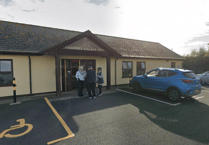
Many times I have passed by the small blue corrugated iron building near Pembroke's station and, I have to admit, given it little thought. Until last week. The building I refer to is the East End Mission Hall which held an open day last weekend to celebrate its centenary and I went to look around.
Inside, the hall is bright and welcoming and I was immediately struck by the friendly atmosphere. I was greeted by Steve Woolford who introduced himself as an elder of the church. Also there was Trevor Stinton, who is actually the grandson of William Thomas who founded the Mission 100 years ago.
My interest was roused and I later went to see Steve's father Peter Woolford, also an elder, to find out more about the history of this little church which has been rather overshadowed by the many substantial chapels and churches with which Pembroke is blessed. Peter was able to fill me in on the history of the Mission.

William Thomas
"It all began with William Thomas, a charismatic preacher who had been very active in promoting the furtherance of Christian ideals in Pembroke and in the surrounding area. A Pembrokeshire man, William Thomas was born in Gumfreston, son of a farm worker. At one time, he owned a grocer's shop in Llandstadwell, but in 1901, the census records him living in Monkton and about this time he became a rep for the Singer Sewing Machine Company.
He held open air meetings and organised regular meetings in various homes for prayer and Bible study. It is understood that, prior to building the chapel, the Mission was undertaken from a rented cottage in the East End of Pembroke.
A larger premises needed, it was eventually decided to build a chapel: land was leased from the Great Western Railway for an annual sum of £2 and 10 shillings and a fund was started to buy the building.
Many local people and especially the dock yard workers gave generously toward the work and a plea was placed by Mr. Thomas in a Christian magazine asking for donations of 2/6 (12p in today's money), towards the work.
By September 1913, a building called a Tin Tabernacle was erected at the entrance to the railway station in Pembroke."
Tin Tabernacles
What is a tin tabernacle? you may ask - as did I. Peter informed me that these buildings came in kit form, like prefabs. There were firms which specialised in these buildings made from corrugated galvanised iron and several can be seen around the area. Pembroke Dock has one, as has New Hedges. The 'kits' were assembled by the congregation. Peter showed me a very interesting book by Ian Smith on the subject which contained photographs of tin tabernacles from all around the country: some of them were really elaborate.
The Mission Hall
"The Mission was opened in 1913," Peter continued, "as the Undenominational Mission Band, popularly known as the Mission, a name which has stuck to this day. The opening service was held by the Hon Roland Phillips (son of Lord St. David's) who was later killed in the Great War".
Peter's photograph of a Mission outing printed here was taken around this time on Pembroke's East End Square. Hard to recognise now, this is the East End roundabout and the ivy covered house has long been demolished to reveal St. Michael's Hall behind. The bus is none other than the Dreadnought, Pembroke's first bus for hire owned by Knacky Stephens of the East Back Works. The East End School is hidden behind the bus. The man with the moustache on the front right of the picture is none other than William Thomas himself.
The Apostolic Church
William Thomas died in September 1925. The closure of the dockyard the following year led to his children moving away, like so many others, to seek work in the other dockyards. The work carried on but some years later the congregation decided to become associated with the Apostolic Church which took over in 1935. Here we can see a photograph of its inaugural meeting at Mount Pleasant Baptist Church which was loaned for the day as too many people were expected to attend than could be accommodated in the Mission. The minister with the glasses in the front row is Pastor P. S. Tiffin, the first Apostolic pastor in Pembroke.
Originally associated with the Ty Gwyn area in Llanelli, the Mission, since the early 1990s, now comes under Bethel in Johnstown, Carmarthen. The full-time Pastor there is Tim Howells.
A simple faith
Peter also tried to explain to me what had attracted him to the Mission. "It was for people who wanted a simple faith. I remember, shortly after having moved back to Pembroke, I happened to hear hymn singing whist passing by the Mission. I was drawn by the singing and the simplicity and sincerity of the faith I found there - I've been with the Mission ever since."
It was this which had attracted Hilda Sweet whom I met there at the Open Day. She told me she had attended the Mission as a child and loved the jolly singing. She also told me that her mother told her that she used to have meetings in her front room. Hilda remembers the church being packed out, mainly East End people who had big families then: Hilda herself was the youngest of 11 children. Born in the 1930s, religion was important.'Father was church and mother was chapel,' she told me, 'and I went to both but I liked the Mission best. There were lots of treats and we had Sunday School outings to Saundersfoot beach, where we would have penny prizes for running races. The Mission was lovely - such happy memories."
Continuing the tradition
The Tin Tabernacle continues, "if ever there is true Christianity it is here," Steve said to me, "everyone is welcome to attend our service every Sunday, at 3 pm, and we have Bible study on Wednesday evenings, at 7 pm."
I have to say, I was impressed by their sincerity and the history of this little church - I am so glad I happened to go in that day. I learnt a lot.
Sunday School at Catshole Quarry, Monkton
The travelling community have long been associated with the Mission. Peter told me that they felt a need to reach out to the community in the Quarry and bought a caravan - this was before the Quarry was done up with units and was a lovely place where local people liked to walk. They took an old ARP bell and sweets, chatted to the parents and the Sunday school grew from there.
The photograph was taken in 1961. Back row (left to right) are: Sarah Woolford, Harry Hearn (holding baby Chris), Alfie and Davey Roberts, Julie Roberts in front of Dai Palethorpe, Jimmy Cooke, Anna Woolford, Vera with Norman in front.
Amongst the children are Joey and Debbie Roberts, Dirgie, Walter and Elizabeth Boswell, Stephen Roberts.
Contact
If you have any stories, photographs or feedback for this column, please contact me, Linda Asman, on 01646 622428, email [email protected]">[email protected] and visit our website http://www.pembrokeandmonkonhistory.org.uk">www.pembrokeandmonkonhistory.org.uk
Next events
We have two events this month, both at Monkton Priory Church Hall: Today (Friday, September 13) at 7.30 pm - a talk by Edward Perkins, 'The Historic Houses of South Pembrokeshire'. Free event.
Friday, September 20, at 7.30 pm - quiz night. £3.50 includes buffet. Bring your own bottle if you wish.
Comments
This article has no comments yet. Be the first to leave a comment.