
It's the sort of thing you don't imagine happening to you - stranded across the sea, unable to get home. Well, it happened to us. After a month in Germany visiting family, we returned to the North Sea port of Esbjerg, Denmark to catch the ferry back only to find the place deserted. Apparently, the ferry had crashed into the Harwich terminal the previous week and was out of action. Talk about lack of help and support! The best they could offer us was a crossing 11 days later - unless we wanted to travel down to Dunkirk, a very long journey we couldn't quite face. It meant a long wait, but as we were travelling in our camper van at least we had our home with us and could while away the time by exploring Denmark.
Common Ground
We always look for connections on our travels, whether at home or abroad - I like to find common threads in our past which bring us somehow closer to that place. So what has Denmark in common with us over here - apart from Lurpak butter, Danish pastries and bacon? Well, Vikings of course! Those bands of heathen warriors in their longships who swept into coastal settlements in the 9th and 10th centuries hell bent on rape and pillage - although that is not quite an accurate description, as the Danes themselves are at pains to explain and as we found out when we visited some of their museums.
The Danes do much to preserve and promote their heritage and we visited some super museums, including Ribe and the National Museum at Copenhagen. Outstanding was Ladby museum where, constructed around a ship grave, you can step into a 1,000-year-old burial mound from the Viking age. The ship was mainly an imprint in the earth, a ghost ship with imprints also of the animals which were sacrificed to accompany the lord on his last journey. Then, at Trelleborg, we saw an impressive Viking fortress dating from the reign of King Harold Bluetooth in AD 980 and the reconstruction of a largeViking house, its curved walls strangely giving it an almost oval shape, resembling in some way their ships. There's nothing quite like a Viking ship, the sheer beauty of their form is amazing. A visit to Roskilde (near Copenhagen) was therefore the highlight of our trek where, reconstructed, are the remains of no less than five ships. Wow!

The Skuldelev ships
The ships date back to the later years of the 11th century, tough and troubled times. The five ships on display in the Viking Ship Hall were scuttled to form a blockade in the Roskilde Fjord near Skuldelev, to protect Roskilde which was then the capital of Denmark. They were excavated from the sea bed in 1962; thousands of pieces which were reassembled to recreate five Viking ships. What was so valuable about the find was that there were actually five different ship types, which together provide a unique impression of Viking shipbuilding skills and craftsmanship. Outside the museum, those skills are being perpetuated. Replicas of the ships are moored outside and there are living history exhibits which include a boatyard where visitors can see boatbuilding taking place. Of course, Stuart being a leading member of West Wales Maritime Heritage, was captivated - I couldn't get him away!
We went aboard the reconstructed longship 'The Sea Stallion from Glendalough'- an ocean going craft which had 60 oars and a crew of 65-70 warriors and was actually built in Ireland,the vicinity of Dublin about 1042. This replica made the journey to Ireland in 2007 via Scotland to Dublin, a six-week voyage. The return trip was made a year later.
The conquering Danes
We found much about Vikings and Danish history generally on our travels which included a visit to Kronborg Castle - 'Hamlet's Castle of Elsinore' - where people queued to have their photograph taken as Hamlet with Yorik's skull. Of greater interest here was a frieze by Lorenz Frolich depicting the Danish Kings' dominance in England. Large parts of England and Ireland were conquered and settled by them and their empire was extensive. In 1013, Swein Forkbeard took the English crown succeeded by Canute (of trying to turn back the tide fame) but after the demise of his son Hardknud in 1042, the Danish domination ended. However, in Wales, we had Rhodri Fawr 'the Great' to defeat the Vikings and drive them away. But unfortunately for us all, in 1066 England was conquered by the descendants of Normandy's Danish Viking settlers and the rest is history.
Our Viking legacy
The Vikings were great traders as well as warriors and came to settle and trade. Back in Pembrokeshire the Vikings have left their legacy in the names of our off-shore islands; Ramsey; Skokholm, Skomer, and Caldey. The village of Hubberston is named after Hubba, the Viking chief who, in the winter of 877-8, brought 23 ships into Milford Haven, which itself may derive from Melr-Fiord, the fiord with sand-banks.
I always think you can experience so much more about a place by knowing something of its past and Denmark invests much in promoting and preserving its heritage. As one Danish lady said to me: "we are a small country now, but once we had a great empire and we want people to know that". Perhaps the same could be said of Pembroke -we were once a great power and now we are a small town much in need of regeneration. I wish that we had here a county council which would help bring about our desire for a museum. The town council had put forward a bid for the empty, council-owned Northgate Street properties which could have made a fine museum, but that was not successful. Worse still, they are actually flogging off Barnard's Tower as being, in the words of the Leader of the Council 'surplus to requirements' - hard to believe! Our heritage is precious and shapes what we are. It has huge economic benefits too - a real magnet to visitors, why cannot they grasp that?
The Pembroke Museum Project
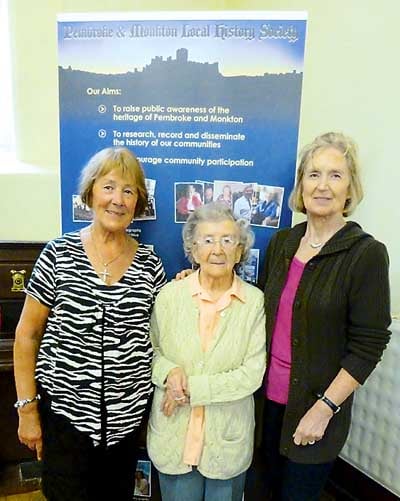
Last time, I wrote I reported on the opening of the Pembroke Museum Project in the Town Hall, a partnership between Pembroke Town Council and the community, which includes our Society, West Wales Maritime Heritage Society, the Sealed Knot and the Pembroke Civic Trust. I am pleased to say that this project is doing really well with many visitors, positive feedback and a band of volunteers to man it (ably coordinated by our secretary, Rachel Norman). The museum is in the Court Room upstairs in the Town Hall - there is a lift for disabled access - and entry is free. It is open from 10.30 am to 4 pm Monday to Friday with half-day on Wednesday from 10.30 am - 1 pm until August 30, when opening will be reassessed by Pembroke Town Council. It is purely voluntary and if anyone would like to volunteer to help man it for a couple of hours, please contact us or drop into the Town Hall to put your name on the rota.
Contact
If you have any stories or photographs for this column, please contact me, Linda Asman, on 01646 622428, email [email protected]">[email protected] and visit our website http://www.pembrokeandmonktonhistory.org.uk">www.pembrokeandmonktonhistory.org.uk
Comments
This article has no comments yet. Be the first to leave a comment.