
'Welcome to Pembroke - twinned with Bergen' - I have driven past the sign countless times but it has never really meant much to me. Where exactly is Bergen, and what actually does twinning involve? So when, as a town councillor, I had the opportunity to join a twinning visit to Bergen with Pembroke Town Council, I decided to find out and experience it for myself.
Twinning - an historical note
The visit was organised by the Pembroke Dock and Pembroke Joint Twinning and Tourism Committee, of which Clr. Aden Brinn is chairman and he explained to me what it was all about.
Since the 1960s, a close relationship developed between the German Army and the people of Pembroke and, despite its departure from Castlemartin, reunions are still held every other year.

It was this relationship which led to the signing of a partnership and twinning agreement between the then Mayor of Pembroke, Clr. Joe Gough, and Burgermeister (Mayor) Dr. W. Kothe, of Bergen, in Lower Saxony in Germany, on April 16, 1977.
Clr. Brinn is a strong advocate for the twinning process which has led to exchange visits not only by members of the council, but by school and youth groups.
He stressed that "the concept for town twinning was important then as it is today in 2013, enabling us to learn about each others cultures, languages and history. It also serves to promote international friendship enabling people in our communities of Pembroke Dock, Pembroke and Bergen to engage in the dimension of European issues which affect us all."
Off to Bergen
Back to the trip. It was dark, cold with lashings of rain when we set off from Pembroke last Monday midnight, arriving some 12 hours later in brilliant sunshine in Hamburg. (At this point I will hasten to explain that these trips are entirely at councillors' own expense - town and community councillors do everything voluntarily and are not entitled to any expenses).
We were met at the airport and conveyed to a most unlikely German hotel in Bergen named Les Desperados, decorated with Mexican cactus strewn landscapes, stuffed buffalo heads and snakes.
Back in the real world we were greeted to a warm welcome in the Stadthaus (Municipal Hall) Bergen, where we met the Burgermeister Rainer Prokop.
The hospitality we received was wonderful; lovely people, so friendly and welcoming. They organised a busy itinerary for us and we were accompanied everywhere by Katrina Hoopman who took very good care of us.
A British Base
Bergen is a town of 13,140 inhabitants according to the official website (http://www.bergen-online.de">www.bergen-online.de). However, this figure is greatly increased to around 17,000 when members of the forces and their families are included.
These soldiers occupy a NATO base and exercise on the Bergen-Hohne Training Area, the largest training ground in Europe.
So, first visit on the agenda was a tour of the Hohne Base, garrison to the 7th Army Brigade, the Desert Rats. The British liaison officer, Hugh Pearson, showed us around: he told us that it was policy to integrate British soldiers and their families with the local community and the base obviously has a huge impact on the local economy. However, it is a matter of great regret that current government policy and cuts will result in the British army pulling out in 2015; a serious loss to the district.
Visiting Belsen
Afterwards, we went on to visit that other site for which Bergen is famous: for a short distance away lies Belsen, a place synonymous with all the evil that was Hitler and the Nazi Party, but now the site of international remembrance. I have to say I felt rather apprehensive about visiting it, scenes of that horror having been etched into my consciousness from a young age.
There is nothing left of the concentration camp now; a huge open space of heathland bordered by conifers and silver birches standing out starkly in the distance. There is a feeling of peace here, interspersed with birdsong, although there is much to remind us of the horrors that took place.
The Jewish memorial was erected on the first anniversary of the relief of Belsen and bears the inscription: "Israel and the world shall remember the 30,000 Jews exterminated in the concentration camp at Bergen-Belsen at the hands of the murderous Nazis."
Around it are symbolic gravestones erected by family members of those who died there: one of these is dedicated to Margot and Anne Frank who came from Auschwitz at the beginning of November 1944 to die along with many thousands of others from typhus in March 1945.
When British troops liberated Belsen on April 15, they found thousands of unburied bodies and completely emaciated prisoners at death's door, liberation too late to save them.
Pembroke's Tribute
All around are raised areas. These turned out to be mass graves, each marked with a stone into which is carved the estimated numbers of people who lie therein - 500, 2,000, 5,000. Beyond belief. We all made our way to the Obelisk and Inscribed Wall, erected in 1948 on the order of the British occupying Forces. Here our Mayor, Mel Phillips laid a wreath on behalf of Pembroke Town Council, accompanied by Burgermeister Rainer Prokop, a moving moment which all felt deeply.
You cannot visit Belsen without feeling moved, without a feeling of incredulity: how could such a thing have happened and how can you begin to comprehend the minds of those who perpetrated it?
The German people feel it very deeply and actively keep the memory alive. In 2007, they built a new documentation centre, a massive, austere, concrete structure reflecting the grim history portrayed therein.
We were given a guided tour of the building and the exhibitions, which portray the conditions in the camp and its victims in photographs, texts and documents while at regular intervals stand screens displaying survivors telling their harrowing stories.
The Becklingen War Cemetery
We left Belsen to make our way to the Becklingen War Cemetery for another moving ceremony. Our Mayor, on behalf of Pembroke Town Council, and Clr. Brinn, on behalf of the British Legion, with the Burgermeister again in attendance, placed wreaths on the memorial, while bugler Neil MacIsaac played the Last Post so beautifully. It was so sad seeing all those brilliant white grave stones uniformly arranged in rows, so many young lives lost.
"I found both visits to be unbearable and heart breaking experiences," Mel told me afterwards.
"Having said that I do truly believe that everybody should visit these dreadful places once in their lifetime, as a reminder of man's inhumanity to man. As the great poet and author Rudyard Kipling once wrote: 'Lest we forget'.
On a lighter note...
Our short stay was thoroughly enjoyable - our German hosts looked after us well and showed us around.
We visited a local school where we were entertained by the children in their music lessons, the local police station, fire station and museum.
One of the highlights was a trip to the beautiful city of Celle, with its amazing architecture and cream cakes.
We were also invited to a reception where we met other members of the council 'Stadtrat Bergen', including the first Deputy Mayor Adolf Krause and second Deputy Mayor Marianne Kohrs.
Overdosing somewhat on their liberal hospitality, I think we all weighed more on leaving than when we arrived!
Having experienced it for myself, I have to say I am all in favour of twinning. The links between our two towns are strong and long may that last. Pembroke Town Council hopes to return the hospitality and welcome received from our Bergen friends when next they visit us in Pembroke.
Contact
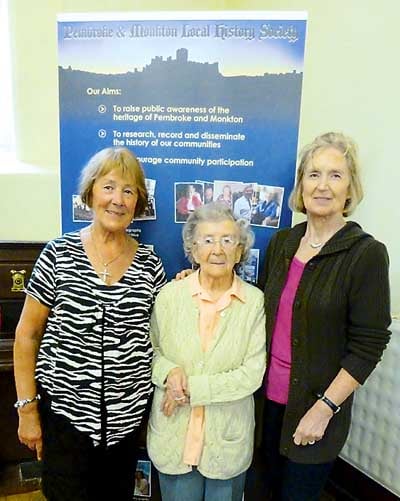
If you have any stories, photographs or feedback for this column, please contact me, Linda Asman, on 01646 622428, email [email protected]">[email protected] and visit our website http://www.pembrokeandmonkonhistory.org.uk">www.pembrokeandmonkonhistory.org.uk
Next event
Saturday, May 4, 10.30 - 12.30, at Monkton Church Hall: coffee morning with slideshow by Gordon Smith, 'The farms and buildings of the Castlemartin Range.'
Comments
This article has no comments yet. Be the first to leave a comment.