
'Pembrokeshire's contribution to early aviation history'
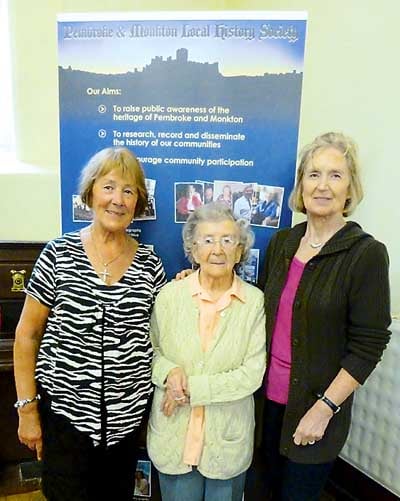
The subject of our exhibition at Saturday's local history coffee morning was 'Pembrokeshire's contribution to early aviation history'. We usually make up an exhibition on different themes to accompany the coffee mornings (which are held on the first Saturday morning of the month at Monkton Priory Church Hall) and this involves a fair bit of work. So, for a change, we borrowed an exhibition from the Pembrokeshire Museum's Service.
From Pembrokeshire to Ireland
Did you know that the first successful flight across St. George's Channel to Ireland took off from Goodwick? Well, this exhibition tells the story of that remarkable flight one hundred years ago when Denys Corbett Wilson flew his Blériot aircraft from Goodwick to Crane, near Enniscorthy, a journey of 65 miles which took one hour and 40 minutes.


For an inexperienced aviator, having only received his aviation certificate in France less than three months earlier, Corbett Wilson's journey was ambitious. Very brave too considering the flimsy craft in which he flew was built mainly of wood, fabric covering the flying surfaces. And there was no plan regarding the possibility of having to land in the sea.
The Flight
Much of the information on the display boards was conveyed in Corbett Wilson's own words; in extracts from his journals.
On Monday, April 22, he set off from Goodwick at 6 am, a large crowd having turned out to watch him take off. Visibility was good and all went well until 15 miles from the Irish coast when he ran into a squall "... after about 30 minutes the motor began to miss ..the compass was also behaving erratically, the visibility was bad ... I staggered on for another ten miles with a failing motor and just two miles from Enniscorthy decided to come down. It was still pouring when I landed and the machine was saturated. The landing chassis was somewhat damaged in its encounter with a good honest Wexford stone-faced bank. I landed in a fog and didn't realise the field was so small until it was too late. However, very little damage is done."
He made it, the first to do so but there is a sad end to his story. The Great War broke out some two years later and Corbett Wilson volunteered for the Royal Flying Corps: in May 1915 he was killed in action, shot down by enemy fire.
Many thanks to Pembrokeshire Museums Service for this very interesting exhibition which generated much interest.
And now for something different
Not wanting to end on a sad note, I am now going to tell you a love story especially for St. Valentine's Day which is on Thursday.
Turn the clock back to 1797 to the famous, or infamous, story of the French invasion of Fishguard, the last invasion of mainland Britain.
Stories of Jemima and the local ladies parading in their Welsh costume to fool the French (who mistook them for soldiers and surrendered) have passed into Pembrokeshire legend.
The victory is celebrated in the wonderful 30-foot tapestry which is displayed in Fishguard Town Hall.
Golden Prison
Pembroke too has a chapter in the tale, and a romantic one at that. The defeated army was taken prisoner and some 500 Frenchmen were imprisoned in the Golden Prison Pembroke. This was, I believe, where Golden Farm now stands on the north side of the Millpond and was the scene of a most daring escape.
In the prison was a market where the Frenchmen were allowed to eke out their very meagre rations and purchase luxuries such as ale and tobacco by the sale of models, which they carved out of wood and bone.
Now, two young Pembroke lasses by the name of Anne Beach and Eleanor Martin were employed to clean the prison and bring food to the prisoners.
On their daily visits, they would have passed through the prison market where the prisoners were trying to sell their craft work to visitors, and amongst them were two handsome young Frenchmen with whom the girls got acquainted. They fell in love.
A bold plan
The lovers devised an escape plan. Each day the girls carried, amongst the food supplies, shin bones of oxen. These were used by 30 of the prisoners to dig a sixty foot long tunnel which ran under the prison walls. The refuse buckets were then filled with the excavated soil and carried away by the girls each day when they left work. They must have been very much in love for Anne and Eleanor were taking a huge risk: discovery would have meant imprisonment and in those days justice was harsh.
When the tunnel was complete, the girls kept a look out for a boat to arrive at the Quayside. At length, a sloop came in loaded with a consignment of culm for Stackpole: the prisoners, under cover of darkness, stealthily made their way down to the water. They boarded the sloop, bound the crew hand and foot, but unfortunately the vessel was high and dry. It was impossible to get her off.
However, as luck would have it, alongside was a small yacht belonging to Lord Cawdor which they managed to launch, taking with them the compass, water casks and provisions from the sloop.
Hue and Cry
In the morning, there was a great hue and cry. Dr. Mansell a leading man in Pembroke, posted handbills over the whole country, offering 500 guineas for the recovery of the two traitorous women, alive or dead.
A few days later the stern of the yacht and other wreckage being picked up, they were presumed drowned.
They were mistaken, for the Frenchmen captured a sloop laden with corn and, abandoning the yacht, compelled the crew to carry them to France.
Happily ever after...
Apparently, the girls married their lovers: one was an engineer and he and his wife returned to Pembroke and told their story. They then went to Merthyr, and obtained employment in the mines.
This is all part of the story of Pembroke - and a good one at that. Would make a good film don't you think?
Contact
If you have any stories, photographs or feedback for this column, please contact me, Linda Asman, on 01646 622428, email [email protected]">[email protected] and visit our website http://www.pembrokeandmonkonhistory.org.uk">www.pembrokeandmonkonhistory.org.uk.
Next event
Friday, February 15 - AGM and talk by Simon Hancock 'The last man hanged in Pembrokeshire', 7.30 pm, at Monkton Priory Church Hall. Entry free and open to all.
Comments
This article has no comments yet. Be the first to leave a comment.