

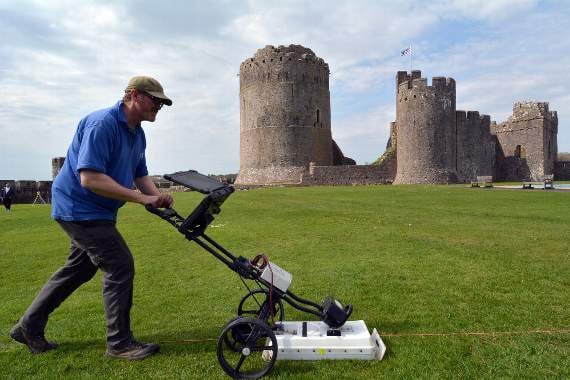
The Castle Studies Trust has awarded a grant to Neil Ludlow and Dyfed Archaeological Trust to research Pembroke Castle. Excavations and topographic survey will further advance the understanding of one of Wales’s and the UK’s most iconic castles and birth place of Henry VII.
Tantalising glimpses of what lies beneath the surface were revealed in aerial photographs in 2013, with parch marks revealing the outline of a possible late medieval double-winged hall house. This was further confirmed by geophysical surveys carried out by Dyfed Archaeological Trust, funded by the Castle Studies Trust, in 2016.
Under the guidance of well-known castle expert Neil Ludlow, Dyfed Archaeological Trust will put in two trenches to understand more about the form, date, context and function of the remains.
Additionally, they will do a topographic survey to make a detailed record of the layout of the castle.


Neil Ludlow said of Pembroke: “The geophysical survey carried out in Pembroke Castle, in 2016, funded by the Castle Studies Trust, showed a large, winged building that resembles, in plan, a late-medieval manor house. This is an unusual find within a castle, and has additional significance at Pembroke as the possible birthplace of King Henry VII.
“But this is still guesswork, as nothing else about the building is known. All we really know is that it was excavated in the 1930s without records. Thanks to the support of the Castle Studies Trust, some of these questions will be answered as well as learning more about later medieval high status living.”
Castle Studies Trust chair of trustees, Jeremy Cunnington, added: “Pembroke is a major monument, but one not in state care and therefore has not been studied in the same degree of detail as many other castles. The Trust is delighted to be able to fund further work on this iconic site and learn more about its hidden past.”
Comments
We've recently changed our login process. If you have an account for commenting, you will need to re-register on the login window.
This article has no comments yet. Be the first to leave a comment.