

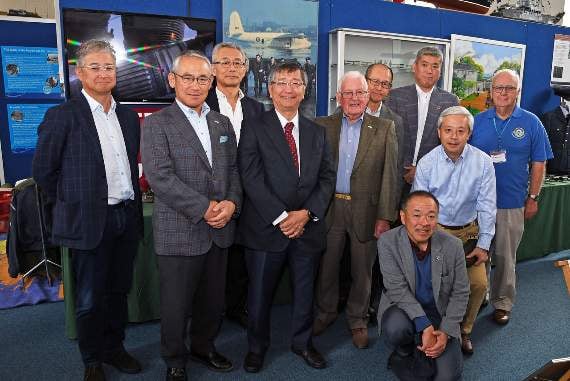
His Excellency Koji Tsuruoka - Japan’s Ambassador to the United Kingdom and a group of Japanese business men came to Pembrokeshire last week to meet David James of the West Wales Maritime Heritage Society.
The purpose of the visit which took place on July 13 was to see the new memorial to the ten Japanese sailors buried in Angle Churchyard which had been built following a campaign led by David.
Readers will know that these men died when their ship the Hiranomaru (owned by the Nippon Yusen Kaisha Line) was torpedoed by the German UB91 on the 4th October1918.
Also in the group were Isao Kano, CEO Mitsubishi Europe and Keiji Kubota Deputy Director of the Nippon Yusen Kaisha Shipping Line as well as many directors of Mitsubishi and NYK.




They met David and Angle villagers at St Marys Church in Angle and said a prayer at the Japanese grave side. They then saw the burial records in the Church.
After signing the visitors book they left Angle to go to the Heritage Centre in Pembroke Dock to see the model of the Imperial Japanese Ship Hiei of 1877.
The original ship had been built in Bufferland Pembroke Dock, one of the first warships for the Imperial Japanese Navy.
Her first Lieutenant was Heihachiro Togo, and to mark the kindnesses shown him during his stay in Pembroke Dock a ginko tree was planted in the garden of his lodging house. During David’s campaign to build the Angle memorial he mentioned the tree to several Japanese journalists who became very excited .
It seems that Heihachiro Togo had become Japan’s most famous Admiral - known as the Nelson of the East.
“To find something connected to him in Pembrokeshire, half the world away from Japan was wonderful,” said David who was instructed to obtain cuttings from the tree, pot them on, so some could be taken back to Japan to be planted in Places of Honour connected with Admiral Togo.
Staff from the National Botanic Gardens of Wales took about 30 cuttings, potted them on and are caring for them.
Meanwhile the story broke in Japan and suddenly things Welsh are of great interest there. The list of places requiring cuttings increased to include all the Japan Maritime Self Defence Forces bases, Admiral Togo’s Birthplace, temples and shrines dedicated to Him and a few other sites in Japan.
The saplings will be sent to the Japanese National Botanic Garden in Hiroshima for a quarantine period as is normal when plants are imported into a Country.
Mitsubishi and Nippon Yusen Kaisha are involved as they see this as a matter of National pride and are arranging the transportation of the saplings.
An interesting point - David James told a Japanese journalist that the Imperial Japanese Navy was born in Pembroke Dock , which appeared in the Japanese press.
The Mayor of Kure City, in Hiroshima province sent David an email saying that because the Hiei was built in Pembroke Dock his City owes its existence to Pembroke Dock.
“The Ambassador also said to me if it wasn’t for this Dockyard (Pembroke Dock ) Japan would not exist today,” added David.
Comments
This article has no comments yet. Be the first to leave a comment.