
Sir,
Thank you to my various respondents on the topic of same-sex marriage via the letters page of the Tenby Observer and personally. I believe it is important for a local newspaper to reflect what Simon Hart MP described thus in his handwritten letter to me: 'The debate has generated a huge reaction.'
Since MP Hart did not mark his letter 'Private and Confidential', I suppose I am free to quote him. In fact, our MP states that he did not see his position in voting against same-sex marriage as being 'anti-gay', but that he was opposed to the Bill arising without the Government having a mandate to introduce it when the Government was elected.
Readers may be familiar with the following anology: There is an accident in a public place, perhaps a road accident. When the police ask the 12 witnesses to this accident for their accounts of it, each account varies from the others to a great or lesser degree. For 'accident' read truth (and, as some psychologists agree, to some extent, in certain social circumstances, reality, too, can be subjective). Truth (arguably with a lower-case 't') may or may not be out there, but everyone, according to this paradigm, has their own take on it: who could claim the lion's share?



My un-named respondent comments: 'When reading a book, it's an insult to the author to say he didn't say or mean what he said! Yet people try to change the meaning of the Bible if they don't like its message.' Regarding the former, whether fiction or non-fiction is intended, I cite Wimsatt and Beardsley, 1947, in an essay on literary theory titled 'The Intentional Fallacy:' basically, the argument is that once a piece of writing comes into the public domain, readers are free to interpret it as they wish and it is invalid to discuss 'the author's intentions.' The author may have forgotten his original intentions or be dead but, in any event, interpretation is the reader's prerogative - be it post-colonial, psychoanalytic, feminist, Marxist - all the possible takes on literature offered to students. Concerning the bible, the elderly priest in my former, Cheshire parish offered us the following thought in a bibilical discussion group: that Jesus walking on the water might be easier for us to wholly take on board if we interpreted 'on the water' like 'St. Anne's-on-Sea,' where, as readers who may know this Lancashire, Fylde-coast resort, will be aware the sea is always miles out!
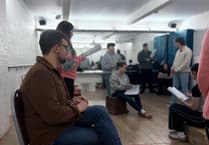
Thank you, to my anonymous respondent for directing me to the precise verse: Leviticus 19v19. And how about a Tenby Debating Society being got up? A good use for the threatened Greenhill building where Tenby Library and Community Learning Centre are currently housed? Surely, it is very important that locally, as nationally, we can have a proper arena in which to thrash out issues that affect many of us? And surely such debate is healthy.
Finally, I would merely observe how interesting it is that the avant-garde often provokes reactionary conservatism at the time, but how many of us now would, for instance, claim to be shocked by Stravinsky's 'The Rite of Spring'?
Anne Alton,
Tenby.
Please note: No more letters will be accepted on this issue at the preent time - Editor
Comments
This article has no comments yet. Be the first to leave a comment.