

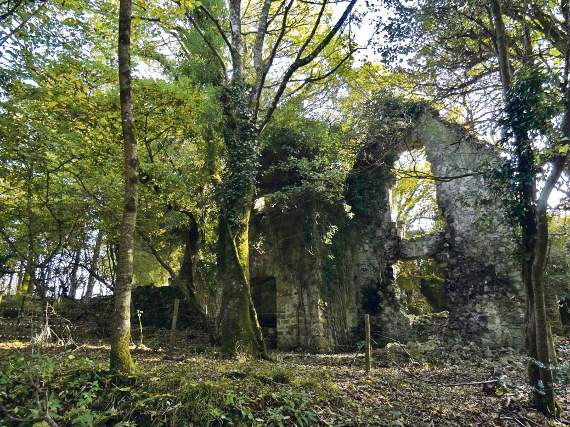
Where the road from Tenby to Gumfreston is at its lowest, a public footpath along a muddy track leads very shortly to the lovely ruins of Scotsborough House, sometimes referred to as Scotsborough Castle, though there is no sign of it having been fortified.
– By Patrick Ovenden –
A COUNTRYSIDE WALK
The ruins may also be found by following a footpath that runs down along the backs of the gardens of the estate known as Scotsborough View, off Lamack Vale, opposite Belvedere House Residential Home.
Soon the footpath crosses a stream and takes the walker up into light woodland that lines the bank of the railway. Before long the waymarkers take you into fields with fine countryside views. They are sometimes used for cattle grazing, so it is important to keep dogs on leads. At the bottom of a second field, the path turns into a track and as you come to a fork in the road, the ruin is on your left.
Other footpaths are known to lead from here to Bells Corner and New Hedges. Or if a shorter walk is required, follow the track to the Gumfreston Road, turn up Heywood Lane and avoid the dangerous part by heading through Oakridge Acres to the footpath along the side of Ysgol Hafan y Mor. The next footpath off Heywood Lane (to the right of the school) runs behind Serpentine Road and completes the circle to Scotsborough View.
HERITAGE
As well as being able to access the countryside quickly from the town, this walk is a chance for a glimpse into history. The following is what I’ve managed to find out about Scotsborough House; do let me know if you can add to these details at all.
In the early 17th century, Scotsborough House was the residence of Thomas ap Rhys (or Rees), born 1570, whose monument to his wife Margaret Mercer (died 1610) is in St. Mary’s Church.
Thomas ap Rhys, of Scotsborough, is recorded on Wikipedia as being High Sheriff of Pembrokeshire in 1610. He was, an ancestry website states, the son of Catherine Perrot, heiress to the Scotsborough estate that can be traced right back to the Mayor of Tenby in 1413, Thomas Perrot.
Thomas Perrot was the seventh peson ever to hold the title and the first under Henry V. He was most probably the grandson of Stephen Perrot, of Popton. (A much-published online article claiming that Stephen Perrot was Mayor of Tenby in 1413 appears to be inaccurate.)
“Among the records of the corporation of Tenby is a deed of John Chepman to Thomas Perrot and Alicia his wife; her name being included in the deed, as if a joint possessor of the estate with her husband. This Alice, therefore, may have been the heiress of the estate, through whom it descended to the Perrots. The document is dated Henry V [1415]…The deed conveys seven acres and three perches [1 perch = 16.5 ft] of land, within the liberty of Tenby, consisting of two parcels.” Barnwell (online extract)
According to Alison Bielski’s Tales and Traditions of Old Tenby, Philip Henry Gosse, the 19th century marine biologist, was on his way to Hean Castle in Saundersfoot when he passed Scotsborough House, already a ruin. His coachman then told him a couple of local legends:
“Do you see that ruined mansion, Sir, to the right among the trees, all covered with ivy? That is Scotsborough, the ancient seat of the famous Ap Rhys. The house is half a mile from Tenby and he could not always hear the Church-Bell; so he lined the bell with silver at his own expense, that he might hear when to go to Church. The bell now hangs outside the tower at Tenby, and anybody can see it is lined with silver.”
With Scotsborough and Trefloyne in mind, Gosse then asked what had caused the ruin of the two houses.
The coachman replied:
“Oh, Sir, that is more than I can tell. There’s many fine mansions, in all parts of Wales that now lie in ruins under the green ivy, but I have heard say that the two families that inhabited Trefloyne and Scotsborough lived by wrecking. They put false lights on the windmill at the end of the South Cliffs, just over the cavern where they used to store their plunder. This went on well-enough for a time; but it was the end of the families, for only one son of one family and the only daughter of the other, were coming home from abroad, and were wrecked through the false lights, and what is strange, the ship went ashore on the sands just opposite the mouth of the cave.”
Alison Bielski added: “The Ritec marsh was once a creek and boats were able to sail right up to Scotsborough, passing Hoyles Mouth cave. Scotsborough stands two miles to the west of Tenby and was garrisoned for King Charles in the Civil Wars.
From the BBC’s Derek Brockway in ‘Weatherman Walking’ we learn how the house fell into disuse. It was last occupied in 1824 until an epidemic of smallpox broke out. Just a few remaining
survivors managed to flee the house.
NB. When exploring paths, farmland, woodland, ruins and memorials, please park considerately, respect land that is privately owned, obey all signs, keep to paths, keep dogs on leads and stay safe.
Comments
This article has no comments yet. Be the first to leave a comment.