

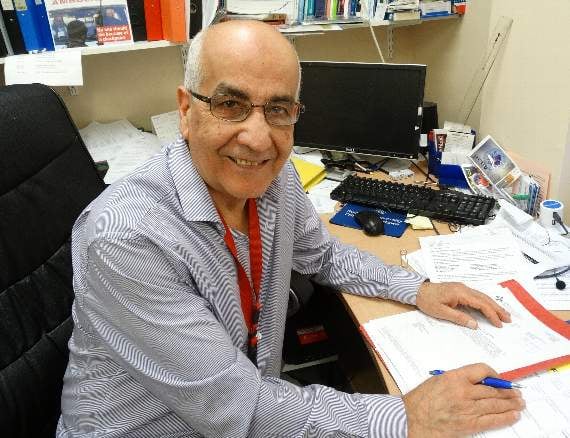
The consultant responsible for establishing bone marrow transplants in Swansea is retiring after a 47-year medical career.
Since taking up his post as a consultant haematologist at Singleton Hospital in 1982, Dr. Saad Al-Ismail (right) has treated thousands of patients from across the whole of South West Wales.
Now many of them have written heartfelt letters wishing him well for his imminent retirement and thanking him for their life-changing care.
He says it is appreciation like this - shown by patients from Bridgend to Bronglais ? that has made his time at Singleton so special.
He said: “I would say I have just done my job but I am very touched by some of the kind messages I have received and very grateful that I have been able to help people.”
When Iraqi-born Dr. Al-Ismail arrived in Swansea, he joined haematologist Dr. Mohammad Khurhid looking after patients with different blood conditions, including cancers, at Singleton, Morriston and Neath General hospitals.
“I had only intended to be here for three or four years before going back to Baghdad, but the two main reasons I stayed were the realisation of the need for good blood services and the appreciation, kindness and gratitude I was shown by patients and their families,” he said.
After Dr. Khurhid left, Dr. Al-Ismail worked initially single-handedly to develop haematology services and establish the current department which now sees six consultants, clinical specialist nurses and junior medical staff providing state-of-the-art care.
He has been instrumental in the creation of the haemophilia centre for patients with coagulation disorders and also oversaw the centralisation of clinical haematology services and parental chemotherapy services at Singleton.
Dr. Al-Ismail explained that all the changes and developments have been driven by a desire to improve care for his patients.
“I don’t believe in treating a disease, I believe in treating a person and their family. My ethos has always been to address every element, not just a blood disease.
“If you can show empathy and appreciation of what they are going through your patients will respond to that.”
Dr. Al-Ismail’s legacy also includes the Bone Marrow Transplant Unit at Singleton which marked its 20th anniversary last year.
Over the years, it has gone from strength to strength, more recently joining with Cardiff to offer a regional service that will see more people receiving bone marrow transplants in Swansea than ever before.
Dr. Saad Al-Ismail takes a look at some of the many cards and letters sent by patients wishing him well for his retirement.
So far more than 300 patients have been cared for in the BMT unit and last year the Welsh health specialised services committee, which commissions the service, approved a £793,000 investment for its expansion.
Dr. Al-Ismail said: “It started as very much a local service for Swansea and Neath Port Talbot and has now moved to a regional service, which means we can treat more people than ever before.”
During his long career, Dr. Al-Ismail has served as medical director of the South West Wales Cancer Network, is a member of the All Wales Medicine Strategy Group and the current chair of its new medicine group.
He has been involved in undergraduate and postgraduate teaching and as senior clinical tutor participated in the development of the haematology module for the Graduate Entry School of Medicine at Swansea University.
“I always wanted to be a doctor after seeing the medical care my family received. It was the only job I ever considered.”
And he says he has been very proud to be part of the NHS.
“In 1982 if we saw a 75-year-old patient with blood cancer, we would only be talking about palliative care, but now we are often looking at providing treatment for patients 10 years old than that.
“It saddens me to see the shortfalls of the NHS dominating the news. We don’t appreciate what we have - the NHS is still the envy of the rest of the world.”
Dr. Al-Ismail is now looking forward to spending more time in his adopted home of Swansea with his wife Fatin, his daughter and two young grandchildren.
He added: “I know I am leaving my patients in fantastic hands and I consider myself lucky to have worked with such a dedicated team.”
Comments
This article has no comments yet. Be the first to leave a comment.