
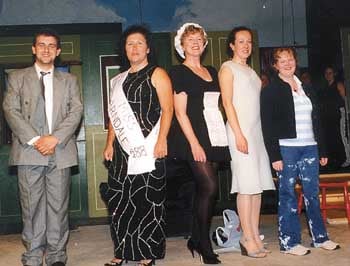
The imposing title Farndale Avenue Housing Estate Townswomen's Guild Dramatic Society Murder Mystery suggests Tenby Players' latest production is not exactly heavy drama. The fact that it was first staged at the Edinburgh Festival Fringe in 1980 confirms that it is not merely comedy.
In fact it is outrageously hilarious, virtual farce, with dialogue, situations and stage calamities to bring tears to the youngest - and oldest - eyes.
The play, by David McGillivray and Walter Zerlin Jr., presents a severe challenge to director and cast, particularly amateurs. It demands fine team work, slick timing and immaculate stage managing.
Director Len Harvey and his cast of five - four female and one lone brave male - do a fine job at the De Valence Pavilion.


.jpeg?width=209&height=140&crop=209:145,smart&quality=75)
There is nothing novel about having a play within a play, but the annual offering of this particular Townswomen's Guild company under its forceful Mrs. Bucket-like chairman, Mrs. Phoebe Reece, is doomed from the outset.
The scene and the tone for the evening is effectively set by the versatile Hilary Harvey, who plays no less than six roles. As Mrs. Reece, she immediately apologises to the audience for being caught on the hop and explains that they had had a little calamity the previous night when someone misbehaved with the tea urn. She assured us there was nothing now wrong with the water as she had passed it herself.
Her comment provokes the first of many laughs. Much of the humour emerges from a succession of hiccups. Lines get mixed up, cues are missed, sound effects are out of sync, knockers sound after people have come through the door and lights switch on when they should switch off.
Once when a character is having difficulty in locating the telephone to inform the police of a murder, the corpse obligingly whispers that it is under the table.
All the players, apart from Steve Butler as Inspector Lionel O'Reilly, have a variety of roles to play and they all portray a wide range of characters with confidence and competence.
Hilary Harvey, wife of director Len, has the biggest challenge. She switched from Clarissa Rook, first murder victim of the evening to Regine, the French maid with an alluring black costume as skimpy as her vocabulary, and from an aristocratic equestrian figure in jodhpurs and hacking jacket to the elegant Letitia in a striking black and scarlet creation with picture hat and an outsize in cigarette holders - and how elegantly she puffed.
All these in addition to her authoritative role as the Guild chairman.
Hilary has a rare gift of appearing to enjoy every part she undertakes. She used the stage cleverly and never appeared to over-act even in her final death scene.
The drawing-room of Checkmate Manor, scene of the murder mystery, is the setting for many outrageously funny incidents - people emerging through the wrong doors and the sun shining brilliantly through a window as the sound of a thunderstorm rages outside.
Corny it may be, but I was convulsed by the sight of the butler's confusion when picking up the telephone turned on the standard lamp and the 'phone rang when the lamp was switched on.
The story of the play, revolving around the murder of a number of hopeful beneficiaries of Sir Reginald Bishop's, seemed irrelevant to the sequence of side-splitting incidents.
Miranda Davies as Felicity handled difficult double roles, both male and female. She displayed all the dignity and indignity demanded as portly Pawn the Butler. The part called for excellent timing, as farce invariably does, and Miranda was never found wanting. And she drew maximum humour from the exuberant Colonel King, once emerging on stage with half of his blustery moustache on her cheek, such was the confusion of the TG presentation.
The replacing of chairs in one hilarious silent scene was so well done that not everyone could have realised that all the manoeuvring was carefully choreographed.
Newcomer Jackie Hickling, an actress of obvious experience, showed all the qualities of a St. Trinian's head girl as Daphne Bishop. She patently fell for the charms of Inspector O'Reilly. She and Steve Butler, also making his debut for the Players, figured in two of the most delightfully amusing interludes of the evening. Apart from some saucy double entendre, they exchanged a series of wonderful single-liners which did justice to an ingenious dialogue.
And they were at their best in a song and dance routine with the deep sounds of the romantic male being mimed by Daphne and Inspector O'Reilly blending in with an awe-inspiring soprano.
Another new face was that of Aine O'Connell who made an elegant Lady Bishop, but was equally at home as my lady's spinster aunt, with her blunt northern accent, and as a sophisticated colonel's wife with an intriguing little cameo as a bespectacled archaeologist thrown in for good measure.
As if the play within a play did not suffice, the company contributed a revealing fashion show telling the story of the Townswomen's Guild movement in rhythmic style, ascending to a spectacular finale with the stage hidden in a cloud of smoke.
And just as the play was reaching a dramatic climax, the chairman intervened to announce the winner of the evening's quiz competition.
It was certainly a show with a difference. More than anything else it was a team success.
Director Len Harvey not only produced the show. He designed and constructed the set and had the onerous task of handling the sound effects. Helen Wright stage-managed with the help of Rhob Pattinson, Robyn Hickling and Joni Whitfield. Leslie Rotchford was responsible for rehearsal prompt and continuity.
The attractive programme was designed by Joni Whitfield.
The production, which is sponsored by HSBC Bank, warranted a far bigger opening night audience. It is being staged every Thursday evening throughout September.