
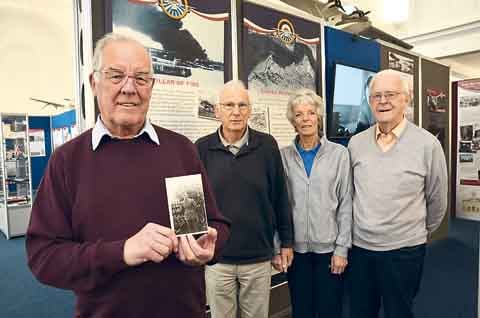
Friends who worked together at Heathrow Airport had a nostalgic reunion at Pembroke Dock's Heritage Centre recently, but their meeting also recalled a tragic chapter in the town's wartime story.
Mike and Angie Flude, of Hayscastle Cross, linked up with John Buxton and Geoff Greene, former colleagues at the airport.
It was a very poignant return for John, a regular visitor to Pembrokeshire, as it coincided with the 74th anniversary of an air raid which claimed the life of his father.
In the early hours of a November morning, German bombs fell on Bush Street and four people died, including a 34-year-old airman, Stanley Leonard Buxton, who was stationed at the local RAF station.



He was lodging with a well-known business couple, Mr. and Mrs. W. Kinton, who were also killed as bombs struck their house and damaged adjoining properties. Mr. and Mrs. Kinton ran a well-established grocery business. These were the first air raid casualties in Pembroke Dock.
A photograph of Leading Aircraftsman Buxton and other memorabilia have been donated to the Sunderland Trust, which runs the Heritage Centre, by John Buxton and are very valuable additions to the Trust's rapidly growing archive. John was only five-years-old when his father was killed.
In that November raid an estimated 30 bombs fell on Pembroke Dock. Journalist Bill Richards, in his book 'Pembrokeshire Under Fire', records that several bombs fell on the County School playing fields, three in the Memorial Park and another fell near the Llanion oil tanks - this one very luckily did not explode. Damage was also done in Co-op Lane, Prince's Street, Dockyard Avenue and alongside the Military Hospital (now South Pembs Hospital).
But it was in Bush Street where the fatalities occurred. In addition to LAC Buxton and the Kintons, Mrs. Harvey, who lived next door was killed. Her doctor husband, who had recently taken over a medical practice in the town, was seriously injured, but their baby had a miraculous escape. One story is that the child was blown onto a hook on a door and was found hanging by its clothing there, uninjured. Another lodger with the Kintons, bank clerk Mr. T. H. Clement, was also badly hurt and taken to hospital.
These first casualties were to be followed in the months to come by many more as the town endured a prolonged 'blitz', culminating in a devastating raid in May 1941.
Comments
This article has no comments yet. Be the first to leave a comment.