

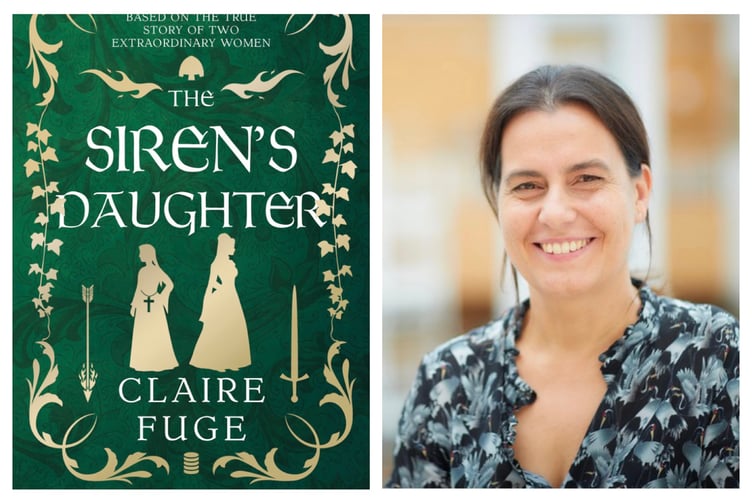
A Pembrokeshire author’s new novel based on the incredible story of a Welsh Princess who became a key figure in the Norman conquest of Wales, takes inspiration from Carew, Manorbier and Pembroke Castles.
The Siren's Daughter is set in the 1120s against the violent aftermath of the Norman conquest of Wales, and based on true events.
The book is based on the true story of 'Princess Nest', daughter of Rhys ap Tewdwr (Rhys ap Tudor Mawr), King of the Deheubarth in South Wales. Seized as hostage as a child after her father's death, Princess Nest led a tumultuous life, and had relationships with key political players of the time.
Author Claire Fuge lives near Carew where Nesta’s castle still stands, and often walks her dog around its ruins. It was hearing of the woman for whom the castle was originally built that inspired her to research her story.




The novel is based in Cardigan Castle, with scenes set in Carew, Manorbier and Pembroke Castles.
1126: The Norman conquest grips Wales. Rebellion stirs. And one woman’s choice could ignite it all.
Nineteen-year-old Angharad, the daughter of a Norman knight and a captive Welsh princess, arrives at Aberteifi Castle to face an arranged marriage. But her stepfather, the merciless Norman commander of the castle, has other plans.
He demands that Angharad expose her mother, Nesta, as a secret rebel or be cast out to die.
To survive, Angharad presses Nesta to reveal the truth about her past: as a Welsh princess stolen by invaders, the victim of wars and betrayals, the seductress of kings and princes.
Historical fiction author Claire explained: “I live near Carew in Pembrokeshire, where Nesta’s castle still stands, and I often walk my dog around its ruins. It was hearing of the woman for whom the castle was originally built that inspired me at first to research her story.
“The novel is set at the time when Nesta’s family, the descendants of Rhys ap Tewdwr, have lost their kingdom in West Wales to the Norman Conquest.

“This extraordinary family subsequently survived through hundreds of years of war, hardship, scandal and rebellion – until they finally rose up one last time, seized the throne of England…and began calling themselves the Tudors.
“I have long wanted to write a more authentic representation of medieval women than often appears in literature.
“In many novels, the women are either given unrealistic levels of agency or they fall in love with their invaders and oppressors. I wanted to explore the reality of how it must have felt to marry and have children with your country’s conquerors.
“Women are absent from most of the chronicles in this medieval era. Women’s stories, and storytelling, was therefore largely oral.
“I wanted to create a story which was, at least in part, an oral narration from one woman to another – sharing the craft of verbal storytelling which would have been such a vital part of these women’s lives.”
Published by The Book Guild, it is released on June 28.
Comments
We've recently changed our login process. If you have an account for commenting, you will need to re-register on the login window.
This article has no comments yet. Be the first to leave a comment.