
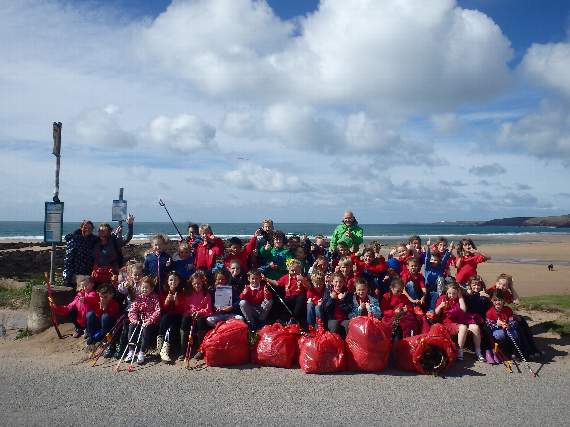
As part of the Ocean Conservancy’s International Coastal Clean-up, The Darwin Centre and Year 4 pupils at Narberth School partnered up with the Ocean Sole and Watamu Marine Association in Kenya to share data on the litter they collected on their beaches.
Narberth joined the Darwin Centre at Freshwater West and collected seven bags full of rubbish, weighing 33.91 kgs in total. All individual pieces of litter were recorded and all the information is being shared with the group in Kenya.
As well as sharing with friends in Kenya, all the data is forming part of the Ocean Conservancy’s research on marine litter globally. In 2015, as part of their citizen science experiment, over eight million kgs of plastic was retrieved from the world’s coastal fringes.
Among the litter collected at Freshwater West were 174 pieces of fishing nets, 95 bottle tops and 49 sweet wrappers.



The pupils also learned about the detrimental effects of plastic pollution in the ocean. Plastic doesn’t biodegrade like organic materials, but breaks into smaller and smaller pieces. The physical nature of plastic means that it acts like a sponge to chemical pollutants in the ocean, and as such, the tiniest bits of plastic can be consumed by the tiniest creatures in the sea. This means that plastic and the toxins it has absorbed are ingested by animals at the base of the food chain.
As larger and larger creatures feed on each other, the amount of toxins accumulates in the bodies of all manner of marine life, causing poisoning and often death.
The plastic pollution problem in our ocean has been well reported recently, with the UK and US governments set to ban cosmetics with ‘microbeads’ in order to try and reduce the ingestion of plastics in the marine food web. The BBC recently reported that around 680 tonnes of microbeads wash down our plugs and into the sea every year, and that over 280 different species of marine animal have been found to have consumed microbeads.
Comments
This article has no comments yet. Be the first to leave a comment.