
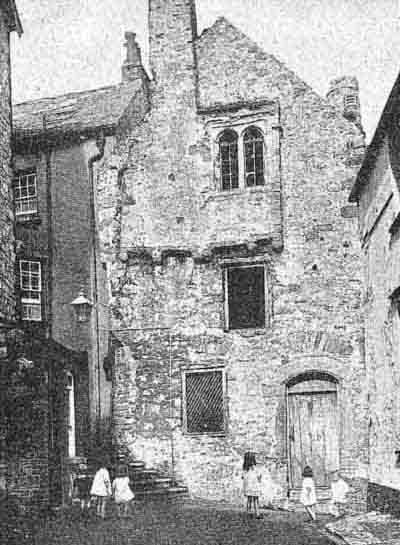
Barely out of the Great Depression and lurching towards the Second World War, international issues dominated the late 1930s landscape, so why were so many globally recognised figures focussing on one Welsh house?
Amidst the many dark concerns of the time a number of prominent Welshmen were working hard to draw national attention to the plight of one of Tenby's great landmarks in a little known episode in Welsh history.
At the head of the campaign to rescue what is now National Trust Wales's Tudor Merchant's House was Clough Williams-Ellis creator of world-famous Portmeirion.
National Trust custodian of Tudor Merchant's House Alyson Bush said: "Back in 1935, he was one of a number of high profile figures who visited Tenby and wrote to The Times expressing concern about the 'ruinous' condition of the 'Old Flemish House' as it was known then.




"The early Tudor house was described as a rare survivor and the letter suggested that 'if the building could be restored and fitted up as a merchant's house of the fifteenth century, it would be a most interesting and attractive feature and a great asset to the town'."
The state of the house had been a source of concern for many years, but only after the appeal by Tenby's Mayor Thomas Thomas, backed by renowned scholar Sir Henry Stuart-Jones and noted historian, author Herbert M Vaughan, Sir John Conway Lloyd and A. C. Raynor-Wood appeared in The Times in April 1936 was the necessary money found.
Seventy-five years ago the house was transferred into the care of the National Trust and work began to repair the fabric of the building.
Throughout its recent life, the house has had many uses - in the late 1800s there were families living on each floor and the Ministry of Defence even commandeered the house during the Second World War. The upper floors were living quarters for an officer and the ground floor a storage and cooking area. The house was also used as temporary accommodation for evacuated mothers and children.
Alyson said: "It's amazing that the interior features of the house have survived - the latrine tower and cess pit, the fireplaces on each floor - all the things that make the house special are still here today for our visitors to enjoy."
National Trust project manager Sue Hicks says: "We're very proud to be celebrating 75 years of National Trust ownership and would like to think that the Tudor Merchant's House has become the asset to Tenby that was imagined by Clough Williams-Ellis and his contemporaries back in 1935. With our on-going project to re-present the interior as the merchant would have seen it in 1500, we really have reflected that original wish."
The 75th anniversary celebrations started with a concert given by Tenby Male Choir in St. Mary's Church, Tenby, with over 200 people enjoying an excellent performance and over £1,200 being raised for the Tudor Merchant's House project.
Further celebrations will take place on Tuesday, July 24, starting at the town's Five Arches, at 10.30 am, with a trumpet fanfare by Corey Morris, a proclamation by Pembroke's Town Crier Rose Blackburn, and a procession to Tudor Merchant's House led by Tenby's Mayor Trevor Hallett and his Mace Bearers. The house will be open to the public from 11 am to 4.30 pm, followed by a barbecue at the sailing club on Tenby Harbour from 5.30 pm (weather permitting).
Comments
This article has no comments yet. Be the first to leave a comment.