
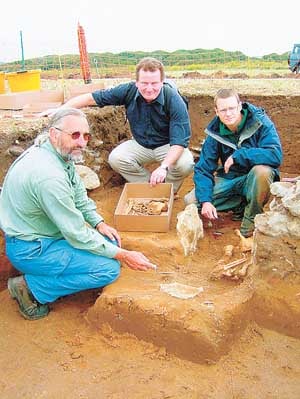
Well over a century after first being investigated by Victorian archaeologists, a site in the Pembrokeshire Coast National Park has revealed some of the most significant finds ever made in Wales.
Up to 40 well-preserved graves and evidence of an associated settlement were all found beside Brownslade Barrow on the Castlemartin Army Range. A month-long dig on the coastal site - funded by the Ministry of Defence and co-ordinated by Cambria Archaeology and the National Park Authority - proved it to be a 'fantastic site,' said Cambria's Pete Crane.
The human remains, many in stone lined cist graves, are very well preserved, thanks to the sand and limestone geology.
"Usually in Pembrokeshire you only find bone fragments in the acidic soil but here the state of preservation is superb," added Pete.


.jpeg?width=209&height=140&crop=209:145,smart&quality=75)
"The graves are laid out reverently and range from adults to an infant who was buried in a cist with a covering capstone.
"Carbon dates obtained previously from the site are from 650-960 AD. Further dating will be undertaken and it is possible that the cemetery continued into the Norman period.
"Plough marks and other features indicate that the area was under agriculture before the cemetery.
After the cemetery had gone out of use there appears to have been a high status settlement nearby given the selection of pottery, some of foreign origin, and a fragment of glazed ridge tile." Brownslade Barrow is a wellknown site, but has not been investigated since Victorian archaeologist Edward Laws and his team carried out a dig in the 1880s. He recorded that there were '200 graves stacked like pigeons in a pie.'
In recent years, a large badger sett has been disturbing the site and this year's dig aimed to protect what remained and to recover as much information as possible after the badgers had moved to a custom-built home nearby.
National Park archaeologist Polly Groom said: "We are grateful to the Ministry of Defence for funding this major project and it has certainly come up to our expectations, and more. It is a unique and very important site and deserves larger scale research. Hopefully this will take place in the future."
Joining the Cambria team on the dig were students from Cardiff University and local volunteers. The site, which is on the Army Range and has no public access, has now been filled in and a badger-proof fence erected around it. Badger digging had threatened to destroy the barrow.