

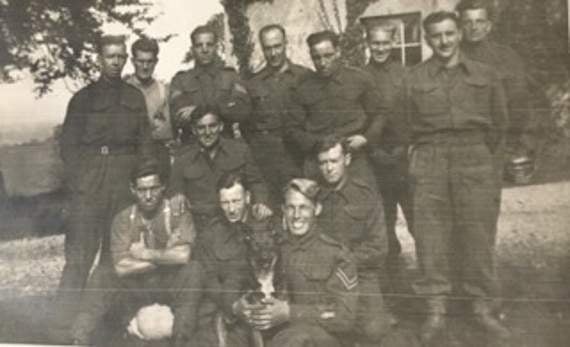
A retired headteacher is appealing for help about the story of Captain John Hannaford, the Last Bomb Disposal officer of WWII, who died aged 98, on Armistice Day 2015.
His wife of 64 years, Joyce, died a few days before.
Pat Strickson contacted his family to ask permission to write about him when she found a watercolour painting of the De La Warr Pavilion on the seafront at Bexhill-on-Sea.
“We lived in the same town, Bexhill-on-Sea, East Sussex, though sadly I never met him,” explained Pat. “I had the painting framed and it’s above my computer.

“The family provided me with his notes and war time photos.
“He worked in South Wales clearing UXBs from early 1941-to the end of 1943, based firstly at Cardiff, then Narberth. He worked around Swansea docks, in Newport and the surrounding countryside.
“John Hannaford was then sent to London to train US officers in bomb disposal, who had just entered the war. By that time, he was an experienced Bomb Disposal officer and had nearly been killed on several occasions. On his first training day, he was told there was a 10-week life expectancy for Bomb Disposal officers, but their CO assured them that the medical boffins had just discovered that bombs exploded faster than the human nervous system reacted, so not to worry, he wouldn’t feel a thing.
“Whilst away in London, he was taken ill and had major surgery on a duodenal ulcer.
“Many Bomb Disposal officers became ill in this way or had PTSD and suffered anxiety, but carried on with the job.
“John never returned to South Wales in wartime, but somehow he heard that his Section 8 had been sent on beach mine clearance to the Saundersfoot/Tenby area.
“With local historian Steven John’s help, I have found three names of Section 8 who possibly appear in the photograph, Sapper Frederick Tennison, Corporal Ronald Pacey and Sergeant Ernest Cant, who all died in a bomb explosion on Easter Monday, April 26, 1943. Where did that happen?
“The above photo had a sad message written on the back.
“That’s why I visited Saundersfoot last year. But there was no record of Bomb Disposal men being killed on their beach, though I heard some fascinating stories and was warmly welcomed by Penny Brace and their History Society.
“Any help would be great. I am nearly ready to go to the publishers, my first book, but still keep searching for answers in John’s notes and photos and then find another lead.
“The photo of the young lad made me think possibly someone might recognise him. He could still be in South Wales and remember those wonderful men as John called his Section 8.
“John believed WWII Bomb Disposal ‘were forgotten in history.’ They certainly never received recognition. No medal has yet been awarded for their dangerous work. I find that astounding and that’s what spurred me on to write John’s story. Captain John Hannaford and his fellow Bomb Disposal men deserve to be remembered. He believed they were heroes. I believe he was an unsung hero too. Their job was surely one of the most dangerous in the war, but they never left these shores and never fired a gun, but every job could have been their last.”
The book will be called Eyes Wide Open, Captain John Hannaford, The unforgettable story of the Last Bomb Disposal Officer of WWII.
Anyone who can help Pat in her research is asked to email her at [email protected]
Comments
This article has no comments yet. Be the first to leave a comment.