
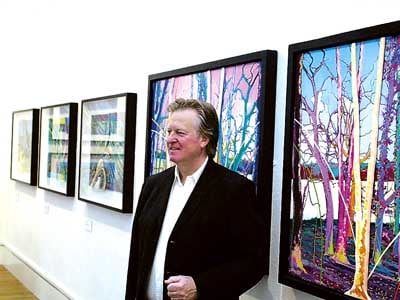
IN his bold new exhibition at Picton Castle, artist Ian Jacob offers a unique view of the Pembrokeshire landscape as he walks in the footsteps of Graham Sutherland.
With its bold execution, vibrant palette and innovative use of mixed media, Ian Jacob's work offers a fresh and arresting perspective on the landscape that sparked some of Graham Sutherland's greatest paintings.
Born and raised in the Pembrokeshire village of Llangwm, Ian has walked in Sutherland's footsteps since childhood. His intimate knowledge of the landscape surrounding his riverside home informs his latest body of work, exhibited in the same gallery that once housed many of Sutherland's Pembrokeshire paintings.
Trained at Newport College of Art, Gloucestershire College of Art and Design Goldsmiths College, London, Ian is known for his use of experimental, often ground-breaking techniques. Photography, computer imaging and the application of unconventional materials, including enamel paints, iron filings and even diamond dust, add an element of surprise; yet his experimentation is balanced by a profound grasp of colour and composition that resonates with the great British tradition of landscape painting.


For inspiration, Ian looks to a diverse range of artists working across various media - among them Andy Warhol, Tom Wesselmann, Ansel Adams and Henri Matisse. But he owes Sutherland a special debt where his latest body of work is concerned.
"Sutherland captured the environment in a very subtle way and sent signals about a deep understanding of what this landscape and its people are about - there's a ruggedness, a rawness about a lot of his work and I like that very much," he says.
He finds it easy to understand Sutherland's enduring fascination with Pembrokeshire - an area the artist famously visited several times a year from 1967 until his death in 1980.
"Pembrokeshire is a county of contrasts - in a short amount of time the weather can change from summery to bleak and wet and cold, and I think Sutherland was inspired by that."
Some of the work in Ian's exhibition takes a similar tack, recording Sam's Wood - which faces his riverside home - at various points throughout the year.
"I took photographs of the same spot two or three times a week over 12 months," he said. "Some of the paintings track how it's changed; others come from walks that I took along the shore."
These paintings employ a circular motif reminiscent of a magnifying glass to give partially abstracted glimpses of the wood's more intimate details.
"It's lifting the lid as to what's underneath the rocks and the trees," he added. "I liked the idea of exploring quite a small piece of geography from a distance and then close-up."
Ian describes the framed pictures as 'constructions.' Made using different layers of imagery and materials, they create an illusion of three dimensional space. Move around each picture and the shadows lengthen and change, creating an effect reminiscent of a mini stage set.
In the place of titles, Ian has included the gps references of the different locations featured in the paintings. These will enable anyone who buys a picture to locate the exact spot it depicts.
The show offers further close-ups, notably several prints of rhododendrons in full bloom at Picton Castle; other works record Picton Point, where Sutherland frequently worked. Like Sutherland, Ian looks set to have an enduring fascination with Pembrokeshire.
"I can see myself working in the same area for the rest of my life," he said. "The changing light here really is so evocative, you can never capture it once, you have to do it time after time - I can see myself doing lots more of these paintings."
• The exhibition will be opened at Picton Castle Gallery by Paul Davies AM at 6 pm on Friday, April 1 and runs until May 31.
Comments
This article has no comments yet. Be the first to leave a comment.