
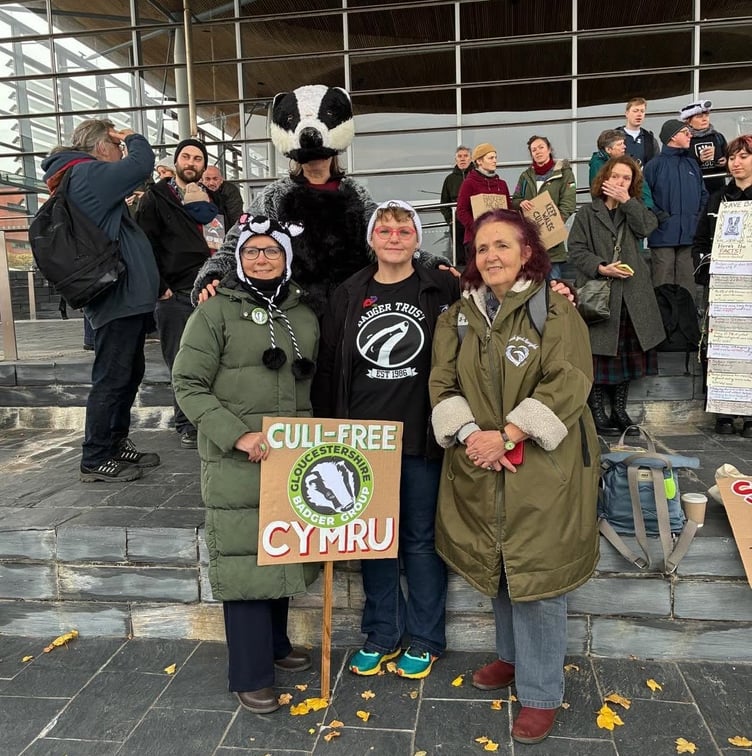
RSPCA Cymru has cautiously welcomed the Welsh Government’s announcement that a mass, non-selective, cull of badgers is not being pursued in the fight against bovine TB (bTB) in Wales - but remains concerned that wildlife could still be unnecessarily killed by the new plans.
Pembrokeshire and Ceredigion Badger Groups have also voiced their concerns, that despite the Welsh Government pledging a wider focus on cattle and protecting farming communities, the lethal control of wildlife is still not “off the table”.
RSPCA Cymru believes the Welsh Government should prioritise stringent cattle-based measures in the fight against the disease.
The charity firmly opposes badger culling in any form as a solution to tackling bTB, based on both scientific and animal welfare evidence, with evidence recognising the significant progress that has already been made in Wales in recent years without badger culling.
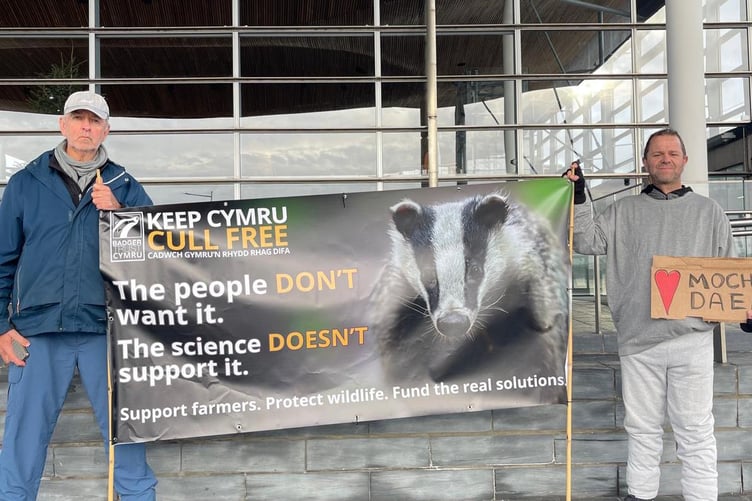
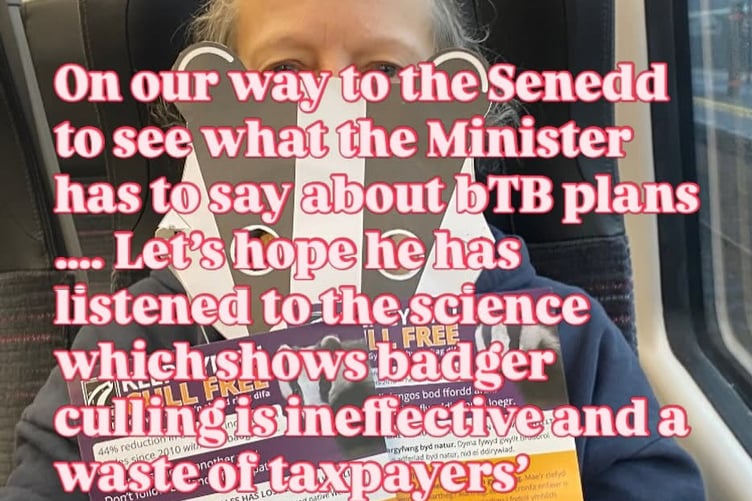
Members of Pembrokeshire and Ceredigion Badger Groups handed in a petition against badger culling signed by hundreds of local residents to the six Ceredigion Penfro MSs at the Senedd, as the Welsh Government announced its new bovine TB (bTB) policy on November 24.
Welsh Cabinet Minister for Rural Resilience and Sustainability, Llŷr Gruffydd described stronger controls on cattle, people and wildlife as the bTB policy’s three pillars.
In his announcement though, the Minister failed to mention any measures to tackle bTB bacteria-laden slurry, which contributes to the contamination of cattle feed, fields, rivers and wildlife.
A spokesperson for the Pembrokeshire and Ceredigion Badger Groups stated: “Despite headlines suggesting otherwise, badger group members were horrified to hear the wildlife controls still do include killing badgers, and could begin soon.
“The case for killing badgers in Wales has not been made. Killing badgers will not deliver benefits beyond those achievable through better cattle testing, biosecurity and herd controls.



“Any proposal to kill wildlife must publish and explain the evidence used for justification, which is not clear from its published papers, and be subject to transparent scrutiny and meaningful public engagement.”
Wales has already cut cattle herd TB prevalence by 44.9% since 2009 without badger culling, and today, 96% of Welsh herds are TB-free. Badger groups are calling on the Government to build on that progress through cattle-focused disease control rather than badger culling. Wales should not follow England’s failed path of killing badgers.
The spokesperson continued: “In Pembrokeshire and Ceredigion our badger group members are trying to get this message out - it is bovine Tuberculosis which is the enemy, not badgers.
“We want to see wildlife protected, farmers supported and the real solution funded properly: Together with the Badger Trust and badger groups across Wales we therefore call on the Welsh Government to abandon any proposals to kill badgers or other wildlife and focus instead on the real problem: bovine TB in cattle.
“To do this Minister Gruffydd could invest in improved testing, closer collaboration between farmers and vets, and financial and mental health support for affected farms, instead of using taxpayers’ money to pay for expensive badger killing measures. We would like to see protection of farming livelihoods and protection of wildlife as shared goals.
“If you believe killing badgers is wrong, or simply want to celebrate this incredible native animal, please join us and help protect badgers in Wales.”
RSPCA Cymru states that scientific evidence increasingly demonstrates that cattle measures are critically important in any strategy against TB, with Wales having achieved 96% TB-free status without culling any badgers.
The Welsh Government has also published recommendations from the Bovine TB Eradication Programme Board and advice from the Technical Advisory Group alongside its next steps to tackle the disease.
The Technical Advisory Group (TAG) acknowledges that the effects of culling cannot be separated from cattle measures introduced at the same time. The group also recommends further research where knowledge gaps remain.
Furthermore, TAG rightly acknowledges the welfare concerns associated with culling. During industry-led culls in England, over 20% of badgers killed suffered an inhumane death, with a small number of shooting events monitored.
According to UK Government data, between 2013 and 2024, less than 1% of controlled shoots were monitored.
A spokesperson for RSPCA Cymru said: “In his statement the Cabinet Minister Mr Gruffydd, said that the Welsh Government will start to act on the Board's advice now “while carrying out further work in parallel”.
“Positively, the Cabinet Minister also confirmed a mass, non-selective, cull of badgers “is not being pursued”.
“However, the Welsh Government said action will be taken on TB in wildlife - suggesting some ‘targeted’ culling could still happen.”
Billie-Jade Thomas, Senior Public Affairs Manager for RSPCA Cymru, said: “We cautiously welcome the majority of the statement, especially a commitment against a mass cull of badgers - and we’re so grateful to our supporters who have made their voice heard and helped make this happen.
“However, the fight has not been won yet. The killing of wildlife is not off the table, which is a concern. The Welsh Government must prioritise a science-led, cattle-focussed approach towards combating this awful disease.
“While a range of wildlife can carry bovine TB - including badgers - the vast majority of transmission is between herds. That’s why we are concerned by the Welsh Government singling out ‘targeted and proportionate interventions’ in relation to wildlife, and we will seek assurances that the killing of any healthy wildlife will not be taking place in Wales under any circumstances.
“The Welsh Government must look beyond unnecessary wildlife interventions given there are highly effective cattle measures available, grounded in science, and already proving so successful in Wales.”
In addition the charity believes that the international consensus principles for ethical wildlife management are key to any successful approach.
The principles state the lethal control of a species should be the very last resort and only when all other methods have failed.
Billie continued: “Ethical principles make it clear that lethal intervention should be the last option and only in exceptional circumstances, with clear, time-bound objectives as part of a systematic plan.
“We strongly urge any new approach to tackling Bovine TB to focus on cattle-based measures that are more cost-effective and have been proven to work, as opposed to killing wildlife unnecessarily and inhumanely, which so clearly goes against international ethical principles for wildlife management.”
Recent polling from the RSPCA revealed that nearly half (46%) of the Welsh population categorically oppose badger culling, while only 27% of people actively support the method.
Meanwhile, the polling also shows that 98% of people in Wales consider protecting Welsh wildlife to be important, with badgers among our most treasured species.
“Badgers are such wonderful creatures and, like all wildlife, deserve to be treated with kindness and respect,” added Billie.
In RSPCA Cymru’s manifesto for the seventh Senedd - ‘Securing A Better Future For Animal Welfare in Wales’ - the charity highlighted how animal welfare can be improved and prioritised by the Welsh Government, the now expanded number of Senedd Members and political parties across Wales.
Wildlife protection organisation Protect the Wild welcomed the announcement by the Welsh Government ruling out a mass, non-selective badger cull in Wales, following months of sustained public pressure.
However, the organisation warns that the fight to protect badgers is not over, as ministers have left the door open to the targeted killing of badgers.
A spokesperson for Protect the Wild said: “While confirming that Wales will not introduce the widespread, England-style culling that has killed hundreds of thousands of badgers since 2013, the response states that ministers intend to carry out further fieldwork and population surveys.
“Crucially, it leaves open the possibility of trapping badgers, testing them for bovine TB, and either vaccinating and releasing them or "removing" them from the population.”
Protect the Wild emphasises that bovine TB is already declining in Wales without a cull. According to the Welsh Government’s own figures for the year to June 2026, new cattle herd TB incidents fell by 22.6%, cattle slaughtered following testing dropped by 22.6%, and 95.7% of Welsh cattle herds were officially TB-free.
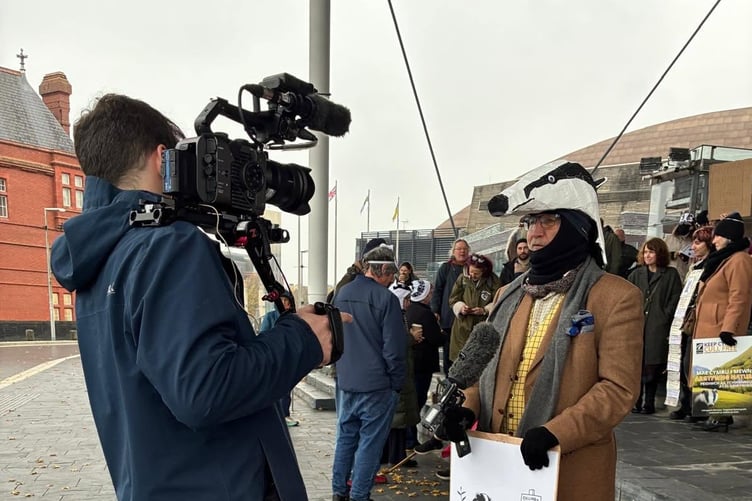
The announcement follows an intensive campaign by Protect the Wild, Dyfi Badger Group, Badger Trust, scientists, local campaigners, and tens of thousands of members of the public - including a Senedd petition opposing culling that garnered over 28,000 signatures and a protest outside the Senedd.
Rob Pownall, Founder of Protect the Wild, said: "The confirmation that the Welsh Government will not pursue a mass badger cull is an enormous relief and a testament to the tens of thousands of people who refused to stay silent. It means Wales will avoid the widespread slaughter that has devastated badger populations across England.
"However, we cannot declare this campaign completely won while the killing of badgers remains on the table. Calling it ‘targeted removal’ does not change the reality for an animal trapped in a cage and killed. Badgers are not the architects of the cattle farming industry, and they should not be made scapegoats for disease spread within human-created systems.
"With Welsh Government data showing that bovine TB is already falling significantly without culling, ministers must now reject any new lethal programmes and focus entirely on non-lethal solutions—including stronger biosecurity, better cattle testing, and vaccination,” he added.
Protect the Wild is calling on the Welsh Government to ensure full transparency regarding its upcoming wildlife research and to commit permanently to non-lethal bovine TB control measures.
The Welsh Government said that it would take a ‘New and pragmatic’ approach to help Wales become TB free that is evidence-based and science-led, incorporating the three pillars of cattle, people and wildlife, which reflects its Programme for Government commitment.
Cabinet Minister for Rural Resilience and Sustainability, Llyr Gruffydd, said: “Bovine TB remains one of the most serious animal health challenges facing Wales. For farming families, a TB breakdown can mean months or years of restrictions, uncertainty and difficult choices.
“Nearly 96% of herds in Wales are now TB free. However, on current progress, Wales is unlikely to be Officially TB Free by 2041.
“The status quo is not an option. That’s why we are taking a new and pragmatic approach to eradicating bovine TB. We will not stand by while farmers face uncertainty and anxiety, nor will we pursue a mass non-selective cull.
"Instead, we will be taking evidence-based and science-led action, incorporating the three pillars of cattle, people and wildlife. Where there is evidence of infection threatening farmers’ herds and consequently their livelihoods, we will intervene.
“Farmers and the public will rightly judge us on whether we prevent disease, and reduce its impact, even when the decisions are difficult. Progress will depend on partnership and sustained effort and action by all, towards the common goal we all share of a TB-free Wales.”
Welsh Government’s three pillars of cattle, people and wildlife:
• Cattle: An approach will be developed so that farmers with persistent TB breakdowns, and their vets, will be able to choose an approach that tailors biosecurity and managing out high-risk cattle, learning lessons from trial projects in Pembrokeshire, North Wales and Nant y Garth. Reducing the length of time herds stay under restriction is a priority. It will also ease the strain on farming families' wellbeing.
The Welsh Government will also bring forward options for diagnostic testing to spot infection earlier, while keeping statutory skin testing. It will also explore safe ways to move cattle out of TB restricted herds.
As part of this, farmers and vets will get better information on the TB status and disease risk of cattle, including those they plan to buy.
• People: Approaches for farmers and vets to receive proactive support will be developed, rather than only after a TB breakdown has occurred.
Farmers, private vets, the Animal and Plant Health Agency (APHA) and Welsh Government will work more closely - using local knowledge to manage disease.
• Wildlife: The Welsh Government is not pursuing a mass, non-selective, cull of badgers. But action will be taken on TB in wildlife.
Targeted, proportionate options - where evidence supports them – will be developed, guided by the principle that intervention should follow the disease. This may include testing, vaccination and removal or release where the evidence supports this.
New badger population surveys and fieldwork will add to the evidence. Work on the role of deer will do the same.
Pembrokeshire and Ceredigion Badger Groups are affiliated members of the Badger Trust of Wales and England.
You can volunteer, donate, support their local sett surveys and badger rescue work, or campaign by sharing information with your local councillors and Members of the Senedd to oppose badger culling and demand better support for farmers and cattle-focused disease control.
Further information can be found here: www.pembrokeshirebadgergroup.wales and also at: www.ceredigionbadgergroup.org
Find other Welsh Badger Groups here: www.badgertrust.org.uk/badger-groups
For more information about badgers please visit the RSPCA website, which includes information about badgers and the current law
Comments
We've recently changed our login process. If you have an account for commenting, you will need to re-register on the login window.
This article has no comments yet. Be the first to leave a comment.