
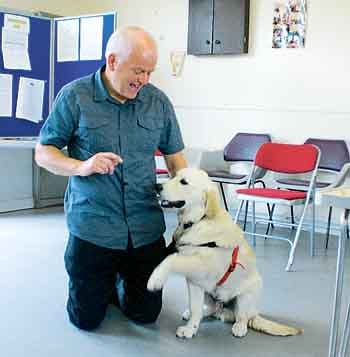
On Monday, members of the Tenby and District Branch of the U3A were treated to a most interesting and informative talk from Rod Haynes, a local dog trainer, as well as a dog psychologist and behaviourist.




Rod began his career in the police force in 1990 working as a trainer of dog handlers and general purpose police dogs. In 1996, he was promoted to a branch of the force dealing with explosives search, and in this capacity he looked after various conferences and also the Commonwealth Games. As terrorists are always altering their methods of causing mayhem with explosives, the police have to follow suit and alter their strategies accordingly. Rod pointed out that with the advent of explosives which could be manufactured out of ordinary, but extremely volatile, ingredients, dogs could easily be harmed in their searching, so they were trained by putting minute amounts of the ingredient onto small cotton pads for the dogs to familiarise themselves with.
Another problem was to get the dogs to search methodically, a difficult task as anyone familiar with canine behaviour will know, and it was trying to work out a method of doing this that got Rod interested in the psychology of dogs. As a result, he altered his training methods to a reward-based strategy known as 'operant conditioning', which he found was far more successful.
He is a firm believer that training has to be fun, above all. Dogs are skilled at sensing their owners' moods, just as in the wild they will feed off each other's signals to know how to respond. If you lighten up when training your dog, he will take his cue from you, and you will find him much more responsive.
Rod went on to do an advanced dog psychology course, and he outlined the various methods different trainers use. Dog training is very opinion based, person to person, dog to dog, he said. Caesar Milan, whom most of us have watched work his miracles on various troublesome dogs, bases his training on 'calm assertiveness', and he is undoubtedly very successful, though we are often left wondering how ordinary owners can replicate his methods. We were shown a video clip in which a dog he has 'subdued' then bites him. The issue with the dog was that it was 'resource guarding', protecting its food, and Caesar tried to take its bowl away by dominating the animal. Rod feels that trainers should never challenge aggression, but rather work at training aggression out of the dog, and he gave us several pointers as to how to do that, as well as the titles of some books which he recommends to dog trainers and owners.
It was a fascinating talk, and Rod spent a considerable time answering questions from members who had problems with their best friends or wanted to understand their behaviour better. Many of those present went home to look at their dogs with new eyes.
Comments
This article has no comments yet. Be the first to leave a comment.