

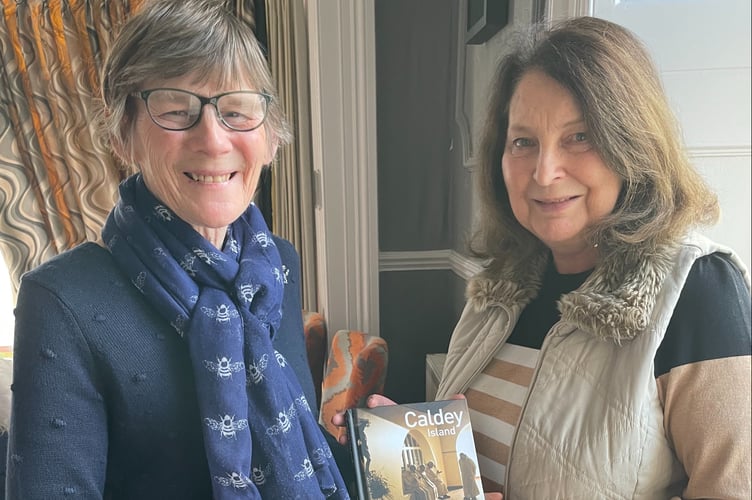
President Jane Davies was delighted to welcome Vicky Tomlinson to the March meeting of Narberth Ladies Probus Club. Vicky spent many of her childhood summers in the 1960s staying in a cottage in Tenby which looked directly at Caldey and this inspired her life-long love of the island.
Vicky began her presentation by referencing the famous monologue from As You Like It concerning the seven ages of man, as she had divided the island’s history into seven ages, commencing with its Pre-Historic origins. The Old Red Sandstone rocks on the north were formed some 400 million years ago and the Carboniferous Limestone rocks on the south, facing Tenby, were formed some 375 million years ago. It wasn’t cut off from the mainland until about 5,000 years ago. Mammoth bones from such animals have been found on Caldey and some are displayed in Tenby museum and in the island’s little post office shop.
Caldey’s second age is that of the Celtic Saints, from approximately 500 to 900 AD. Ynys Byr, refers to the first Celtic abbot, St Pyr. He is largely remembered for his unfortunate death when, while allegedly inebriated, he fell into an island well. He was succeeded as abbot by St. Samson whose statue is on the island near the current monastery. Another Celtic saint linked to the island is St Dubricius whose name is inscribed on a stone now located in the old Priory in the 4th to 6th century Irish script known as Ogham.
The third age of the island covers a period from the Normans to the Reformation. In 1113 Henry I gifted Caldey to Robert Fitzmartin. He gifted it to his mother and she gifted it to St. Dogmael’sAbbey, a Benedictine order. Following this, between the 12th and 14th centuries, the Old Priory was built, along with a watchtower.

The fourth phase spans the 1500’s to 1700’s. Henry VIII leased both Caldey and St. Dogmael’s to private hands. During the 16th century farming would have continued with tenant farmers. In the 18th century the island was bought for £3,000 by the Earl of Warwick. Some years later it passed to Thomas Kynaston of Pembroke in 1798 and that marks the beginning of the fifth age of the island’s history.
This marked was the beginning of an industrial age for the island. The Kynaston family owned the island from 1798 to 1867. During this period a mansion was built for the family adjoining the old priory. Other developments included the building of the lighthouse in 1828. The family developed both the farming potential and the quarrying of limestone from both Caldey and St Margaret’s. The island was sold in 1867 to James Hawksley. The Hawksley family developed a market garden with greenhouses and exported their produce to wholesalers in Swansea, Tenby and Pembroke.
In 1894 the island was sold to T.S. Cunningham for £12,750. He sold it 3 years later to Revd Dom Bushell for £12,000. The 9 year ownership by Revd Bushell marked a transition into Caldey’s sixth age when Revd Bushell invited Aelred Carlyle, to visit the island in 1900 with some of his fellow brothers to help with the farm work. Aelred Carlyle was a high church Anglican with a dream of becoming abbot of the first Benedictine Anglican abbey to operate in Britain since the Reformation.
The island came up for sale in 1906, and Carlyle used his charm to negotiate the purchase from Rev’d. Bushell at a price of £12,000 of which £8,000 was left outstanding on a 3 year loan. In the seven years leading to the outbreak of WWI he succeeded in building a guest house, St Philomena’s, workman’s cottages, a steward’s house, a shop, clubroom and the current monastery building, along with a road system, sewerage, a new jetty for the quarry and even an electricity supply.
However, by the 1920’s Caldey was in debt to the tune of £21,000. In 1925 the Catholic Church arranged for the Order of Reformed Cistercians to buy it. The community on Caldey were given 3 years to try to get their finances in order. They were unable to do so and in 1929 those who remained left Caldey for Prinknash Abbey in Gloucestershire. Caldey was then adopted as a daughter house by a Cistercian Abbey in Belgium which sent over a community of 13 Cistercians from Belgium, whose order remains there today.
Vicky concluded with a brief look at the 7th and current age in Caldey’s long history. The people of Tenby may have been a bit mystified by the arrival of the foreign Cistercian community on the island. However with the arrival of Brother Thomas in 1932, barriers were broken down and friendships slowly formed. Tourism has replaced farming and most animals on the island are kept for grazing management rather than for livestock farming. Whether it is seal watching or spotting the recently introduced red squirrels, there are lots of wildlife delights to enjoy, along with Caldey’s rich history.
President Jane thanked Vicky for a most interesting and beautifully illustrated talk.
The next meeting will be on Friday, April 1 at The Plas Hyfryd Hotel at 11 am – new members are always welcome.
Comments
This article has no comments yet. Be the first to leave a comment.