'The Art of Graham Sutherland', an exhibition sponsored by Chevron Texaco and The Friends of Tenby Museum and Art Gallery, opens at Tenby Museum and Art Gallery, tomorrow (Saturday). Following his death in 1980 Graham Sutherland's artistic reputation suffered a decline in attention and his work was seldom the subject of major exhibitions despite the fact that he is represented in public collections throughout Britain and elsewhere. The closure of the Sutherland Gallery at Picton Castle in 1995, denied the art appreciating public an opportunity to see a wealth of work by an artist who, during a long career, spent extensive periods in the county, gaining inspiration from the surrounding landscape. In more recent times however, there would appear to be a growing revival of interest in Sutherland's art. A major exhibition 'Graham Sutherland: nature into art' was presented at the Glynn Vivian Art Gallery, Swansea in 2004, in collaboration with the National Museums and Galleries of Wales. In 2005, another substantial exhibition of the artist's work 'Graham Sutherland, landscapes, war scenes, portraits, 1924-1950' is being held at the Dulwich Picture Gallery, London. There are also plans to build a gallery in Sutherland's name at St. Davids; negotiations for this project are on-going. In selecting work for this exhibition, it is Tenby Museum and Art Gallery's intention to introduce some key examples of Sutherland's work to visitors who may not have had an opportunity to see the diversity of this artist's aesthetic ability, his invention and the surprise and thrill of his use of colour. 'The Art of Graham Sutherland' contains examples of some of the artist's finest works, ranging from his early landscape etchings of the 1920s in the romantic tradition, his work as an official war artist, to his striking post-war abstractions and later poignant works with religious themes. The exhibition also contains a number of works displaying powerful and persuasive elements pursued by the artist in his response to the Pembrokeshire landscape, illustrating the manner in which he incorporated his experiences as essential themes, allowing him to develop from the late 1960s new significant environmental and ecological issues. Tenby Museum and Art Gallery sincerely hopes the works presented will both delight and surprise the visiting public and that this exhibition will further assist in the current reappraisal of the achievement and status of Graham Sutherland as one of the greatest British artists of the 20th century. The exhibition is drawn from collections of the National Museums and Galleries of Wales, The Pallant House Gallery, Chichester, and from a private collection. The trustees of the museum gratefully acknowledge the support of all those who have loaned works of art and also wish to express their thanks to the exhibition's sponsors Chevron Texaco and the Friends of Tenby Museum and Art Gallery. The exhibition runs until October 2. • Graham Sutherland is the most distinguished and the most original artist of the mid 20th century... No other English painter can compare with Sutherland in the subtlety of his vision, the forcefulness of his imagery and the sureness of his touch. Also there is none whose sensibility and inspiration are so unmistakably and naturally English, yet whose handling and technical approach are so authoritative, modern and European'. Douglas Cooper, 1961. Graham Sutherland's art has been remarkable for the vocabulary of flatly drawn, opaquely coloured shapes with which he has described the forms of natural objects in landscape while at the same time evoking a world of internal fantasy... It was a creative transformation, such as all good art accomplishes, and it worked... A hitherto invisible element in the commonplace had been made visible'. Patrick Heron, 1956.
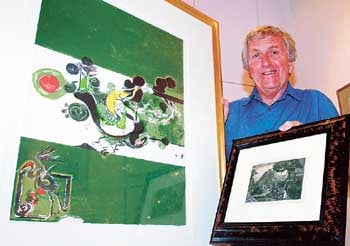
John Beynon with paintings for the exhibition. Pic. Gareth Davies Photography