The item chosen in September's 'Object of the Month' at Tenby Museum and Art Gallery is a piece of apparatus known, variously, as a 'waywiser', 'hodometer', an 'odometer', a 'perambulator' - or quite simply a 'mile-measuring wheel'. The waywiser was an apparatus formerly used for measuring distances. It consisted normally of a large wooden wheel with an iron tyre, to which a handle was attached, on a garden roller. On the handle was fixed a clock, the dial arranged upside-down, so that the person pushing the waywiser could read the distances. Usually the clock had two hands, actuated by a simple mechanism connected to the wheel, which measured on the dial the distances traversed. The dials of 18th and 19th century waywisers - and the majority of the few survivals date from that period - are normally engraved with two concentric rings, divided into yards, or links and poles, chains, furlongs and miles, or into yards, poles and miles. A few elaborate clocks have a small inner dial, like a seconds dial on a watch, with a separate hand for registering the miles. The waywiser, therefore, was essentially the product of a woodworker - more often a joiner or cabinetmaker than a wheelwright - in partnership with a clock or more general scientific instrument maker. It is the latter's name which is usually engraved upon the dial. The engraving of the dial and the shaping, and sometimes perforations, of the hands follow the fashion in clocks, varying from simple to elaborate, and the dials may be polished brass or silver. Waywisers for estate measuring are of lighter construction than those for setting up milestones on the roads. In the former, the wheels and handles are usually gracefully constructed of mahogany and polished. The latter, designed for much heavier use, are of elm, ash, or oak, or a mixture of hardwoods, and were originally varnished or painted. Most of the estate waywisers appear to have been made in London. The museum's instrument, which was donated to the collection in 1896, was made some 40 years earlier by the London firm of Troughton and Sims of Charlton, at the time a suburb of London. During the time that they were made and used, waywisers were also known as hodometers, odometers, and perambulators. Perambulator was an excellent name, because from the 16th century or earlier, to perambulate, or a perambulation, meant a ceremonial walk round a forest, manor, parish, or holding for the purpose of recording its boundaries or extent. The Victorians, with their love of romantic misnaming, transferred the word perambulator into a name for a child's push carriage. The earliest known reproduction of a land surveyor's carriage for measuring distances occurs in Vitruvius's De Archttectura of 1511. It is an elaborately ornamented, chariot-like vehicle. Additional to the two wheels on which it was drawn, it had a toothed wheel, the revolutions of which were recorded by the dropping of a pebble through a hole into a receptacle beneath at each thousand revolutions. Some authorities state that the single wheel waywiser with clock was invented at the end of the 17th century, but it was known some years earlier. John Evelyn recorded in his Diary, on August 6, 1657: "I went to see Col. Blount, who shewed me the application of the way-wiser to a coach, exactly measuring the miles, and shewing them by an index as we went on. It had three circles, one pointing to number of rods, another to miles, by ten to 1,000, with all the subdivisions of quarters; very pretty and useful." A novel type of perambulator was invented by Richard Lovell Edgeworth, in 1767. Edgeworth submitted his idea to the Royal Society of Arts, who awarded him a medal. The invention, of which a drawing still exists, was a curious one. It consisted of a hub on a threaded rod, and had 11 spokes, but no rim - in fact, it was a rimless wheel, measuring a pole in circumference. It had no clock, and was pushed along the road, its revolutions being recorded by means of its passage along the screw thread. 'Blind Jack of Knaresborough' (John Metcalf 1717 – 1810) was a famous character who made or remade many roads in the north of England, employing, it is said, up to 400 navvies. He carried out his own surveys, using a waywiser which had raised markings on its dial. His instrument is now at Knaresborough Castle. Another, reputed to have been used by him, is in the Wakeman's House, Ripon. Dorothy Wordsworth, the poet's sister, was a well-known trundler of perambulators, and several references to her road distance measuring occur in the Pinney Papers for 1796. Other references of about the same date show that surveying of estates and gardens was a fashionable pastime for ladies. Tenby Museum's waywiser will be displayed in 'The Story of Tenby' gallery throughout September. The museum is open every day 10 am - 5 pm (last admission 4.30 pm).
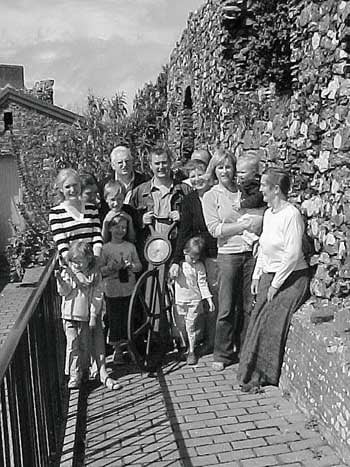
Photo caption: Visitors from Kent, Derbyshire, East Anglia and Birmingham learning to use the museum’s waywiser.