

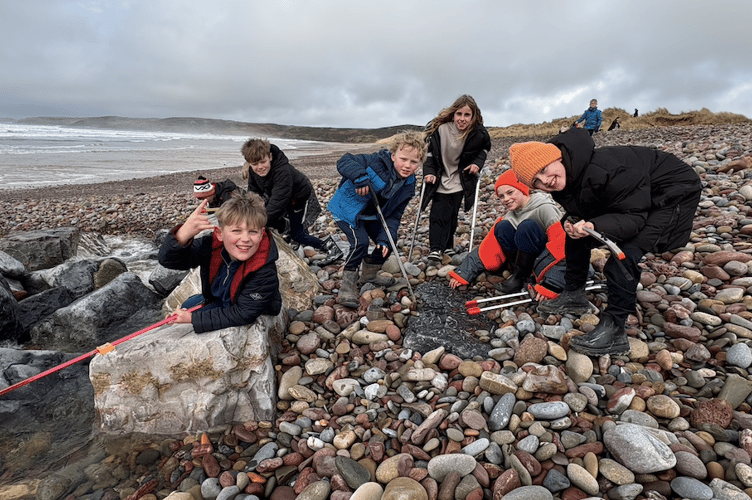
Year 5 pupils from Ysgol Hafan y Môr in Tenby recently took part in a hands-on marine conservation field trip with the Dragon Darwin Experience, combining outdoor learning with real-world environmental action.
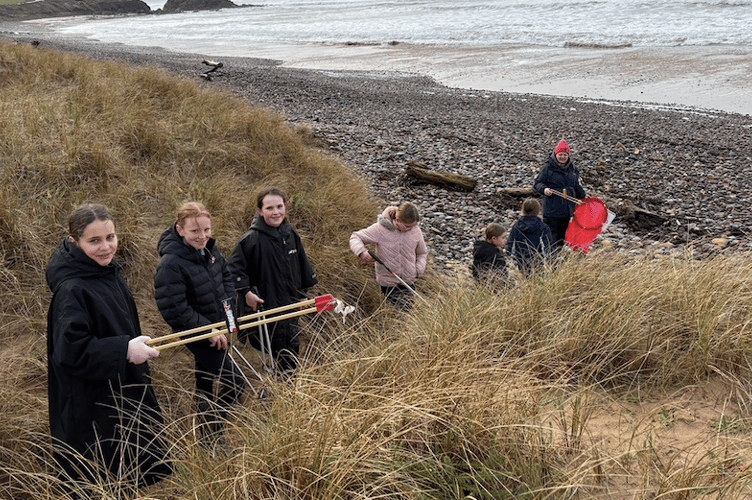
The class spent the morning of February 6 at Freshwater West, where they created detailed field sketches and collected weather data before heading onto the beach to clean the strandline.
During their beach exploration, pupils discovered remarkable evidence of ocean currents at work, finding two lobster pot tags that had drifted across the Atlantic.
One had travelled all the way from Newfoundland, while the other originated in Maine, offering a striking real-life example of how far marine debris can travel.

After a fantastic effort by the class, they successfully removed an impressive 20.95kg of litter from the shoreline.
This sparked discussions about the sources of marine litter, the journey it takes, and the problems it causes for marine wildlife and ecosystems.
In the follow-up workshop, pupils explored the plastic problem in greater depth.
They learned how plastics break down into microplastics, how these particles can enter the food chain, and the potential impacts on marine life and human health.
A highlight of the session was examining zooplankton samples from the waters off Tenby using stereomicroscopes. By observing the tiny organisms up close, pupils gained a clearer understanding of how microplastics can be mistaken for food by marine species, linking their field discoveries to real scientific evidence.
To conclude the workshop, the class discussed practical ways to address the plastic problem—from making more sustainable shopping choices to finding alternatives to single-use plastics.
Samantha Williams from the Dragon Darwin Experience said: “It was inspiring to see how engaged the pupils were throughout the entire experience.
“Finding litter that had travelled thousands of miles really brought home the scale of the issue, and their curiosity during the plankton investigations showed a genuine interest in understanding how our actions impact the ocean.
“Experiences like this empower young people to feel that they can make a difference — and that’s exactly what we hope to achieve.”
Over the course of four beach cleans this academic year, a total of 113 young people have helped clear 70.69kg of litter from local coastlines.
A big thank you goes to Keep Wales Tidy for the use of their litter pickers and bags, which have supported these important efforts.
Schools wishing to book a free session on ocean plastics and plankton can email Sam and Amy at: [email protected]
The Darwin Centre for Biology and Medicine was founded by Biochemist, Professor Tony Campbell CBE and Dr Stephanie Matthews in 1993, registering as a charity in 1994.
In 1999 it relocated to Pembrokeshire. The Darwin Centre aims to engage and enthuse young people and communities in STEM subjects through hands on field trips and workshops, from rock pooling to theoretical nuclear physics.
The charity raises aspirations through opening up access to experts within the STEM industry and highlights potential careers available to the young people of Pembrokeshire.
Comments
We've recently changed our login process. If you have an account for commenting, you will need to re-register on the login window.
This article has no comments yet. Be the first to leave a comment.