
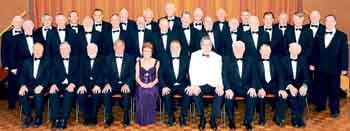
The Members
There is a little bit of a lull now in the choir concert season.
After the early opening concert on St. David's Day, we have a break, from concerts at least, until Easter Sunday.
It gives us time to hone, to as near to perfection as we can get, those new and especially Welsh language songs.




Striving for 'perfection' or at least a good performance is one thing which the people in the photo have in common.
There is little else though that is 'in common' about their backgrounds.
They have cleaned windows, delivered milk, built houses, there are several teachers, an accountant, surveyor, scientist, salesman, policeman, fireman, butcher, oil-worker, some are in the hotel or licensed house trade, and some working in retail.
Our oldest member, 91-year-old Bobby Turnbull was a miner and there are numerous others. They are English, Irish and Welsh and from different parts of all three countries and somewhere in there is a bit of Italian and Scots blood!
Bobby Turnbull - at 91 our oldest member
Perhaps it's surprising for a male voice choir based on the traditions of choral singing in Wales that not many of the choir speak Welsh, but that is very much the case, as there are probably only two or three who do speak the language.
So how do Brummies (or Black Country), Scousers, Geordies, Londoners, Irishmen and Welshmen from non-Welsh speaking areas learn a song in Welsh?
It takes a bit of practice, but typically we will listen to a song being sung, we will be talked through the words by one of our Welsh speakers and then we will basically sing it and learn it.
It's as simple as that in essence, although that does belie the amount of practice and rehearsal that goes into it with the firm guidance of unconventional musical director Ian Williams.
There are four sections to the choir, Bass, Baritone, Second Tenor and Top Tenor, and each section will have its own music, which is what produces the instantly recognisable harmonic sound of a male voice choir.
I did say above that there is little in common about the members of the choir, but the second and most important thing they do have in common is the enjoyment which singing gives them.
The learning and the practice become insignificant as an arrangement takes shape and is sung with confidence. It is then all about 'enjoying yourself' and singing for the joy of singing.
That joy is an ancient and worldwide joy going back into the mists of time.
Wales, of course, though is 'the land of song' and medieval chronicler Geraldus Cambrensis stated that 'the Welsh sang in as many parts as there were people, and even that quite small children could harmonise.'
It's still the same, the Tenby Observer last week was packed full of school groups who had performed St. David's Day songs and if you went to see them you would have seen that they loved it.
At that age we all lack the inhibitions of adulthood and just sing away to our hearts content. What a shame that so many of us, as we get older, give up that enjoyment.
But if you are one of those, you don't have to be. You have a local choir, and you will find a welcome at the piano-side if you should come along.
So if you'd like to know a little more, ring 01834 813198 or just come along and watch a rehearsal (no need to join in) on a Tuesday or Thursday at 7.30 pm at the County Club, The Croft, Tenby. For more information including the full programme of concerts, see our website http://www.tenbymalechoir.org">www.tenbymalechoir.org
A.G.K.
Comments
This article has no comments yet. Be the first to leave a comment.