
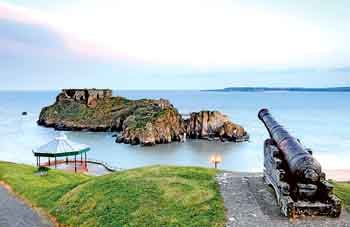
The developers behind a project to turn a Tenby landmark into a visitor attraction, told a planning appeal hearing this week that they have been 'up front' in every process of their proposals, despite the Pembrokeshire Coast National Park Authority labelling the application "ambiguous and insufficient".
The application from the developers of the Tenby Island Project, which is subject of the planning appeal, aims to turn St. Catherine's Island alongside Castle Beach, into a new visitor attraction, proposing a change of use of the fort, along with internal and external changes to the Grade II listed building.
The plans, which were refused by the Pembrokeshire Coast National Park Authority's development management committee last July, propose elements such as exhibition and storage spaces, food and drink, and retail uses, and various other installations on the island, such as two boat landings, a replacement fort entrance bridge, path and operational lighting, solar panels, telescopes, railings and new roof rooms.
The appeal hearing, which was scheduled for two days at Tenby's De Valence Pavilion, began on Wednesday morning, with planning inspector Robert Gardner (whose recommendations will be passed on to Welsh Government Ministers) stating that he wanted to get a firmer idea of what was being proposed from the applicants and the reasons for the refusal of the scheme from the National Park Authority.
In documents submitted to the appeal, the scheme's developer Mr. Peter Prosser stated that they had experienced "a peculiar handling" of the application by National Park planning officers.
Mr. Prosser said that they had been given the impression that all the requirements had been met, but five days before the committee were due to discuss the application, he learnt from the media and an email from one of the planning case officers that it was being recommended for refusal.
Head of development at Pembrokeshire Coast National Park, Vicki Hirst, told the appeal hearing that the authority was very supportive of finding a use for the island and fort, but there were certain aspects of the proposals that lacked details and sufficient information.
"It's not that we don't support it, it's just that we don't fully understand what the applicants are trying to do, and as a planning officer, I'd feel very uncomfortable in granting certain issues without more details," she said.
"The application has not established a primary purpose - if it's a visitor attraction, then fine, but there are other elements included that I don't think are clear and could have a much bigger impact on the landmark and area.
"We'd need to see a much more focused business plan of what the primary use is going to be. Is it for the casual beach user wanting to have a look at the island, or more? The plans are very vague in terms of primary focus of what the usage is.
"There are no floor layout plans for some of these aspects that are proposed within the building, so we do not know where they are meant to be occurring, and there is a lack of survey work. The application details are very inconsistent," added Ms Hirst.
Mr. Prosser explained that they were hoping to create a visitor attraction that would make a difference to Tenby and had the potential to extend the season in the resort.
"We've got an island that everybody wants to go on, and we want to create an exciting and interesting, family experience, for the people of Tenby and its visitors," he said.
As well as opening the island and fort as a visitor attraction, Mr. Prosser said that there would be a number of features, such as telescopes on the roof, that would provide tours of the night skies and show the surface of the sun, cameras underneath the water, showing off the nature and habitats around the island, a number of exhibits that would incorporate military displays, along with a small café where visitors could enjoy the views of Caldey.
Mr. Prosser said that the planning officers had misinterpreted the hotel use within the application, and that it was merely included so that the night tours could allow Scout groups and the like to stay on the island overnight.
"The planning case officer said we must put down the 'hotel' use, so we put it in, but it is not our intention to be a hotel," he remarked.
"We have had requests for weddings to be held on the island, so it could be used as a venue, but we understand why people would want to get married there, as they would have an association with the island all their life.
"Work has already started a year ago in making the island safe to get on and we've been able to open it to the public on weekends when the tide is right, and we've had a great response, and seen 2,500 visitors in a short space of time.
"The island has been trashed for the last 35 years, with people breaking in; we're changing that, so that people can enjoy this landmark.
Speaking on behalf of the Lexden Terrace Conservation Group, whose buildings overlook the island, Douglas Fraser said that he and other residents living nearby had concerns over the viability of the scheme.
"It's an experimental risk for Tenby and what would happen if it failed; the last thing we would want to see is more dereliction for the town," he commented.
Mr. Prosser responded by saying: "If I fail and it is not viable, then we gain a restored national monument, so it's a win-win situation and not a fail-fail."
Mr. Fraser went on to discuss what he described as the 'elephant in the room' and the bridge element of the scheme.
It was explained by Ms. Hirst that the application had been presented without the bridge aspect and that it was her reading that it was an 'essential and integral' part of the project, as there would be a major problem with the tides in getting visitors on the island at certain times.
"It is in an extremely sensitive location, and we don't know what the bridge would look like, and it would change the way the island is seen," she said.
Mr. Gardener asked the applicant if it was essential for the bridge to form part of the development for it to be a success.
"It is like the chicken and the egg, you have to do this first, but it would be desirable to construct the bridge to have the best possible use, otherwise it's just a use," explained Mr. Prosser, who added that the scheme would still go ahead though if permission was not granted for a bridge down the line.
The hearing was due to continue yesterday, with planning inspector Mr. Gardner scheduled to undertake a site visit to the island, before making his recommendation to Welsh Government ministers.
Comments
This article has no comments yet. Be the first to leave a comment.