
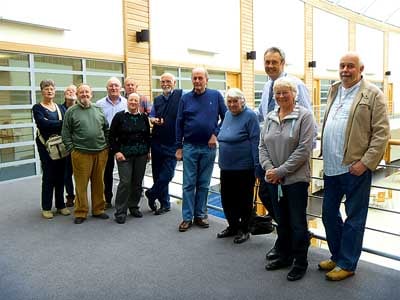
Members of Pembrokeshire South East Energy Group were both intrigued and delighted recently to be invited to visit the centrepiece of the Pembrokeshire Science and Technology Park at Pembroke Dock.
The building, known until recently as the Technium, incorporates many advanced features making it a model of sustainability. So exacting were the standards to which it was built, that it gained the coveted BREEAM 'excellence' award.
On arrival, members of the party were welcomed by the manager David Thomas. There were, he said, many advanced features incorporated in the building. Perhaps the most impressive was the rain water harvesting system. The filtered grey water was collected in tanks and the overflow fed into a small carp filled lake.
It was most wasteful, said Dave, to use high quality drinking water from the mains to flush toilets. It was more environmentally sound to use the grey water. Bottom water from the lake was even used in hot weather to provide underfloor air conditioning.




Making optimum use of Pembrokeshire's sunshine was the thinking behind the building's unusual roof. Made of stretched clear polycarbonate, this provided the atrium with abundant natural light and also a high level of solar heating. The possibility of excess heat was catered for by an intelligent building management system which automatically opened windows on the warmest days.
Space heating in colder weather was provided by a highly efficient carbon neutral wood pellet boiler which fed a network of underfloor pipes. Not only was all lighting in offices provided by energy efficient lighting units but sensors had been located in most rooms to automatically switch lights on when entry was detected and off when the room emptied.
In the course of the tour, Dave explained that now that the Science and Technology Park was coming under the sole control of Pembrokeshire County Council, there was a new vision for the future of the site. Milford Haven was a vitally important centre for energy imports to the UK, accounting for 20 per cent of UK's refined petroleum products and 25 per cent of gas. This resulted in many jobs and many firms were needed to service these major industries and spin-offs from them.
The Park provided an ideal base for both established business and new start-up ventures.
For the latter, 'hot desks' were available with all services provided at very reasonable rates.
Particularly exciting was the new High Performance Computer System link with Swansea University.
This will attract many business users with the greatly enhanced computer processing speed.
An even more impressive development will be the installation later this year of a super computer hub, one of only two in the whole of Wales.
The chair thanked Dave for the warmth of his hospitality and the comprehensive and enthusiastic explanation of the purpose of and prospects of the Pembrokeshire Science and Technology Park.
The future did indeed seem bright.
Comments
This article has no comments yet. Be the first to leave a comment.