
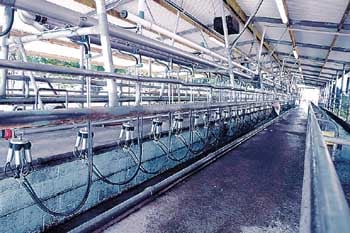
The chairman of the Pembroke County branch of the National Farmers Union, Alan Prichard and his wife, Mary, were hosts to the media at Esgalwen, near Letterston, on Thursday of last week and to a number of local politicians the following day. Alan explained to the visitors that his parents had taken up a tenancy of Esgalwen just over 50 years ago and had, in subsequent years, expanded the unit to comprise a total of some 450 acres of grass all within a ring fence. His father, the late Mr. Arthur Prichard - himself a former county NFU chairman - was a great innovator and planned much to simplify the working of the farm, including livestock handling, and to make good use of it's natural water supplies. In recent years, in order to carry on a simplified method of farming, the sheep and beef enterprises have been discontinued and the farm now carries a mixed herd of cows with 400 calving in February and March and the remaining 200 calving in September and October - mostly to New Zealand bred Friesan and Jersey bulls. The herd also comprises 350 followers (including 150 in- calf heifers) and some additional land is rented over the summer months for silage cuts and a number of cows and heifers are usually wintered off the farm. Previously five different systems of milking had been used on the herd, all bought second- hand, until the latest New Zealand designed Dairymaster 88/ 44 parlour was installed last year - with four milkers working in teams of two (four days on, four days off) which now enables the herd to be milked in around two hours night and morning. There is no recording of individual cow yields but the herd averages about 5,200 kgs at four per cent butterfat and over 3.36 per cent protein from 0.18 tonnes of concentrate feed. A total of 2,000 tonnes of grass silage and 600 tonnes of wholecrop cereals, with wheat feed and mineral supplements, are placed in a newly laid out feeding area utilising a mixer wagon. The latest project under construction is an underground main pipeline, to deliver slurry to points around the grazing block, where the pumped supply can be connected to a tractor- mounted machine that will inject it into the ground without contaminating the sward. Looking around his immediate locality Alan sees many former family run farms who have given up milk production and a large number have taken up employment other than in agriculture. Of the future, he sees farming having to endure a further difficult period before any true signs of improvement may appear. "No one can give an assurance that if milk supplies were reduced that the price would improve and we constantly have the supermarkets using imports to suppress our home market," insists Alan. Alan and Mary have a son, William - who is now a partner in the business - and a daughter, Nina, who is presently a student at the University College of Wales, Cardiff.
Seeing is believing
Brown Swiss breed enthusiasts Clive and Pamela Davies, of Treffgarne Farm, Lampeter Velfrey, opened their farm and herd of almost 200 milkers for inspection on Thursday of last week. The 'Garne' herd, which was established following the importation of two Brown Swiss heifers in 1989, has progressed steadily ever since and now returns an average yield of 8,209 kgs at 3.83 butterfat and 3.43 protein - slightly down on last year due to the restrictions imposed by milk quotas. Visitors to the farm were welcomed from many parts of South and West Wales and also from Cheshire (including the UK Breed president, Mr. Chris Candy), Shropshire, Worcestershire, Wiltshire and Devon.
Not everyone's cup of tea



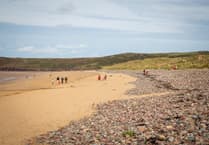
An evening farm walk at Highfields, Llangwm, last week highlighted some of the work of the Farming, Forestry and Wildlife Advisory Group. The relevance of the work being done at Highfields can be taken into context as one considers the implications of cross compliance and so forth being imposed following the EU mid- term review. However, this poses the question - How can we generalise on these requirements when weather and temperature conditions in the UK vary so greatly? In an high rainfall area such as ours the suggestion that field margins should be extended in order to encourage a better wildlife habitat will soon lead to other problems if the hedges cannot be periodically cut back. Excess growth in the form of gorse and briars will weigh down all the fences and make livestock impossible to contain. Also, the claim that woodland areas should be fenced off and allowed to regenerate at will will soon lead to a jungle habitat that may be of no use to man, beast or wildlife. It's all very well for those with arable acres to put forward suggestions of this kind but they are not everyone's cup of tea.
Farming Connect
Dairy farmers and herdsmen should not forget the open event this (Friday) afternoon at Picton Castle farm when New Zealand consultant Tom Phillips will focus on key performance indicators for milk production.
Chaff
Tesco's premium pork chops are pumped up with water despite costing £2 per kilo more than ordinary chops, says the Consumer's Association. Tesco say that the high cost of the chops is due to rearing the pigs out of doors.