
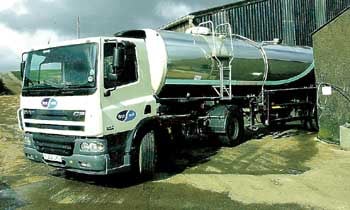
Twenty years ago, the dairy industry in West Wales found itself in a dilemma as, at a time when our Government of the day was still calling for an expansion of milk production, the EU had overnight slapped quotas on the amount of milk each farmer could sell.
Up until then some 5,000 family farms in the counties of Pembroke, Carmarthen and Cardigan had - for the best part of 50 years - derived all or part of their income from their dairy herds.
Since 1984, the industry has become decimated, firstly with the closure at Whitland of the largest creamery in Europe, then the facilities at Carmarthen went and others, even now, face an uncertain future.
Probably two thirds of the dairy farms also no longer exist, but herd sizes that once averaged just 30 cows are now counted in hundreds but, despite so called economy of scale, the measure of expected profitability might even result as an end of year loss. The farm tankers, many of which now collect during the hours of darkness, are also double the size.

.png?width=209&height=140&crop=209:145,smart&quality=75)

The NFU in Wales and elsewhere just this week pleaded with the dairy companies and co-ops to show their commitment to dairy farmers and to work together to put an end to persistent attempts to talk down the dairy market.
Despite positive market indications and low seasonal milk supply there have been indications on the part of some commentators that farm gate prices are still under threat. There is no way that farmers can accept a price reduction based on anticipating market conditions, which cannot be accurately predicted.
All of the organisations signalled their resolve to attempt to deliver a culture change in the dairy industry that delivers fairness, trust, transparency and dynamism.
They called on all those negotiating prices to maintain their resolve and use the full arsenal of market information at their disposal to negotiate fair prices through the summer.
"Looking at the market, there seems to be no reason whatsoever for a price cut at this time. Commodity markets are strong, supply is down for the time of year, and the weather has not been brilliant," commented Dai Davies, of Whitland -the NFU's vice-president for Wales.
"The language has to change. Farmers are simply not prepared to put up with the politics of mistrust that seems to pervade this industry any longer.
"Farmers want a clear signal from the rest of the supply chain that their milk supply is valued.
"If not, then there is absolutely no certainty of a future milk supply," he concluded.
No 'ways'!
Almost a year ago there was the sudden appearance across Pembrokeshire of hundreds of new 'footpath' signs which set alarm bells ringing for many residents of the rural areas. Many of these misguiding signs still remain pointing directly at high hedges which no one could possibly get through or over and are causing extreme frustration to the genuine walker who must feel badly let down.
The strange thing was that the powers that be did not appear to have carried out the research which they should have done for probably 90 per cent of these 'rights of way' had fallen out of use even before the war years.
In the main the 'paths' shown on maps surveyed about 1890 referred to routes used long before the network of field and road hedges were erected to contain livestock.
Their purpose, before the days of motorised transport - or even bicycles!- was to provide the shortest route to link isolated farms and cottages, for use by the postman, Church goers and for children going to rural schools.
So many of these 'ways' had never been walked in living memory, stiles and footbridges had long since become overgrown or have rotted away decades ago and many of the fields have been enlarged to meet the changing needs of the farmers who now have tractors (in case the officials had failed to notice!).
Livestock herds and flocks on individual local farms now number many hundreds, or even thousands, and if these 'rights of way' are enforced farmers will be limited in the choice of breeds of cattle which they may graze on their land.
The former Dyfed County Council, in association with all town and community councils in it's area, carried out a survey of every footpath almost 20 years ago and fully accepted the reports which it received back relating to the paths which should have been removed from any definitive maps.
Yet the 'Countryside Officers' chose to ignore those records and went ahead riding rough shod over everyone by planting costly new signs that were seen to pop up like mushrooms at every turn.
A national campaign was launched last year to help reconnect people with the countryside after a survey had shown that most Britons had lost touch regarding where their food came from.
This survey revealed that much of urban Britain had never been more disconnected from its rural roots and the agricultural industry urgently needed a co-operative initiative to help publicise the crucial role that farmers and growers play.
As custodians of the countryside Britain's farmers have been working hard in their care of the environment just as much as they have in the production of wholesome quality food.
The campaign detailed some of this work and sought to explore why, if the public care about the food they eat and the countryside that they live in, they should care more about British Farming.
Because much of the farmland in this region is pastoral (with dairy farming and extensively reared cattle and sheep) it is also beautiful for the thousands of visitors it welcomes every year and 80 per cent of that landscape - which attracts a significant proportion of the tourists who contribute millions to the region's economy - is in the care of farmers at a time when farm incomes have never been lower.
Also, a significant percentage of the region's land area is designated as nationally and internationally important wildlife sites.
The influential Countryside Alliance welcomes increased, managed access to the countryside that respects the needs and the livelihoods of local residents. They insist that the claims of the rural community must be taken into account when implementing 'rights of access' and reflect these views as represented by local access forums.
They also call for appropriate and adequate guidance to be put in place for users to ensure that any adverse effects on the rural environment are minimised.
President- elect
A key figure at the Carmarthenshire Young Farmers Rally last week was Mrs. Elonwy Phillips, of Brynsiriol, Heol y Gogledd, Whitland - a stalwart of the local club and president- elect of the Federation.
Mrs. Phillips presented a stockjudging trophy to Rhys Beynon Thomas and Iwan Thomas.
Chaff
Years, even centuries ago, when people were obviously very much poorer than they are today how come that so much wealth in the form of jewellery and coins was lost around the remote countryside and is now being discovered by users of metal detectors. Could it be that they had holes in their pockets or purses!
Has anyone heard the cuckoo this year yet?