

Don’t forget the girls
With fewer men and boys keen to take an interest in the livestock aspects of dairy farming, it is becoming increasingly well-recognised that females in farming are like an untapped oil well.
Across the UK, milk producers have become heavily dependant upon the availability of staff from Eastern European countries and a very large proportion of these are women and girls.
Having two months ago taken up the role as deputy president of the Irish Creamery Milk Suppliers’ Association (ICMSA) dairy farmer, Lorcan McCabe, has highlighted his two main ambitions are to encourage more women and young people to get involved in the ICMSA, and farming in general.
With three daughters of his own, as well as a son, McCabe believes that women are as capable as any man when it comes to farming. All of his children have grown up working on the farm, from feeding calves to milking cows - they’re all accustomed to the pit!
He described to me how he and his wife, Brid, encouraged all of their children to work hard and gain practical experience.
I showed my eldest daughter how to weld. I said to her: “Some day you could be in a situation where you might be in the middle of the Sahara Dessert and something has to be welded or fixed there and you’ll be able to do it.” They all have a bit of practical experience, he laughed.
But, ICMSA’s deputy president believes maternity support measures need to be put in place to assist female farmers. “It will be something I will be pushing in the ICMSA. There has to be something done on the maternity end of things. With farming being very mechanised now - with milking machines, tele-handlers and all that - females can farm unquestionably as good as any male.
“But, there has to be something to facilitate them having kids - maternity leave of some sort. I know it’s difficult, because you can’t give a farming woman more than a farming man - you have to strike a balance.
“I don’t know how I’m going to do it; I’m open to ideas or suggestions on the matter,” he said.
Furthermore, he tells me that it ‘sickens him to the core’ to see young women overlooked when it comes to taking over the family farm. The mentality that the eldest son, or the only son in the family, should be handed the farm without question is outdated, he said.
McCabe believes that the farm should be handed down to the most suitable and willing successor - regardless of whether that is male or female.
I have seen the very, very best of girls bringing in and milking cows - and the lads getting the land. That’s is not right. I have no place for that attitude.
“There is a fantastic role for females in farming; it’s like an untapped oil well in my opinion,” he said.
In an effort to encourage generational renewal, the deputy president of the ICMSA believes that the Irish Government should look at reintroducing an Early Retirement Scheme.
McCabe explained how he availed of such a scheme when he was starting out in his farming career.
“I would be pushing hugely for the younger generation. I would love if there were more stimulants to allow older farmers to retire and hand on the farm.
“I was very lucky, my father saw the need. He always said: ‘if you haven’t got it at 30, it’s no good to you’. He maintained, if you want to farm in your own right, there is no point giving it to you when you are 40, 45 or 50.”
Having left school in 1979, at just 15 years of age, McCabe worked in factories for a number of years - as the family farm alone wasn’t big enough to support both him and his father.
“He gave me part of the land when I was 17, it was held in trust. I started farming full-time in about 1988 and in 1992 I took over completely with the help of the Early Retirement Scheme.
“It would be great if there was an incentive like that to give the older farmer the needed push to hand it over. There’s just six per cent of farmers under 35 in Europe; it’s worse than crazy,” he concluded.
Lorcan is hopeful that one day he will be able to pass on the family farm - which he has gradually built up over the last 25 years so - to one of his four capable children.
Not forgotten
Earlier this month, young farmers from across Europe visited the UK to discuss, at Stoneleigh Park, Warwickshire, the impact of potential trade and policy changes post-Brexit at a seminar organised by The National Federation of Young Farmers’ Clubs (NFYFC) and the National Farmers’ Union (NFU) Next Generation Forum.
The visit, which involved members of the European Council of Young Farmers (CEJA), brought young farmers from Europe and the UK together to debate and establish the next generation’s position on Brexit.
The two-day event, supported by Defra (The UK Department of Environment, Food and Rural Affairs), Massey Ferguson and the Crop Protection Association, involved workshops and concluded with an important seminar called ‘Brexit and Beyond’.
NFYFC and the NFU share joint-membership of CEJA, and with policy and trade changes imminent, opportunities and collaboration for next generation farmers both at home and in Europe are rife for discussion.
CEJA’s president Jannes Maes spoke at the event, saying: “In these times of change, it is of paramount importance that we keep an open dialogue among young and future farmers across Europe.
“British young farmers have been longstanding and valued members of CEJA and we look forward to continuing this fruitful collaboration, regardless of what Brexit might bring.”
The bid to host the event was approved by the NFYFC Council, the NFU and CEJA last year and NFYFC chairperson Lynsey Martin said it was essential to get young farmers talking.
Lynsey told me: “Collaboration and forward-thinking discussions with European young farmers are important during this time of change. Our CEJA membership has stood the next generation in good stead for Common Agricultural Policy (CAP) considerations and we relish mutual support during the consultation and implementation of a British agricultural policy -Brexit is as much of a concern for European young farmers as it is for us, so this is a great opportunity for scene-setting, debate and discussion.”
Summing up Richard Bower, chair of the NFU Next Generation Forum, commented: “Our organisations have always enjoyed a close relationship and the joint-membership of CEJA has been productive and enjoyable.
“We want to ensure future next-generation collaboration and to maintain a close, working relationship with European young farmers.”
Unseasonal
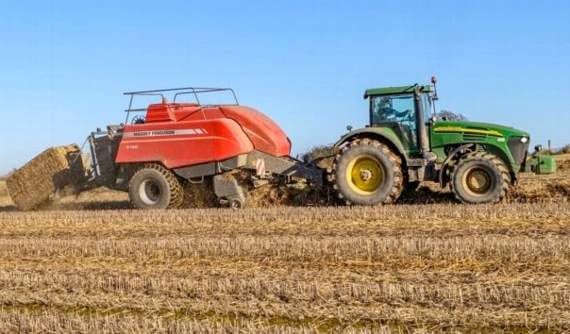
Baling straw on February 28 isn’t the norm. However, some arable farmers in North Pembrokeshire were seen to be wrapping up what was left of the 2017 harvest - there was a tight window as some farmers finished baling when the snow arrived.
The sunshine and windy conditions over the previous weekend allowed growers to finally bale straw that had been on the ground since last year’s harvest.
Constant rainfall led to difficult harvest conditions from August to October and many crops of straw were left on the ground as a result.
Yields of straw baled were back, due to overwinter losses, but made up for some of the poor quality and highly expensive supplies presently available.
Urgent
This may be of interest to you. A friend of mine has two tickets in a corporate box for England versus Ireland this weekend, March 17.
He paid £300 each, but he didn’t realise when he bought them month’s ago that it would coincide with his wedding day.
If you are interested, he is looking for someone to take his place. . .
. . . it’s at Mary Street Registry Office at 4.30 pm. The bride’s name is Nicola; She’s 5ft 4”, about eight stone, quite pretty, has her own income and is a really good cook.
Quote
Only those who risk going too far can possibly find out how far you can go - T. S. Elliott.
Comments
We've recently changed our login process. If you have an account for commenting, you will need to re-register on the login window.
This article has no comments yet. Be the first to leave a comment.